
ILLIA TRETIAKOV
Founder
Since 18 March 2025, every company in Uzbekistan in which the state holds at least half of the capital has had to publish, each quarter, the goods it plans to import. A manufacturer that commits to make one of those goods locally can then sign a guaranteed purchase contract for five years, or ten for medicines, at a price no higher than the last import contract. The rule, set by Cabinet of Ministers Resolution No. 159, turns part of the import bill of state companies into multi-year demand open only to producers with a certificate of local production.
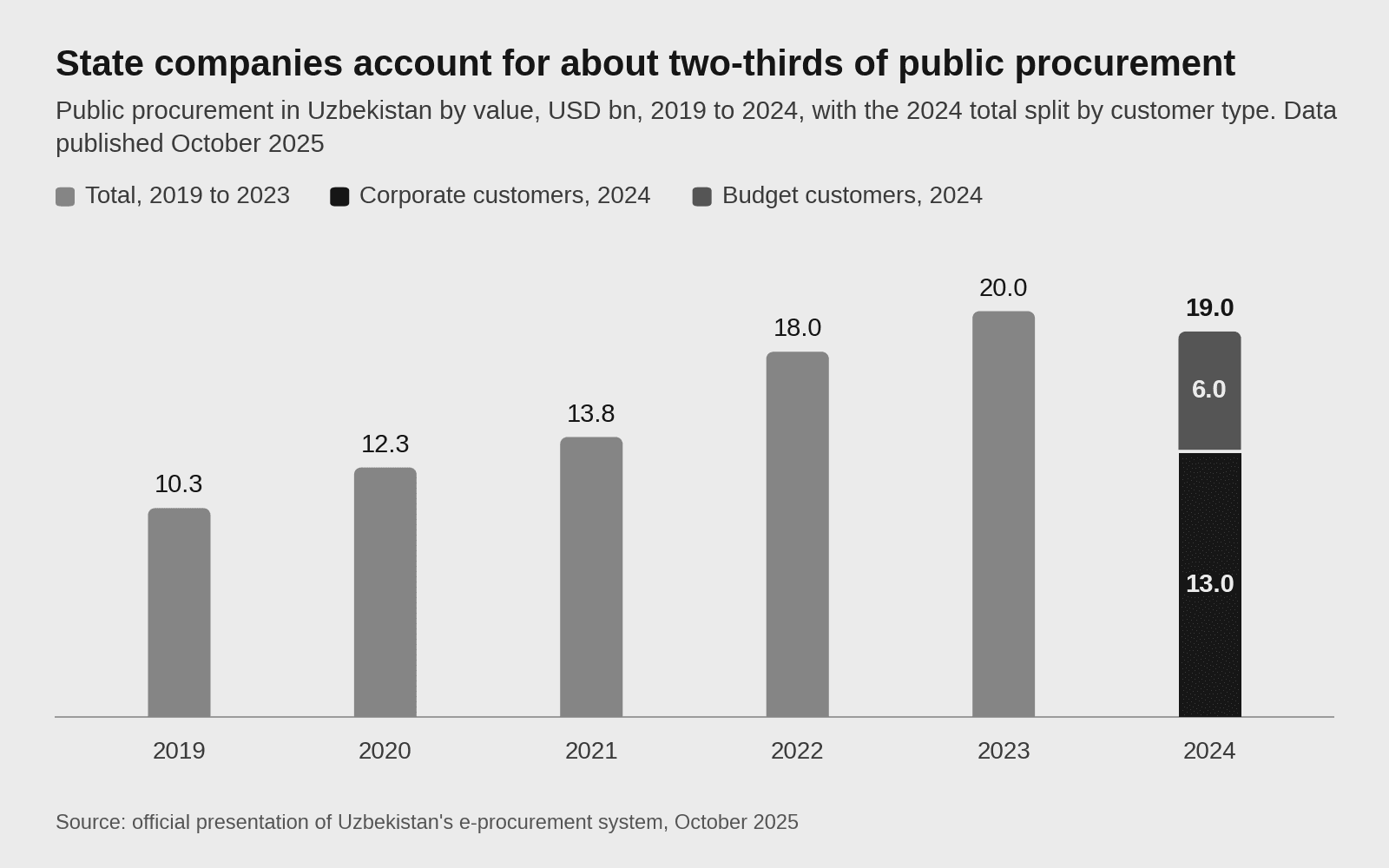
Those state companies, known in procurement law as corporate customers, accounted for about two-thirds of the public procurement recorded in 2024. Budget organisations, which make up the other third, have given domestic goods a price preference of up to 15% since 1 April 2026. Production localisation in Uzbekistan therefore buys different things from different buyers, a price and scoring advantage in budget procurement and volume certainty from state companies.
Both channels sit inside rules that have changed almost every year since tax holidays for localisation projects ended in 2018. Uzbekistan also aims to complete accession to the World Trade Organization (WTO) in 2026, and membership disciplines some of these instruments far more than others. For boards weighing investment and operating conditions in Uzbekistan, this article sets the obligations of localisation against the access to state demand it buys and asks which part of that bargain will outlast accession.
Source: official presentation of Uzbekistan's e-procurement system, October 2025
Localisation in this article means production localisation, and not the separate rule that personal data of citizens be stored inside the country. Uzbek law expresses domestic production through a localisation level certified under Cabinet of Ministers Resolution No. 712, a national metric based principally on the share of imported inputs in production cost and distinct from the local content requirements addressed by WTO rules. Public procurement here covers both budget organisations and corporate customers. Values appear in the currency used by each source, soums or US dollars, without conversion, all values are nominal, and data for 2026 cover January to July unless another period is stated. Import values by product group cover goods only, while import totals and country shares taken from national statistics releases also include services.
Since March 2025 state companies publish what they plan to import
Resolution No. 159 applies to corporate customers, the legal entities in which the state holds 50% or more and their subsidiaries in which such entities hold 50% or more, as defined in Presidential Resolution PP-4812 of 21 August 2020. There were 3,173 such customers in 2024, against 9,483 budget organisations, according to the same official presentation. The largest include the Navoi Mining and Metallurgical Company (NMMC), the Almalyk Mining and Metallurgical Company (AMMC) and Uzbekneftegaz, whose purchasing sets demand for entire supply chains, as a local review of the procurement rules notes. Budget customers and manufacturers may use the same procedure on a voluntary basis.
Each corporate customer keeps a list of the goods it intends to import on a dedicated page of the public procurement portal and updates it every quarter, by the tenth day of the month after the quarter closes. For each item the list states the annual volume, the delivery period, the maximum unit price, the technical specification and the standards or certificates required. Proposals are accepted for ten working days, and the resolution sets no residency test, so foreign as well as domestic companies can apply, as a law-firm review of the resolution reads it. A commission of at least five senior managers assesses the technical and economic case, financing, unit price, production base, warranty and the planned share of localisation, and it may proceed with a single applicant.
What the resolution asks of a producer and what it offers
The selected producer signs an electronic cooperation agreement within ten working days, and this document carries most of the obligations. It fixes a production schedule with stages for mastering the product, annual prices and volumes, and indexation for inflation and the minimum wage within the funds the customer has allocated. The customer's commission checks progress every month and can terminate the agreement for breach. The producer must deliver at prices no higher than the customer's last import contract, a ceiling written into clause 36 of the regulation.
The guaranteed purchase contract follows only after the product receives a certificate of local production. It runs for five years, or ten years for pharmaceutical products, and neither party may refuse performance or change its terms unilaterally unless the law or the contract allows it. Contracts above 25,000 base calculation units, or 6,000 for budget customers, need an expert review before signature. The consolidated text flags amendments to the contract clause from 1 October 2026, whose wording could not be confirmed for this article.
Resolution No. 159 also changed how localisation counts in competitive procurement. Under paragraph 95.1 of the procurement procedure rules as amended in March 2025, a producer bidding in a tender or best-offer selection scored by points receives additional points equal to 15% of its score multiplied by its localisation level. No additional points are awarded where its price exceeds the lowest price offered by other participants by more than 15%, and the bonus does not apply to purchases that corporate customers make for commercial resale or production.
The resolution has now been in force for 18 months, yet no official count of the items listed, their value or the contracts signed under it has been traced in public sources. Nor could any data be found on how often the bonus has changed the outcome of a tender. The mechanism is law in force, but its results cannot yet be measured.
The 2026 decree turns import lists into programmes
Presidential Decree UP-17 of 4 February 2026 built a new institution around this mechanism. It created an Agency for Industrial Cooperation and Public Procurement, which took over the procurement functions of the Ministry of Economy and Finance, and ordered medium-term programmes for eight driver sectors and three base industries. The driver sectors are pharmaceuticals, electrical engineering, electronics and robotics, automotive, construction materials, gas and petrochemicals, light industry and food, and the base industries are energy, mining and chemicals.
From 1 July 2026 the agency publishes, sector by sector, lists of competitive products recommended for local production, and producers that master them are offered guaranteed purchase contracts. A State Target Fund for the Development of Industrial Cooperation received the equivalent of USD 50 m for 2026 and lends up to USD 10 m per project for up to ten years, at 6% in foreign currency or 12% in local currency. The agency's website links an open-data list of recommended products, but gives no count of contracts signed against it.
The price is set against imports
Because the contract price cannot exceed the last import price, the exchange rate and local costs decide whether the ceiling leaves a margin. The soum weakened from an annual average of UZS 10,054 per US dollar in 2020 to UZS 12,652 in 2024, and the daily official rate set by the Central Bank of Uzbekistan stood at UZS 11,814 on 24 September 2026. A stronger soum can reduce the local-currency cost of subsequent imports and therefore the benchmark against which future local supply is assessed.
Domestic costs have moved the other way, since prices kept rising while the soum strengthened. Consumer price inflation slowed from 11.1% in 2020 to 7.3% in 2025 and stood at 6.2% in August 2026, central bank data show. Indexation under the cooperation agreement is capped by the funds the customer has allocated, so rising local costs press on the margin under an import-based ceiling. That conclusion is drawn from the design of the contract, since no contract-level data could be found.
Energy tariffs for companies have risen in steps since 2023. Electricity cost most companies UZS 900 per kWh from 1 October 2023 under the 2023 tariff decision, and all non-household consumers have paid UZS 1,100 since 1 June 2026 under the 2026 tariff decision. Tariffs are one part of the cost base, and the terms on which land is leased and energy is allocated to producers are another. Every step after the cooperation agreement then depends on one document, the certificate that says a product is made in Uzbekistan.
A certificate decides what counts as local production
Cabinet of Ministers Resolution No. 712 of 28 October 2024, in force since 1 November 2024, sets the test. A product counts as local if it is wholly produced in Uzbekistan, if imported materials make up no more than 70% of its production cost, or if processing changes its tariff heading at the four-digit level of the customs nomenclature. The 70% rule is the same as a localisation level of at least 30%, measured as the share of production cost not accounted for by imported raw materials, components and parts, including customs payments.
The method leaves out the origin of energy, machinery and equipment, and it excludes operations that do not transform a product. Storage, packaging, sorting, mixing and simple assembly do not qualify, whatever their share of cost. Certificates are issued by the state-owned company Uzbekexpertiza, remain valid for 24 months and cost three base calculation units per product, about UZS 1.1 m when the rules took effect, as a report on the new certification rules sets out.
The 30% line is where access to state demand begins in practice. The certificate is a condition for the guaranteed purchase contract under Resolution No. 159, and Presidential Decree UP-259 of December 2025 lets budget customers pay advances to producers with localisation of 30% or more, in proportion to that level. At a meeting on the pharmaceutical industry in March 2026, the threshold was named as a barrier to state procurement, and industry reporting put the effect at 16 producers unable to supply 178 products to state enterprises. Pharmaceutical companies already certified as domestic producers were then allowed to bid until 1 September 2026 whatever their localisation level, and the sources reviewed mention no extension of that window.
The current line is lower than the one used by earlier localisation programmes. Entry to the programme required at least 36% under Cabinet Resolution No. 1009 of 2019. Before that, Presidential Resolution PP-2698 of December 2016 had required projects claiming benefits to reach 36%, 45% and 50% in their first three years, with lower steps for machinery. The 2024 certificate replaced project-by-project entry into a programme with a single product test at 30%, open to any producer that meets it.
Sector rules set their own production ladders
Sector regimes go further and specify which operations must move into the country and when. For electric vehicles, a December 2022 resolution allowed the investor in a new plant to import up to 10,000 semi-knocked-down (SKD) kits or finished cars free of customs duty and the recycling fee for up to 24 months. In that period the investor had to set up a full production cycle, with welding, painting and assembly of at least half of the body. Within 36 months it had to localise glass, seats, plastic parts, door panels, dashboards and bumpers. Both deadlines have now passed, and no public assessment of compliance could be traced.
Agricultural machinery has followed the same logic through subsidies. A November 2019 Cabinet resolution tied a 15% purchase subsidy for new machines to localisation of at least 20%, so that machines below that level received no subsidy. Since 2025 state support for farm machinery as a whole has been reserved for machines from domestic producers, as the sector section below explains.
In electrical engineering the ladder is expressed in value added. A January 2025 resolution targets a rise in the industry's average value added from 21% to 30% by 2027. A September 2026 resolution provides for a ten-year exemption from profit, property and land tax for large international anchor investors, on condition that value added exceeds 40% within three years. The resolution also orders draft amendments to the Tax Code to give effect to its tax measures, and no such amendment could be found by late September 2026.
Taken together, the general rule separates assembly from production by the share of local cost and a change of tariff heading, while sector regimes separate them by a timetable of operations. Whether a plant qualifies therefore depends on which operations it brings into the country and which inputs it continues to import, the core of decisions on localisation depth in an industrial investment. The certificate is the latest step in a policy that has changed its main instrument several times since 2018.
From tax holidays to guaranteed demand
For almost two decades localisation meant tax relief on output. The preamble of PP-2698 records more than 2,800 localisation projects worth over USD 5.5 bn between 2000 and 2016, and projects in the programme received three-year exemptions from customs payments on equipment and components, profit tax and property tax. At a review in February 2018 the President announced that these benefits would end from 1 April 2018.
What replaced tax relief was access to buyers, introduced in stages from 2019. PP-4302 of May 2019 expanded industrial cooperation, under which state customers published their import intentions on a dedicated portal from July 2019 and could choose to limit a purchase to domestic producers when three or more took part. PP-4812 followed in August 2020 with a price preference and an obligation to check domestic supply before importing. In January 2021 Cabinet Resolution No. 41 introduced a list of 529 imported items barred from public procurement where at least two domestic suppliers existed, as the US Investment Climate Statement for 2024 records. The list has been amended many times since, most recently in July 2026.
The programme for 2020 and 2021, approved by Cabinet Resolution No. 136, illustrates the new toolkit at scale. It covered 2,371 projects with planned output of UZS 30.3 trn and planned import substitution of USD 3.1 bn. Instead of tax holidays it offered a two-year purchase guarantee, a price preference of up to 20% and a state guarantee on half of a project loan.
Official measures of the result are not consistent over this period. The preamble of PP-2698 put localised products at more than 20% of industrial output in 2016, but in August 2020 the President put the share at 4%. None of the sources reviewed reconciles the two figures, which appear to rest on different definitions, so they cannot be read as a trend.
Guaranteed purchase became systematic with PP-99 of January 2022, which approved 2,455 projects worth UZS 36.6 trn and a guaranteed purchase system from 1 April 2022. Medicines moved to longer guaranteed terms under a January 2022 decree and Decree UP-168 of October 2023. In June 2024 Decree UP-85 began aligning these tools with WTO rules, and the certificate under Resolution No. 712 followed in November.
The most recent results are large but come from a secondary source. Pravda Vostoka, a state newspaper reporting on a ministry presentation to a parliamentary committee, wrote that the 2025 programme covered 1,814 projects producing UZS 78 trn in nine months, with an average localisation level of 65%. It put the import substitution effect for 2025 at USD 6 bn, a figure for which no primary release was found.
Fiscal incentives have become narrower and more conditional over the same period. Since 1 January 2026 Law ZRU-1108 has limited profit tax benefits granted by presidential decisions to accelerated depreciation for up to three years, which appears to be why the ten-year electrical engineering exemption depends on a Tax Code amendment. Companies obtaining participant status in free economic zones from 1 April 2026 receive accelerated depreciation in place of the earlier profit tax exemption, as an international tax summary notes. The wider rules for these zones are covered in our review of investment regimes for foreign companies.
Over this sequence support has moved away from tax relief on output and towards access to buyers and cheaper finance, while the remaining tax incentives carry performance conditions. The table below sets out the main instruments and their status in September 2026. The value of access to buyers rests on the size of state demand, which the next section measures.
Support has moved from tax relief to access to buyers
Localisation support instruments in Uzbekistan, 2016 to 2026, status as of September 2026
Year | Instrument | What it gives a producer | Status |
|---|---|---|---|
2016 | PP-2698 localisation programme | Customs, profit and property tax exemptions | Ended |
2019 | PP-4302 on industrial cooperation | Published import intentions, purchases among domestic bidders | In force as amended |
2020 | PP-4812 | Price preference and a check of domestic supply before import | In force as amended by UP-85 and UP-17 |
2021 | Cabinet Resolution No. 41 | Restricted list of imported goods in procurement | In force as amended |
2022 to 2023 | Pharmaceutical purchase decrees | Long-term guaranteed purchase of medicines | In force |
2024 | Cabinet Resolution No. 712 | Certificate of local production | In force |
2025 | Cabinet Resolution No. 159 | Import lists, guaranteed purchase contracts and extra tender points | In force |
2025 | UP-259 | Local auctions and advances for localised producers | In force |
2026 | UP-17 | Tiered price preference, product lists and a lending fund | In force, fund financed |
Source: Tretiakov Consulting, compiled from legal acts published on lex.uz and president.uz
What access to state demand is worth
Public procurement grew by more than 80% between 2019 and 2024, with a peak in 2023, as the chart at the top of this article shows. Corporate customers accounted for the larger part of the 2024 total, although there were only about a third as many of them as budget organisations. The e-cooperation portal built for domestic producers handled USD 1.6 bn, or 8.3% of the total, in the same year, and no comparable total for 2025 has yet appeared in the published data.
Budget buyers pay a preference, state companies promise volume
Since 1 April 2026 budget customers have applied a price preference to domestic goods, measured against the lowest import offer, of 15% when three or more domestic producers bid, 12% with two and 8% with one, under UP-17. A 15% preference for domestic works and services applies from 1 October 2026. Where offers are scored by points, localisation also earns the scoring bonus described earlier. Budget customers can also hold local auctions restricted to domestic producers under UP-259, in addition to the advances for localised producers.
Corporate customers now work under different rules for the same domestic goods. Decree UP-85 removed, from 1 July 2026, the price preferences for domestic goods in purchases that corporate customers make for commercial resale or for use in production, as a local review of the decree explains. Those preferences had reached 15% of the delivered duty paid (DDP) import price, and 20% for electrical goods. Resolution No. 159 had already excluded the same purchases from its scoring bonus, so what remains for a local supplier to a state company in these purchases is the guaranteed volume.
On this reading, the split between the two buyers is the central result of the rules reviewed here. A budget contract can carry a margin over the import price, whereas a state company contract caps the price at import parity and pays instead with years of assured volume. The scoring bonus works differently again, since it improves the chance that a localised bid wins a tender without guaranteeing either price or volume. A supplier serving both buyers therefore works with two revenue models in one product line. Demand outside the state channel depends on distribution and pricing, which are covered in commercial routes to market outside state procurement.
The direct-contract route is narrowing
At the same time the state channel is becoming more competitive. Direct contracts accounted for 56.8% of procurement value in 2024, according to an analysis presented to a parliamentary committee. Official statistics cited in local coverage of the reform put direct contracts and single-supplier purchases together at 46% in 2024 and 43% in 2025, with direct contracts alone at about 28%. The two sources rest on different definitions, and public data do not allow them to be reconciled.
UP-259 abolished from 1 January 2026 the list of goods that could be bought by direct contract, which had included new vehicles and specialised and agricultural machinery from domestic producers and their dealers. It also introduced automatic notification of domestic producers about planned purchases and, from 1 March 2026, an electronic module that sets the average market price, which direct contracts may not exceed. The decree targets competitive procedures for 80% of procurement and domestic goods for at least 85% by 2030, as the government's summary of the decree sets out.
The baseline for the domestic share is not settled. A business press summary of the decree gives a starting level of 68% for domestic goods and services without stating the year, while a 78% share of local products was cited at a presidential meeting in July 2024. The two figures measure different things, and neither comes with an official series for this indicator.
The import base behind the lists
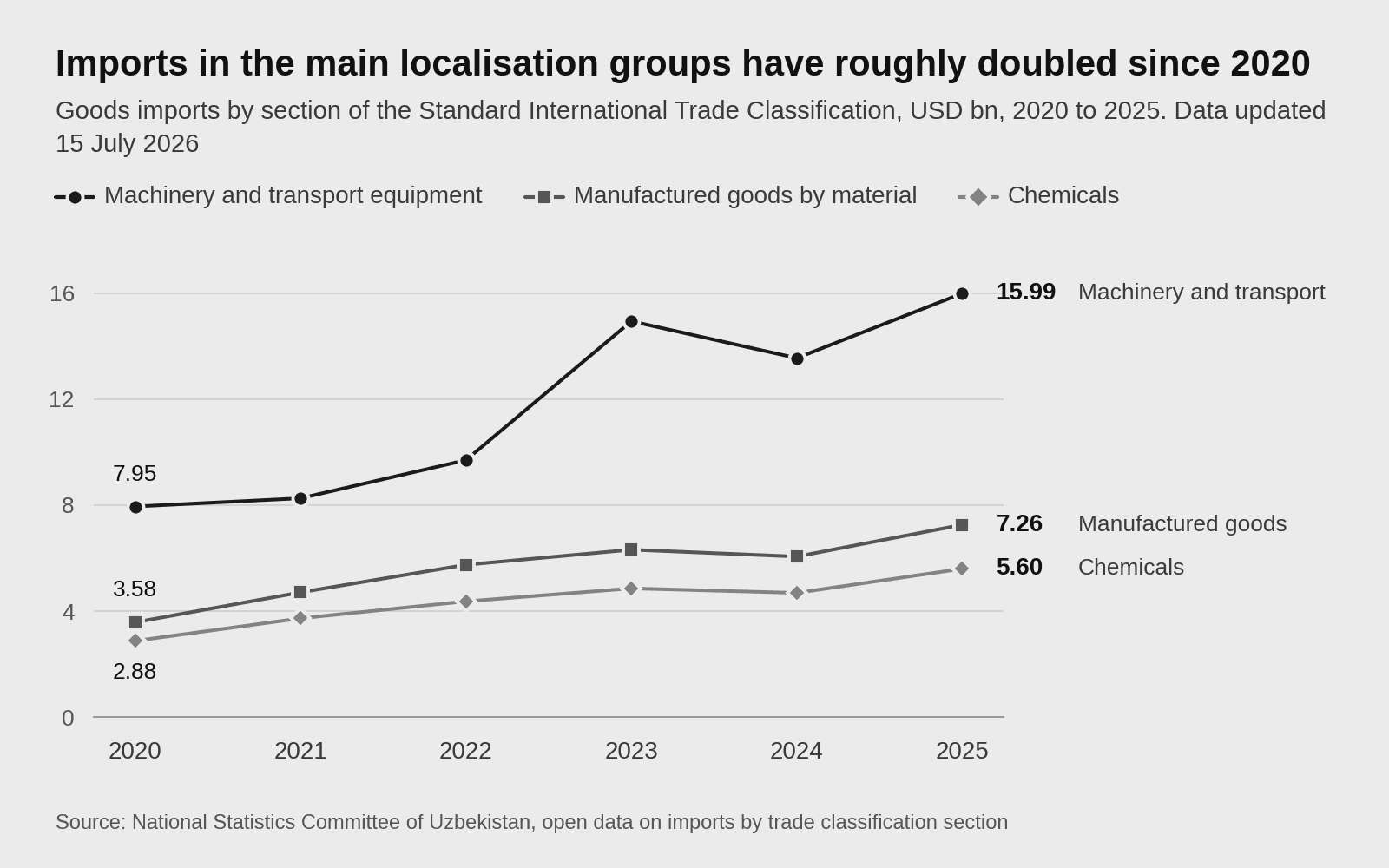
The lists that state companies publish draw on a growing import bill. Goods imports roughly doubled between 2020 and 2025 in each of the three groups closest to the priority sectors of UP-17, which are machinery and transport equipment, manufactured goods classified by material, and chemicals. Machinery and transport equipment nevertheless eased from 37.6% of total imports of goods and services in 2020 to 33.8% in 2025, as the 2020 trade data and the 2025 trade releaseshow, because other imports grew faster.
Source: National Statistics Committee of Uzbekistan, open data on imports by trade classification section
Investment projects add to this demand, since at a meeting on localisation in October 2024 the President said that they import about USD 15 bn a year of equipment, raw materials and construction materials. Imports of goods and services reached USD 29.6 bn in January to July 2026, 17.8% more than a year earlier, the National Statistics Committee reports. The central bank's Monetary Policy Report expects imports to grow by 15% to 20% over the full year.
The origin of imports indicates whose supply a local plant would replace. The share of China in total imports rose from 21.3% in 2020 to 31.2% in 2025, according to the same trade releases, and reached 32.4% in January to July 2026, national statistics show. Over 2020 to 2025 the share of Russia eased from 19.7% to 18.3%. Localisation in machinery and components therefore competes above all with Chinese supply. This follows from aggregate trade data, since product-level data on origin were not reviewed.
Evidence at company level illustrates what the channel can mean for suppliers. NMMC reported in September 2024 that it had bought industrial goods worth UZS 14.2 trn through inter-sectoral cooperation over the previous three years, and that it planned 185 localisation projects producing UZS 1 trn of output in 2025. In the absence of a national count of contracts under Resolution No. 159, company reports and sector data remain the best available measures of uptake, and the sector sections below trace how much they differ.
How far localisation has moved from assembly to production
Foreign-invested companies are already a large presence in the economy of Uzbekistan. On 1 September 2026 the country had 21,490 operating enterprises with foreign capital, 4,177 of them in industry, according to the National Statistics Committee and its breakdown by sector. China accounted for the largest group, with 6,436 enterprises, followed by Russia with 3,589 and Türkiye with 2,365. The releases reviewed do not break down industrial enterprises by country of capital, so the sector evidence below describes producers by industry, scale and ownership.
Automotive shows the full ladder from kits to components
Car making offers the most detailed public record of a move from kits to components. Component localisation in the industry stood at 50% at a presidential meeting in December 2023. By 2025 the state-owned carmaker UzAuto Motors had localised 58% of components for two high-volume models and aimed for 80% within three years, drawing on more than 135 direct and 235 second-tier local suppliers, its executive director told the business press.
Source: National Statistics Committee of Uzbekistan, January to July 2026 output, 2026 target
Newer plants follow the same ladder at an earlier stage. A privately owned plant in Jizzakh region that assembles Korean and Chinese brands began SKD assembly in March 2021 and moved to completely knocked-down (CKD) production in March 2024, reaching a localisation level of 35%, company data show. A joint venture between Uzavtosanoat and a Chinese electric vehicle maker produced about 20,200 vehicles in 2025 and plans 40,000 in 2026, the business press reported. The governance of such partnerships with state holdings is covered in joint ventures with state-owned partners.
Electric vehicles illustrate where border measures in the sector now sit. Imported electric cars pay no customs duty, but the recycling fee on those up to three years old rose fourfold from 1 May 2025, while locally produced ones are exempt until 1 January 2030, a report on the fee change notes. Electric cars still made up 54,826 of the 79,046 passenger cars imported in January to August 2026, according to customs data reported in the press.
Electrical engineering combines preferences with cheaper copper
Industry figures reported in January 2025 put electrical engineering output at UZS 31 trn in 2024 and exports at USD 1.3 bn. A January 2024 resolution introduced a tiered procurement preference for electrical products, which UP-17 later extended to all domestic goods bought by budget customers. Later resolutions added measures on input costs, procurement and taxation.
Two of them act directly on costs and on demand. From 2026 to 2030 the cathode copper that AMMC sells on the commodity exchange starts trading at 4% below the international exchange price, under a resolution of October 2025. Since February 2025 procurement documents for administrative and social buildings of state bodies and of companies more than 50% owned by the state have had to specify domestic products. These must come from the producer ecosystem platform or the e-cooperation portal where available, under the January 2025 resolution.
Imports of electrical machinery and equipment rose from USD 1.20 bn in 2020 to USD 4.12 bn in 2025, according to official trade data by commodity, in a category that also includes the solar equipment covered below. From 1 July 2026 the preference for electrical goods no longer applies to the commercial purchases of state companies. Procurement support for the sector therefore reaches a narrower part of the state market than before July 2026.
Pharmaceuticals carry the longest offtake terms
The market for medicines and medical devices was put at about USD 2.5 bn at the March 2026 meeting on the industry. Imports of pharmaceutical products rose from USD 1.15 bn in 2020 to USD 1.89 bn in 2025 in the same commodity data. The share held by domestic producers looks different depending on whether it is measured by value or by volume.
Domestic producers held about 20% of pharmacy sales by value in 2024, almost UZS 4 trn out of more than UZS 19.7 trn, according to Tax Committee data cited in a local report. Their share by volume was 35% in the first quarter of 2025 in one market research estimate and 41% in the twelve months to September 2025 in a second estimate reported in the press. The gap between value and volume suggests that local output is concentrated in lower-priced generics, although no data on the share of imported active substances were found.
Guaranteed purchase terms for medicines lengthened from three years in 2022 to up to ten years from 2024, and Resolution No. 159 set ten years, twice the general term. State purchases of medicines run at about UZS 5 trn a year against UZS 24 trn of pharmacy sales in 2025, according to the industry report on the 30% threshold. From 1 July 2026 these purchases go through a single electronic platform open only to manufacturers certified for good manufacturing practice and to distributors certified for good distribution practice, as a law-firm newsletter describes.
Official targets have so far moved faster than measured results in this sector. The January 2022 decree set a goal of domestic supply of up to 80% of medicines in physical terms over its 2022 to 2026 horizon, whereas the latest volume estimates are about half of that level. The target set in March 2026 is a 70% share of domestic medicines in the home market by 2030, together with pharmaceutical exports of USD 1 bn within five years.
Mining companies localise largely in house
NMMC's localised output rose from UZS 915.8 bn in 2024 to UZS 1.4 trn in 2025, an industry publication reports. Its own machine-building plant produced more than UZS 1 trn of goods in 2025, and 98% of that output went to the company's own needs, as Pravda Vostoka reported. These figures suggest that much of the company's localisation is carried out by its own subsidiary.
The published figures for external suppliers to the company are smaller. Under the company's programme of support for local producers, 43 enterprises produced goods worth UZS 783 bn in 2025, according to a second report in Pravda Vostoka, and AMMC reported UZS 429 bn of localised output from 147 projects in 2023. The NMMC figures cover different scopes and cannot be added together, which leaves the division between in-house and external supply only partly measured.
In steel, new domestic capacity is still ramping up while imports have grown. Iron and steel imports rose from USD 1.24 bn in 2020 to USD 2.57 bn in 2025 in the commodity data. Uzmetkombinat, which is 93% state-owned, opened a new flat steel complex at the end of 2025 and was still bringing it up to capacity in 2026, as noted in a rating agency review reported in the press.
Coordination of this demand is set to move to a higher level of government. After a visit to AMMC in March 2026, the President announced an Industrial Council to oversee major projects in mining, metallurgy, chemicals and oil and gas, with raising the share of local content through cooperation among its tasks. The internal side of this process is examined in our article on modernisation inside large state enterprises.
Chemicals and polymers remain import-dependent
In June 2026 the President said that domestic chemical output covers less than 60% of national demand, with imports of up to USD 4.5 bn, in remarks reported by the press that give no reference year. That figure is lower than the chemicals section of trade statistics in the import chart, which also covers medicines and plastics in primary forms. The localisation programme of Uzkimyosanoat for 2025 covers 31 projects, 21 of which are planned to reach full localisation on local raw materials.
For polymers the state has lowered the cost of imported inputs to support local processing. PP-252 of August 2025 set zero excise and customs duty until 1 January 2028 on imported polyethylene granules that are not produced in the country, which lowers input costs for local makers of plastic products. Imports of plastics and plastic articles, a category that covers both granules and finished goods, rose from USD 0.70 bn in 2020 to USD 1.57 bn in 2025 in the same commodity data.
Construction materials show what full production does to imports
Output of Portland cement rose from 12.4 m tonnes in 2023, the first year in the release used, to 20.2 m tonnes in 2025, the National Statistics Committee reports. Cement imports declined from USD 129.7 m in 2020 to USD 20.9 m in 2024, according to World Bank trade data for 2020 and 2024. By 2024 exports almost matched imports, with nearly all shipments going to Kyrgyzstan, Kazakhstan and Afghanistan.
State construction adds a direct preference for local equipment. Since 1 March 2024 projects financed from centralised sources have had to use locally made lifts, escalators, industrial cooling and heating equipment, transformers, solar water heaters and panels, and radiators, under a November 2023 amendment to Cabinet Resolution No. 41. These requirements tie localisation in building products to the construction programme of the state itself.
Energy equipment is still largely imported
By December 2024 solar and wind plants with a combined capacity of 3,500 MW had been launched, and the target is to raise the share of renewable energy to 54% by 2030, as a presidential meeting on energy set out. World Bank trade dataput imports under the tariff line for photovoltaic cells and modules, which in the classification used also covers light-emitting diodes, at USD 342.2 m in 2024, 99% of them from China. No local content condition in power purchase agreements or tenders was found in the sources reviewed.
In September 2024 the President instructed that the local share in energy public-private partnership projects be raised to 25%, as reported at the time, but the report gives no baseline, deadline or monitoring data. Mounting structures are one component that has been produced locally for solar projects elsewhere in the region, as a solar mounting localisation project describes. In this sector the state has so far set a direction without binding local content rules.
Agricultural machinery and rolling stock depend on state buyers
For farm machinery the link between localisation and state support is direct. Since 1 January 2025 subsidies, tax and customs benefits and financial support for farm machinery have applied only to machines that domestic producers sell directly or through dealers, under PP-431 of December 2024. Imported cotton pickers and self-propelled forage and garden combines remain exempt from customs duty and the recycling fee until 1 January 2027, under conditions set by the same resolution.
Uzbekistan Railways builds much of its own rolling stock. Its plants produced 1,590 gondola wagons between 2023 and 2025, and the target for 2026 is 2,000 freight wagons, as a report on a presidential instruction notes. The railway's chairman said the President had asked for annual production of passenger coaches to rise from 40 to 50 units, in a report on the fleet plan to 2030. In this segment the state railway acts as both the main buyer and a producer.
Textiles localise through processing depth
In textiles the relevant measure is how much domestic raw material is processed before export. In July 2022 the presidential press service reported that all domestic cotton fibre was processed in the country, against 40% five years earlier, in its account of a meeting on the sector. Official export data record a rise in exports of knitted garments from USD 459 m in 2020 to USD 898 m in 2025.
Export duties on selected raw materials from 1 July 2025 under Decree UP-47 and the cotton terms of the WTO package point in the same direction. The economics of this chain are covered in textile and agricultural processing investment. WTO accession will apply its own disciplines to many of the instruments described in this section.
What WTO accession changes and what it leaves in place
Where accession stands in September 2026
The working party on the accession of Uzbekistan was established on 21 December 1994, according to a European Commission proposal, and held its 13th meeting at the end of July 2026. The earlier aim of completing accession by the 14th Ministerial Conference in March 2026 was not met, and at the July meeting Uzbekistan reaffirmed its goal of joining in 2026. By then 31 of 34 bilateral market access agreements had been submitted to the WTO Secretariat, as reported by the WTO and in local press coverage.
The agreement with the European Union was concluded on 24 October 2025, as the European Commission announced, and the protocol with Russia was signed on 21 December 2025, according to a press report. The next working party meeting is expected in late autumn 2026, and the draft working party report, which will contain the specific commitments of Uzbekistan, is not in the public domain. The analysis below therefore separates the general rules of the WTO from the steps that Uzbekistan has already taken in its own law.
Budget preferences rest on a conditional WTO exception
Under Article III, paragraph 8(a), of the General Agreement on Tariffs and Trade (GATT), the national treatment rule does not apply to purchases by governmental agencies of products bought for governmental purposes. The WTO Appellate Body treats the conditions of this exception as cumulative, and in a 2013 dispute over a Canadian renewable energy programme it confined the exception to discrimination against products in a competitive relationship with those purchased, as the WTO case summary records. Wider procurement disciplines come from the plurilateral Agreement on Government Procurement (GPA), which binds only its parties, and Uzbekistan is not one of them, as the US International Trade Administration notes. The published accession documents contain no commitment by Uzbekistan to join the GPA.
WTO membership alone would therefore not automatically eliminate the budget preferences of UP-17, a conclusion drawn from the structure of WTO law and not from any published commitment. Where a purchase falls within the exception, the national treatment obligation does not apply, and whether a particular procurement qualifies depends on the purchasing entity, the governmental purpose of the purchase and the absence of commercial resale. The scoring bonus in tenders raises the same question. Whether Uzbekistan later accepts procurement commitments is a separate decision that the accession documents available so far do not settle. Read this way, the budget preference is likely to remain the instrument least exposed to accession, although not every budget purchase will qualify.
Commercial purchases by state companies have already been separated
The exception does not cover purchases made for commercial resale or for use in producing goods for commercial sale, and GATT Article XVII requires state trading enterprises to act in accordance with commercial considerations. Uzbekistan drew this line in its own law before accession, through the UP-85 removal of preferences and the exclusion of the same purchases from the scoring bonus under Resolution No. 159. Pricing at import parity arguably places the guaranteed purchase closer to commercial terms than a price preference. How the working party will treat the guarantee itself cannot be established from public documents, so the volume commitment is the part of the state company channel whose treatment after accession remains open.
Border protection narrows on bound schedules
Tariff bindings are the most concrete change that accession brings to the economics of localisation. The offer of Uzbekistan binds 100% of its tariff lines, with a trade-weighted average final bound rate of about 4.5% on trade with the European Union, according to the European Commission proposal. That summary describes most bindings as applying from the date of accession, with a minority phased in over three or five years. In a March 2026 interview, the chief negotiator said that transition periods of up to three, five, seven and eight years had been agreed, and that sensitive sectors such as agriculture, light industry and automotive may be among those covered.
Export duties are bound as well, through a positive list that includes a ten-year implementation period for rice, cotton and cotton products. The list keeps export duties available as a tool for encouraging processing inside the country, as in textiles. For raw materials outside the list, export duties would no longer be available after accession.
Internal taxes must treat imports and domestic goods alike under GATT Article III, paragraph 2. UP-85 set deadlines for aligning excise rates on imported and domestic goods, 1 January 2026 for tobacco and 1 January 2027 for alcohol and sugar, and the sources reviewed do not confirm whether the first deadline was met in full. The recycling fee on vehicles has been paid by importers and domestic producers alike since August 2020, as a report on its introduction explains, but locally produced electric cars are exempt until 2030. National treatment rules address this kind of difference, and the public parts of the accession package do not show how it is treated.
Investment incentives face two further WTO disciplines that matter for localisation. The Agreement on Trade-Related Investment Measures (TRIMs) rules out investment measures that require the use of domestic products, and the Agreement on Subsidies and Countervailing Measures (SCM) prohibits subsidies contingent on the use of domestic over imported goods. UP-85 ordered an inventory of the investment agreements concluded by the government to check them against TRIMs, and it cancelled export support subsidies from 1 January 2025. On its face, the rule that limits state support for farm machinery to domestic products is the kind of measure the subsidies prohibition addresses, and its treatment in the accession package is not public. Whether the terms of the new industrial cooperation fund depend on local content could not be established from the published decree either.
Accession bears on state company purchases and border measures more than on budget procurement
Localisation instruments in Uzbekistan and the WTO rules that apply to them, status as of September 2026
Instrument | WTO rule that applies | Position in September 2026 |
|---|---|---|
Price preferences and extra points in budget procurement | GATT procurement exception where its conditions are met, GPA binds only its parties | Outside the GPA, preferences and points in force |
Preferences in commercial purchases of state companies | National treatment and state trading rules | Removed by UP-85 |
Guaranteed purchase under Resolution No. 159 | National treatment and state trading rules | Priced at import parity, treatment not yet public |
Local content conditions in investment agreements | TRIMs Agreement | Inventory ordered by UP-85 |
Subsidies tied to domestic goods | SCM Agreement | Export subsidies cancelled, farm machinery support and fund terms not assessed |
Excise on imported and domestic goods | National treatment for internal taxes | Being aligned on UP-85 deadlines |
Recycling fee on vehicles | National treatment for internal charges | Paid by importers and producers, local electric cars exempt |
Import tariffs | Bound schedule | Bound on accession, transition periods in sensitive sectors |
Export duties | Bound in the accession package | Positive list, longer period for rice and cotton |
Source: Tretiakov Consulting, based on the WTO agreements, Decree UP-85 and the European Commission proposal
Kazakhstan provides a regional post-accession comparison
Kazakhstan, which joined the WTO in 2015, offers a precedent within the region. It removed its local content requirement for goods bought by subsoil users from 1 January 2021, while keeping one for works and services, and rebuilt support around producer recognition and offtake agreements. Offtake agreements signed within the sovereign wealth fund Samruk-Kazyna reached KZT 257.5 bn across 363 contracts in 2025, as set out in our analysis of production localisation in Kazakhstan. The comparison describes one neighbour's path after accession, and neither its rules nor its figures are transferred here, since the markets and commitments of Uzbekistan differ.
Scheduled changes to 2030 and beyond
Published forecasts for 2026 point to continued growth in demand. Forecasts from the World Bank, the International Monetary Fund and the Asian Development Bank put economic growth at between 6.4% and 7.0%, and the government raised its own forecast to 8.1% in July, with industrial growth of 8%, in its updated fiscal strategy. No published forecast of procurement volumes or of the import lists themselves was found, so these growth rates are the nearest available guide to demand.
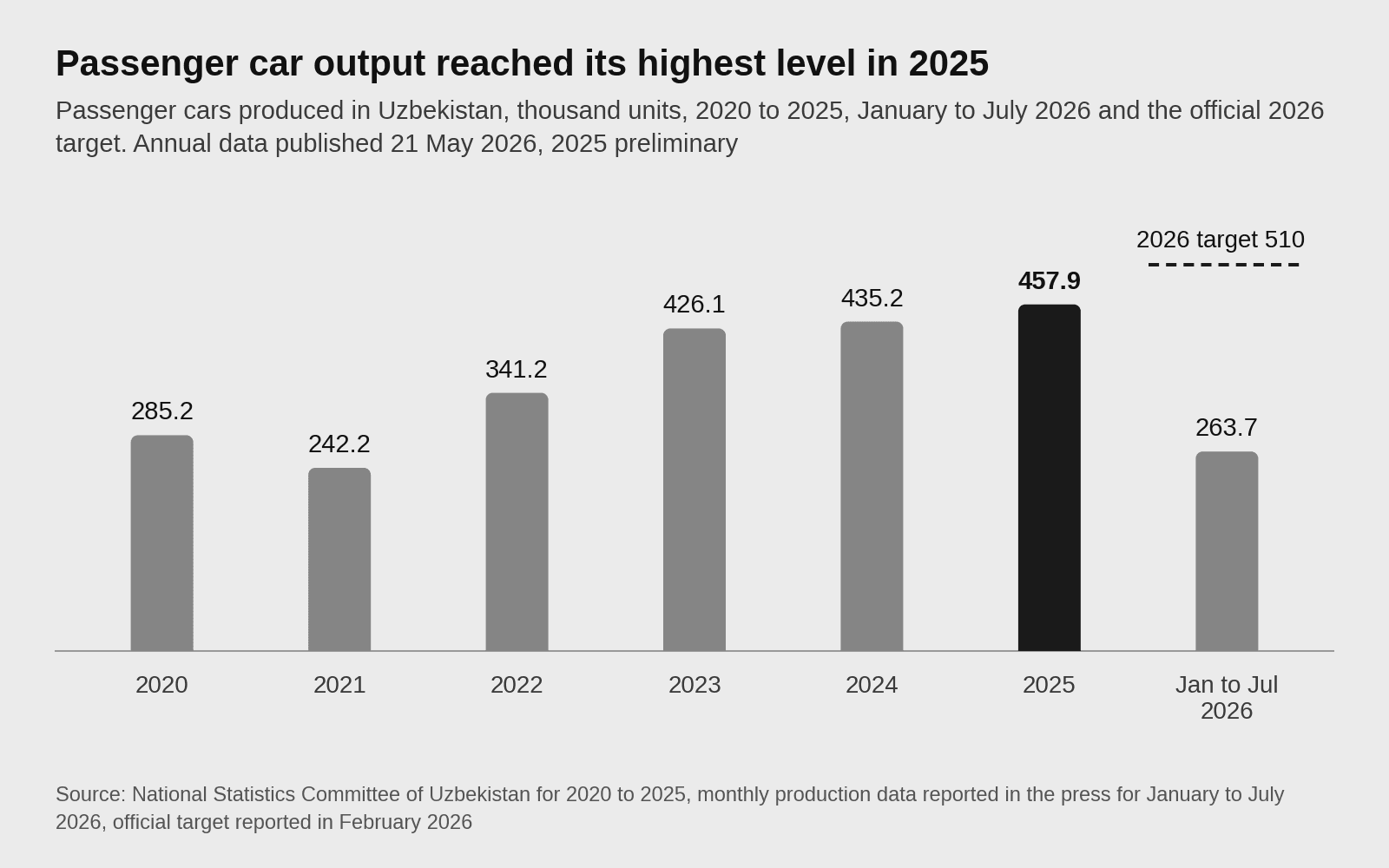
For car making, the full-year estimate is a transparent calculation from published data. Output in January to July 2026 was about 22,600 units higher than a year earlier, according to monthly production data, which implies growth of about 9.4%. Applying that rate to the 2025 total gives about 500,000 cars for the year, slightly below the official target shown in the car output chart. The estimate assumes that the rest of the year grows at the same rate as the first seven months (Source: Tretiakov Consulting).
The procurement rules scheduled for 2026 to 2028, set out in the table below, change how offers are judged as well as who judges them. Evaluation by total cost of ownership for construction purchases above UZS 1 bn and for items with a service life of more than three years moves the test from purchase price to lifetime cost. That change favours equipment whose higher purchase price is offset by lower running costs, and mandatory certification raises the qualification required of the buyers who sign guaranteed purchase contracts.
Beyond 2028 the outlook rests on targets and plans that are not yet measures in force. The 2030 goals for procurement and medicines belong to this group, as does the aim of producing about 1 m cars a year under the Uzbekistan 2030 strategy and the renewable energy target. The plan with the most direct bearing on the offtake channel concerns the number of state companies, which was reduced by 61% in 2021 to 2025, according to the State Assets Management Agency as cited in a report on the privatisation plan.
The government now aims to reduce the number of enterprises with state participation much further by 2030, as the table shows. Because Resolution No. 159 applies only to companies in which the state holds at least 50%, fewer such companies would mean a narrower circle of corporate customers, a consequence that follows from the design of the rule. The privatisation programme therefore bears directly on how much demand the offtake channel will carry after 2030.
If accession takes place in 2026, the tariff transition periods would end within the window shown in the table. Localisation support would then rest mainly on the certificate and on the two demand channels, with border protection limited to bound rates. That outcome depends on the accession date and on commitments that are not yet in the public domain.
Procurement rules tighten to 2028, while structural change runs to 2030 and beyond
Scheduled changes affecting localisation in Uzbekistan, 2026 to 2034, status as of September 2026
Date | Change | Status |
|---|---|---|
1 September 2026 | Electronic reliability rating of bidders | Start date passed, launch not confirmed |
1 January 2027 | Evaluation by total cost of ownership for large construction and long-life items | Set by decree |
1 January 2027 | Certified buyers required in procurement commissions of corporate customers | Set by decree |
1 January 2028 | Corporate customers without certified staff barred from procurement | Set by decree |
2030 | Number of enterprises with state participation cut almost sixfold | Government target |
2030 | Non-state sector share of the economy raised to 85% | Government target |
2029 to 2034 | Tariff transition periods end if accession takes place in 2026 | Conditional |
Source: Decree UP-17, government targets as reported in the press, Tretiakov Consulting calculation for the transition window
Conclusion
Production localisation in Uzbekistan commits a manufacturer to a certified local share of at least 30% of production cost, or a change of tariff heading, before any guaranteed demand becomes available. On the way to that certificate, the cooperation agreement binds the producer to staged obligations under monthly monitoring. Sector rules for vehicles and electrical goods add timetables of their own, so the depth of a plant is in practice fixed before the first guaranteed contract is signed.
Budget organisations reward that commitment with a price preference of up to 15%, and where tenders are scored, localisation also earns additional points. WTO accession would not by itself eliminate these advantages, insofar as the underlying purchases fall within the procurement exception in GATT Article III, paragraph 8(a). In their purchases for production or resale, state companies offer five or ten years of volume at import parity instead. The WTO treatment of that guarantee is not yet public, and its reach would narrow if the planned reduction in the number of state companies goes ahead.
Border protection is the part of the bargain that accession changes most directly, as tariffs are bound and transition periods of up to eight years run out. Once those periods end, a local plant meets imports at bound rates in every channel, and state demand becomes the main support that localisation earns. The two channels then differ in what they are worth and how long they last. A plant built for budget buyers keeps a price and scoring advantage that accession would not by itself remove, while a plant built for state companies trades that advantage for long-term volume in a channel whose size depends on privatisation.
To assess localisation depth and offtake terms for a plant in Uzbekistan at board level, contact Tretiakov Consulting.
Our insights