
ILLIA TRETIAKOV
Founder

Kazakhstan's gross domestic product (GDP) reached USD 306.0 bn in 2025, about twice the USD 147.1 bn recorded in Uzbekistan, a country with almost double the population. Four years earlier the Kazakh economy was 2.4 times as large, so the distance between the two neighbours is closing at a pace that matters for any five-year investment plan. The narrowing has two sources, faster real growth in Uzbekistan and a weaker tenge in 2025, and both are traced below.
For a Kazakhstan vs Uzbekistan business decision, size and speed point in different directions. Kazakhstan offers the larger and wealthier market today, while Uzbekistan offers more people, lower costs and faster growth, having expanded by 7.7% in 2025 against 6.5% in Kazakhstan. Which of them comes first in a Central Asia market entry therefore depends on what a company sells, where it produces and whether its goods have to cross the border between the two countries.
This analysis treats both economies as markets for a foreign company, using national statistics, central bank data and the projections of international financial institutions from 2021 to 2031. Values are nominal and converted into dollars at the annual average rates of the two central banks where no other rate is stated. Growth rates are real and cover the calendar year unless a shorter period is named. The question is which measurable differences decide the order of entry, and the analysis moves from the size of each economy to the rules at its border.

Source: World Bank, World Development Indicators for 2021 to 2024, Bureau of National Statistics of Kazakhstan and National Statistics Committee of Uzbekistan figures for 2025
Kazakhstan vs Uzbekistan Economy in Size and Growth to 2031
Over the five years to 2025, real output grew by 40.2% in Uzbekistan and by 26.5% in Kazakhstan, when the annual rates in World Bank growth series are compounded. Uzbekistan grew faster in every one of those years and never by less than 6%, whereas Kazakhstan's strongest year in the period was the last one. The Uzbek figures reflect a revision of national accounts in November 2025, which raised the estimate of the previous year's GDP after fuller coverage of state budget spending, and this article uses the revised series throughout.
In dollar terms most of the narrowing happened in a single year, which points to currencies as well as to growth. Kazakhstan's nominal GDP rose by 16.7% in tenge in 2025 on our calculation from national accounts, but a weaker average exchange rate held the increase in dollars to just under 5%. Uzbekistan's dollar GDP grew by about 21% in the same year, because the som was broadly stable against the dollar and nominal growth passed through almost in full. The Uzbekistan vs Kazakhstan GDP ratio in dollars therefore moved more in 2025 than the gap in real activity did.
Kazakhstan's GDP grew by 4.1% in the first half of 2026, the statistics bureau reports, and an operational estimate of the Ministry of National Economy puts growth for January to August at the same rate. Over those eight months the oil production index stood at 91.6% of its level a year earlier, but manufacturing expanded by 8.4%, which places the slowdown in one sector and not across the economy. The bureau's short-term economic indicator, which tracks six core sectors and is published monthly, rose faster over the same period, by 4.9%.
Uzbekistan's economy grew by 8.5% in January to June 2026, with construction up 13.7% and services up 9.2%, according to first-half data from the statistics committee. Industry and agriculture also expanded, so growth this year is spread across the main sectors of output. For a foreign entrant this breadth means domestic demand does not depend on a single industry, although the balance of payments shows that gold exports and remittances from workers abroad still link Uzbek incomes to conditions outside the country.
Published full-year forecasts for 2026 keep the same order. For Kazakhstan they range from 4.6% at the International Monetary Fund (IMF) and the World Bank to 4.8% at the Asian Development Bank. For Uzbekistan they range from 6.4% at the World Bank to 7.5% at the European Bank for Reconstruction and Development.
Beyond this year the growth gap is projected to widen. The World Bank's June 2026 projections put Uzbekistan's growth at 6.8% in 2028 against 3.5% in Kazakhstan, a difference of more than three percentage points. The IMF's projections for Kazakhstan then level off at 3.6% a year until 2031, consistent with the Fund's expectation of broadly flat oil output over the medium term.

Source: World Bank, World Development Indicators and Global Economic Prospects, June 2026
Official forecasts in both capitals are higher than those of the international institutions. Kazakhstan's government expects average growth above 5% a year in 2027 to 2029 in the forecast it approved on 25 August 2026, and Uzbekistan's finance ministry projects 6.9% to 7.4% over the same years in its fiscal strategy. Both underpin the budgets drafted for those years, which makes them planning assumptions as much as projections.
Both governments have also set targets for the size of their economies in dollars. Kazakhstan's National Development Plan, approved by presidential decree, sets GDP at USD 450 bn by 2029, and Uzbekistan's updated development strategyaims for more than USD 240 bn by 2030. These figures are policy commitments and not forecasts, so they show the ambition of each government rather than the likely size of its economy.
From the 2025 levels, each of these targets implies growth of about 10% a year in dollar terms on our arithmetic, well above the real growth that institutions project for either country. In a speech on 28 August 2026 Uzbekistan's president named a higher figure of USD 300 bn for 2030, which would require about 15% a year. The excess over projected real growth would have to come from domestic inflation or currency appreciation, which is why a dollar target is a weaker guide to market size than a projection of real output.
Where Household Spending Is Larger and Where It Grows Faster
Income per person separates the two markets more sharply than total output does. Kazakhstan's GDP per person was almost four times the Uzbek level in 2025, and household spending follows the same pattern in a form closer to what a consumer business can sell into. On our conversion of national accounts and World Bank household consumption data at average exchange rates, Kazakh households spent about 1.8 times as much as Uzbek households in total and more than three times as much per person.

Source: Bureau of National Statistics of Kazakhstan, National Statistics Committee of Uzbekistan, World Bank, latest wage data for Kazakhstan and Uzbekistan, population data for Kazakhstan and Uzbekistan, Tretiakov Consulting calculations
Growth in that spending points the other way, which is the centre of the trade-off between the markets. Kazakh household consumption rose by 8.1% in volume in 2025, the statistics bureau reports, while Uzbek retail turnover grew by 11.2% in volume in 2025 and by 18.8% in the first eight months of 2026 in official data. The measures differ, since retail turnover leaves out most services, but both point to faster growth in the volume of spending in Uzbekistan.
The composition of output also shapes demand for anyone selling to farms, factories or mines. On the measures each statistics office publishes, agriculture accounted in 2025 for 17.3% of gross value added in Uzbekistan and for 3.8% of GDP in Kazakhstan, where mining alone generated 11.9% of GDP. Industry as a whole takes a similar share of output in both economies, although in Kazakhstan it is weighted towards extraction.
At country level the picture is consistent, with more spending power today in Kazakhstan and faster growth in Uzbekistan. National totals do not show how much of that spending passes through channels an outside supplier can use, or how it divides between the largest cities and the regions. Those questions are analysed in our assessments of market opportunity in Kazakhstan and of the Uzbek demand that foreign entrants can actually reach.
Labour Costs, Inflation and the Price of Money
On labour costs the advantage passes to Uzbekistan, because Kazakhstan's larger spending power rests on higher pay. At official exchange rates, the latest Kazakh and Uzbek wage data put the average Kazakh wage at about 1.7 times the Uzbek one in 2026. The comparison uses the second quarter for Kazakhstan, converted at that quarter's average rate, and the first six months of the year for Uzbekistan, converted at the latest official rate, because these are the most recent periods each country has published.
The pay gap has narrowed over the past four years and continues to do so. In 2022 the Kazakh wage was 1.9 times the Uzbek one at that year's average exchange rates, based on annual data from Kazakhstan and Uzbekistan. Nominal wages rose by 18.4% year on year in Uzbekistan in the first half of 2026, against 8.4% in Kazakhstan in the second quarter.
In Kazakhstan inflation has more than offset recent pay rises, with real wages 1.8% lower year on year in the second quarter of 2026. Consumer prices rose by 9.8% in the year to August 2026 after 12.3% in 2025, according to national statistics. Price growth has returned to single digits, although it remains well above the Uzbek rate.
Uzbek inflation was lower to begin with and has continued to ease this year. Consumer prices rose by 6.2% in the year to August 2026 after 7.3% in 2025, according to the Central Bank of Uzbekistan. The bank's target is 5% by the end of 2027, which leaves more than one percentage point of disinflation still to deliver.
Nominal policy rates are higher in Kazakhstan as well, although the comparison changes once inflation is taken into account. In September 2026 the National Bank of Kazakhstan cut its base rate to 16.25% and the Central Bank of Uzbekistan kept its rate at 14%. Subtracting the latest annual inflation rates gives a backward-looking real policy rate of about 6.5% in Kazakhstan and 7.8% in Uzbekistan, which points to a tighter monetary stance in Uzbekistan despite its lower nominal rate. Neither figure measures what companies pay to borrow, since bank lending rates also depend on credit risk, maturity and currency.
Exchange rates add a further layer to both cost and market size. The tenge's average rate over the first eight months of 2026 was about 8% stronger than in 2025, and the som's official rate for 29 September 2026 was roughly 6.5% stronger than its 2025 average, on the basis of Kazakh and Uzbek official rates. Stronger currencies raise dollar wages and dollar market size at the same time and make imported goods cheaper in local money.
One Customs Border Between Two Trade Regimes
Kazakhstan is a founding member of the Eurasian Economic Union (EAEU), whose treaty entered into force on 1 January 2015, and it applies the union's common customs tariff. Uzbekistan has held observer status in the union since 11 December 2020, which lets it attend meetings of the union's bodies by invitation, without a vote in decisions or the obligations of membership. The shared border is therefore an external customs border of the union, and goods crossing it in either direction are cleared through customs. Trade across it nonetheless runs under a bilateral free trade agreement signed in 1997 and the free trade area of the Commonwealth of Independent States (CIS), which Uzbekistan joined in 2013. Goods that meet the agreements' rules of origin are exempt from import duty, apart from listed exceptions, although they are still declared and pay import value added tax (VAT).
Kazakhstan has been a member of the World Trade Organization (WTO) since 30 November 2015, and its simple average applied tariff was 5.6% in 2025 according to its WTO tariff profile. Membership fixes ceilings for tariffs and places trade policy under the organisation's rules and its dispute settlement between governments. For an exporter planning to supply Kazakhstan from outside the region, those commitments have now been in force for more than a decade.
Uzbekistan applied for membership in 1994 and had set the ministerial conference of March 2026 as its target for accession, a date that has passed with negotiations continuing. Its working party last met in July 2026, when 31 of 34 bilateral market access agreements had been submitted to the secretariat, and the government still aims to complete accession this year. According to a document setting out the European Union (EU) position for the conference, Uzbekistan's offer would bind all tariff lines at a final rate averaging about 4.5% when weighted by EU trade.
Relations with the European Union add a further difference between the two regimes. Kazakhstan's Enhanced Partnership and Cooperation Agreement (EPCA) with the EU has been in force since 1 March 2020. Uzbekistan's EPCA was signed on 24 October 2025 and has been applied provisionally since 1 March 2026. Uzbekistan has also benefited since 10 April 2021 from the EU's Generalised Scheme of Preferences Plus, which gives reduced or zero duties on a wide range of its exports to the EU, while Kazakhstan's income level makes it ineligible.
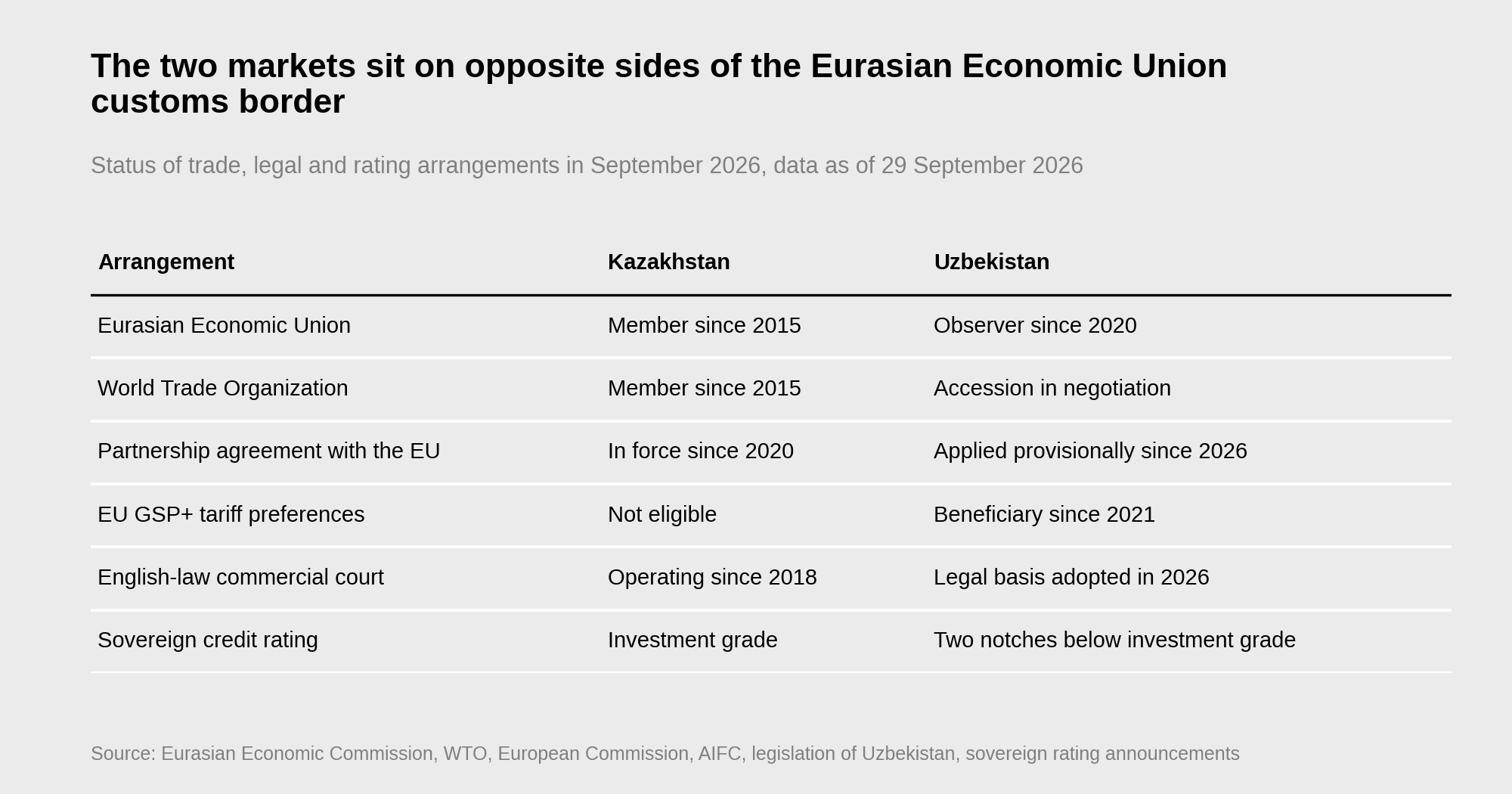
Source: Eurasian Economic Commission, Asian Development Bank free trade agreement database, WTO, European Commission, AIFC, legislation of Uzbekistan, sovereign rating announcements
Import growth shows where the supply of foreign goods is expanding most quickly. Kazakhstan's goods imports rose by 7.4% in 2025 according to national statistics, and Uzbekistan's imports of goods and services rose by 18.5% in official data, with growth continuing in 2026 in both Kazakhstan and Uzbekistan. Measured by goods alone, Kazakhstan's import market remains about half as large again as Uzbekistan's.
Both markets draw their largest shares of imports from the same two countries. Russia accounted for 29.7% of Kazakhstan's imports in 2025 and China for 29.2%, while China provided 31.2% of Uzbekistan's imports and Russia 18.3%. A European exporter meets competition from the same two countries in both markets, although Russia's share is markedly lower in Uzbekistan.
Public procurement adds a preference for local production in both countries. In Uzbekistan, a presidential decree of February 2026 introduced from 1 April 2026 a tiered price preference of 15%, 12% and 8% for domestic goods bought by budget-funded customers, depending on whether three or more, two or one domestic producers compete. Kazakhstan gives registered domestic producers preferential access to state procurement, and both regimes are examined in our analyses of production localisation in Kazakhstan and local content and state offtake in Uzbekistan.
Tax Codes That Moved in Different Directions in 2026
Kazakhstan's new Tax Code, signed on 18 July 2025 and in force since 1 January 2026, raised the standard VAT rate from 12% to 16%. It also cut the annual turnover at which VAT registration becomes compulsory by almost half, to about KZT 43 m, according to a review of the new VAT rules. Together the two changes raise the tax share of final prices and bring far smaller businesses into the VAT system than before.
Uzbekistan left its standard VAT rate at 12% this year, according to a summary of Uzbek indirect taxes, and eased the rules for small businesses instead. From 1 June 2026 a presidential decree raised the turnover at which a company must leave the simplified turnover tax and move to VAT, and linked that limit to the base calculation value. At the base value in force since 1 September 2026, the limit equals about UZS 5.3 bn, more than five times the previous level. The same decree opened an optional simplified VAT regime at 6% for catering, retail and services until 2030.
The standard profit tax rate did not change in either country, remaining at 20% in Kazakhstan according to a current summary of the Kazakh regime and at 15% in Uzbekistan under its 2026 tax amendments. A higher 20% rate applies in Uzbekistan to banks, cement producers, mobile operators and several other activities, according to a summary of the Uzbek regime. On both main business taxes Kazakhstan's standard rate is higher, by four percentage points for VAT and by five for profit tax.
Converted at official end-of-September 2026 rates in Kazakhstan and Uzbekistan, VAT becomes compulsory at about USD 98,000 of annual turnover in Kazakhstan and USD 447,000 in Uzbekistan. For a company whose sales fall between those levels, the difference decides whether it charges VAT from its first year of trading. How both tax administrations work in practice, and what doing business in Central Asia involves beyond statutory rates, is covered in our reviews of the operating reality in Kazakhstan and doing business in Uzbekistan.
Courts, Ratings and the Institutions Investors Rely On
Kazakhstan holds investment-grade sovereign ratings from all three major international agencies, and one of them raised its rating in August 2026 to a level last held before a 2016 downgrade. Uzbekistan's ratings sit two notches below investment grade with each agency, after an upgrade in June 2026, a positive outlook assigned the same month and an affirmation in May 2026. The level still favours Kazakhstan while the direction favours Uzbekistan, and the sovereign rating serves as the benchmark for the cost of dollar borrowing by companies in each country.
Kazakhstan also offers a dispute forum that foreign investors already use. The Astana International Financial Centre (AIFC), created by constitutional law in 2015 and operating since 2018, runs a court whose law and procedure follow English common law, alongside an international arbitration centre. By April 2026 the centre reported more than 5,400 registered participants and more than 4,900 cases. Entry structures that use the centre are discussed in our analysis of market entry in Kazakhstan.
Uzbekistan has put part of a similar framework in place, although its new court has yet to open. The country established the Tashkent International Arbitration Centre in 2018, and this year it created the Tashkent International Financial Centrewith a commercial court that is to apply English law, backed by a constitutional law in force since 25 July 2026. The decree and the law set up the court without naming a date for its first hearings, so for now the advantage in resolving commercial disputes stays with Kazakhstan.
Uzbekistan's investment law, in force since 27 January 2020, guarantees investors ten years of protection against adverse changes in legislation and the free transfer of funds after tax. A new edition was approved by the Senate in January 2025but has not entered into force. On currency, the tenge has floated freely since August 2015 and the som has been convertible for current transactions since September 2017, so the legal basis for repatriating profits exists in both countries.
The World Bank's first B-READY (Business Ready) assessment of both countries, the 2025 edition, shows no single leader. Both score 70 out of 100 for their regulatory frameworks, but Kazakhstan scores higher on public services and Uzbekistan on operational efficiency, which measures how rules work for firms in practice. At topic level Uzbekistan leads on business entry and taxation and Kazakhstan on dispute resolution, although the tax scores were collected before Kazakhstan's new code took effect.
Where Foreign Capital and Foreign Companies Have Already Gone
Kazakhstan holds by far the larger stock of foreign direct investment (FDI), USD 156.4 bn at the end of 2025 against Uzbekistan's USD 26.0 bn. The figures come from the latest World Investment Report of the United Nations Conference on Trade and Development, as reported in July 2026. Uzbekistan's stock grew by more than a quarter in 2025 alone, so the difference is narrowing from a very wide base. For a company deciding whether to invest in Kazakhstan or Uzbekistan first, the stock shows where foreign investors already operate at scale, while flows show where new money is going.
In 2025 the flows of new investment moved in opposite directions in the two countries. Net FDI inflows into Uzbekistan reached USD 4.4 bn, according to the central bank's balance of payments, while Kazakhstan's net figure moved to an outflow of USD 0.9 bn. Gross inflows into Kazakhstan still amounted to USD 20.5 bn according to the National Bank of Kazakhstan, so the net result reflects capital leaving the country as well as capital arriving.
The origin of new capital also differs between the neighbours. The Netherlands, Russia and China were the largest sources of gross FDI into Kazakhstan in 2025, with the Netherlands at USD 4.6 bn. In Uzbekistan, China accounted for 47% of foreign investment and loans in fixed capital over January to June 2026. The Uzbek measure includes loans and is not directly comparable with FDI, yet both series place China among the leading sources of new capital.
Company registers give a wider picture than investment flows, because they also capture trading firms and small ventures. Data from Uzbekistan's statistics committee show 21,490 operating enterprises with foreign capital on 1 September 2026, 26.8% more than a year earlier. In Kazakhstan the statistics bureau counted about 63,000 operating legal entities and branches with full or partial foreign ownership on 1 August 2026, almost three times as many as in Uzbekistan.
China is now the largest source of foreign-capital companies in Uzbekistan and the third largest in Kazakhstan. It overtook Russia in Uzbekistan by the start of 2025 and accounted for 29.9% of such enterprises by September 2026. In Kazakhstan companies with Russian and Uzbek capital are still more numerous than Chinese ones, as the table below shows.
Announced projects point to further inflows, although most of them are not yet realised investment. Agreements worth USD 43.1 bn were signed at the Tashkent International Investment Forum in June 2026, and a privatisation programme approved on 28 August 2026 offers stakes in 84 companies. Uzbekistan's national investment fund also completed a listing in London and Tashkent in May 2026, raising USD 603.6 m in the country's first transaction of that kind.
In Kazakhstan, the sovereign wealth fund Samruk-Kazyna signed agreements worth about USD 11 bn with South Korean partners in September 2026 on gas processing, refining and power projects. Like the Tashkent forum deals, they are counted here as announced intentions and not as investment made. How such pipelines translate into bankable opportunities is analysed in our work on the case for capital commitment in Kazakhstan, investing in Uzbekistan and Uzbekistan's privatisation programme.
How Far One Market Reaches Into the Other
Trade between the two neighbours has accelerated since 2024. Bilateral turnover rose to USD 4.8 bn in 2025, up 16.2% according to Kazakhstan's government, and the figure for January to June 2026 was 35% higher than a year earlier. That growth lifted Uzbekistan from eighth to sixth place among Kazakhstan's trading partners within a year.
At their Supreme Interstate Council in November 2025 the two presidents endorsed a target of USD 10 bn by 2030. Reaching it would require average growth of about 16% a year from the 2025 level, close to last year's pace and below the increase seen so far this year. The target is within the range of recent performance, provided trade keeps expanding at that rate for five years.
The statistics on foreign-owned firms point to the same close ties between the two economies. Firms with Uzbek capital form the second-largest foreign group in Kazakhstan, and those with Kazakh capital rank fourth among foreign-capital enterprises in Uzbekistan. These counts cover legal entities and branches and give their sector but not their size, so they measure presence and not scale. Even so, more than ten thousand companies with Uzbek capital in Kazakhstan show that operating across this border is already common practice.
Physical infrastructure between the two markets is also under construction. The International Centre for Industrial Cooperation Central Asia, a 100-hectare zone split equally across the border, had its external infrastructure 95% complete and its internal networks 45% complete on the Kazakh side in September 2026, according to the regional administration. When the agreement was ratified in March 2025, a technical launch was planned for the last quarter of this year and an official opening in the first six months of 2027.
Serving the second market from the first is thus an established pattern, but it takes place across a customs border and between two VAT systems with different rates. A company that starts in Kazakhstan and sells into Uzbekistan clears Uzbek customs and pays Uzbek import VAT at 12%. One that starts in Uzbekistan crosses the union's external border and pays Kazakhstan's 16% rate. Whether duty is also due depends on where the goods were made, because products originating in either country cross without it under the free trade rules, apart from listed exceptions, while goods made elsewhere pay the importing country's tariff.
The location of the first entity, warehouse or plant therefore fixes the customs, tax and currency conditions for the second market, which is the core question in market entry and expansion planning across both countries. The choice of the partner who carries goods over that border is examined in our analyses of selecting a distributor or local partner in Kazakhstan and selecting a distributor in Uzbekistan. The gap between reform signals and daily practice on the Uzbek side is reviewed in our analysis of market entry in Uzbekistan.
What Decides Which Market Comes First
The evidence does not rank the two countries, because each leads on a different set of measures. Kazakhstan is ahead on conditions in place today, namely household spending power, trade rules anchored by a decade of WTO membership, investment-grade ratings and an English-law court that already hears cases. Those advantages come with higher wages, higher nominal interest rates and a VAT rate raised to 16% in 2026.
Uzbekistan has the edge on momentum and cost, with faster forecast growth, a larger and cheaper workforce, a lower VAT rate, EU tariff preferences and a foreign business base that grew by almost 27% in a year. Its WTO accession is still under negotiation, its English-law court is not yet hearing cases and its ratings, although rising, remain below investment grade. The distance between the two is narrowing on most of these measures, but at different speeds for demand, costs and rules.
For a Kazakhstan vs Uzbekistan business decision, the order of entry therefore follows from two facts about the company rather than about the countries. The first is whether its business case rests on the income and rules that exist now, or on lower costs and on growth that the forecasts to 2031 still have to deliver. The second is where its goods are made and whether they must cross the external border of the Eurasian Economic Union to reach the second market. At that border they enter a different customs, VAT, regulatory and currency regime, and the duty they pay depends on their origin under the free trade agreements.
Tretiakov Consulting supports companies and investors entering Kazakhstan and Uzbekistan with market entry strategy, risk assessment, partner models and operating setup. Discuss your mandate.
Our insights