

Uzbekistan’s industrial economy has grown on the back of capital investment for more than a decade. The economy has been relying heavily on capital investment as the primary growth engine, and to reach upper-middle-income status by 2030, increasing total factor productivity will be central. Yet on the factory floor, the consequences of that growth model are visible in a specific way: installed capacity that runs well below its potential, production systems built around Soviet-era workflow logic, management structures that report upward rather than manage outward, and quality regimes that exist on paper but not in daily operating discipline. Enterprise modernisation in Uzbekistan is not fundamentally a problem of investment scarcity. It is a problem of converting investment into measurable productivity under conditions of inherited operating models, weak competitive pressure and uneven management capability. This article examines where that conversion breaks down, why it is structurally different from factory transformation in other markets, and what investors, owners and boards need to assess before committing capital to industrial modernisation programmes.
Why Uzbekistan’s Industrial Modernisation Is Not a Capex Problem
The national ambition is clear. The Uzbekistan 2030 Strategy targets GDP of $240 billion by 2030, up from $140 billion in 2025, with sectoral strategies spanning industry, automotive, chemicals, building materials and textiles. From 2026, Uzbekistan plans to launch 228 new industrial projects worth €13 billion. Real GDP rose by 7.7% in 2025, up from 6.7% in 2024, driven by export recovery, private consumption and growth in services, agriculture and industry. The headline figures suggest an industrial economy in motion.
The structural reality is more complicated. In 2020, Uzbekistan had over 2,000 centrally held state-owned enterprises with revenues equivalent to 32% of GDP, and four out of five of these SOEs operated in sectors where private firms could compete more effectively. Growth has been driven largely by capital accumulation rather than by improvements in how that capital is used. Economic growth has primarily come from capital accumulation and labour productivity increases in the industrial sector, while productivity gains in agriculture and services have been far more modest. The trade-to-GDP ratio has more than doubled since 2017, reaching 71.6% in 2022, yet only 6% of firms currently export their goods. That gap between aggregate openness and firm-level export capability is a direct indicator of the productivity and quality constraints that sit inside the country’s industrial enterprises.
For investors and owners assessing business and investment conditions in Uzbekistan, industrial reform in Uzbekistan becomes real only when individual enterprises improve productivity, reduce waste, meet export quality standards and build management systems that can operate without constant state direction. Capital expenditure that enters an unreformed operating model does not create value. It creates expensive idle capacity.
The Modernisation Trap: New Assets Inside Old Management Systems
Enterprise modernisation and industrial reform in Uzbekistan face a distinctive set of constraints that distinguish this market from standard factory transformation in Southeast Asia, Turkey or Central Europe. Understanding these constraints is essential for any investor or board considering advisory for industrial and manufacturing companies improving competitiveness.
The first constraint is the incentive structure created by decades of subsidised energy. Uzbekistan’s energy use per unit of GDP is about 50% above the global average and roughly three times higher than in advanced economies, a legacy of ageing industrial infrastructure and obsolete technologies. In 2020, the IEA estimated that Uzbekistan’s implied subsidies on natural gas, electricity and oil amounted to $3.8 billion, equivalent to 6.6% of GDP. When energy is effectively free, enterprises optimise for volume and throughput rather than for yield, waste reduction or energy efficiency per unit of output. Tariff reforms are now underway, with cost-recovery pricing targeted by 2027, but the management routines and process design inherited from the subsidy era remain embedded in most production operations.
The second constraint is the absence of genuine competitive pressure across major industrial sectors. Uzbekistan’s areas of comparative advantage are dominated by SOEs that are shielded from private sector competition, and a burdensome regulatory environment has restrained the discovery of new growth opportunities. The degree of competition in Uzbekistan’s product markets is perceived as weak compared with key peers. The entry of new firms remains well below the averages for Europe and Central Asia, and post-entry firm performance has also been sluggish, with formal private firms staying small as they age. Without competitive pressure, enterprises lack the external discipline that forces continuous improvement in cost, quality and delivery performance. This is why manufacturing modernisation in Uzbekistan cannot be treated as a technology procurement exercise; the underlying management incentive to improve may simply not exist unless it is deliberately designed into the governance and performance framework of the enterprise itself.
The third constraint, and the one least visible in policy documents, is the management layer. SOE reform and modernisation in Uzbekistan encounters a structural shortage of middle management with experience in modern operating discipline. Directors may be skilled at navigating government relationships and regulatory requirements, but the daily operating cadence of a competitive industrial enterprise requires different capabilities: KPI-driven performance reviews, structured maintenance planning, procurement lead-time management, real-time quality monitoring and the authority to make operational decisions without waiting for ministerial approval. These routines do not arrive with new equipment. They must be built, practised and reinforced over multiple production cycles.
The fourth constraint is the gap between installed capacity and effective output. Enterprises may report high nominal capacity after receiving investment, but effective output measured by overall equipment effectiveness, scrap rate, unplanned downtime and first-pass yield often tells a different story. The root causes of this gap sit in maintenance backlogs, unreliable spare parts supply, inconsistent operating procedures and a production culture that prioritises activity over outcome. Business transformation in Uzbekistan fails precisely at this point: when capital investment is not matched with process redesign, management capability and governance discipline.
Enterprise Transformation Framework for Investors and Owners
Advisory for enterprise transformation in Uzbekistan must begin not with equipment specifications but with a structured diagnostic that connects asset condition, process performance, management capability and governance readiness. The framework below sets out the core areas that determine whether enterprise modernisation in Uzbekistan will produce lasting operational improvement or create stranded capital.
Enterprise Modernisation Framework
Transformation area | Practical issue in Uzbekistan | What advisory should clarify |
|---|---|---|
Asset condition and utilisation | Installed capacity may be reported as high while effective OEE remains below 40% due to unplanned downtime, slow changeovers and maintenance backlogs | Baseline OEE, downtime root causes, asset age profile and realistic utilisation potential after process intervention |
Process stability and yield | Production losses often originate in workflow design, inconsistent operating procedures, manual workarounds and procurement failures rather than in the equipment itself | Material yield, scrap rate, rework volume, bottleneck mapping and the gap between theoretical and actual throughput |
Maintenance and reliability | Reactive maintenance culture is common; preventive and predictive routines are rare; spare parts supply chains are unreliable outside Tashkent | Maintenance backlog, MTBF, spare parts availability, local service capability and realistic reliability improvement potential |
Quality and export readiness | ISO certification may exist as a document-level exercise; actual shop-floor quality discipline, measurement systems and rejection tracking may be absent or informal | Export rejection rates, customer complaint patterns, measurement system capability, quality control points and alignment with target market requirements |
Energy and resource intensity | Subsidised energy pricing has historically masked waste; tariff reform will expose true cost structures and create pressure that management systems are not currently designed to handle | Energy consumption per unit of output, resource intensity benchmarks, quick-win reduction potential and capex requirements for efficiency upgrades |
Management cadence and KPI discipline | Local management teams may lack experience with structured daily operating routines, performance dashboards and accountability-based decision-making | Role clarity, reporting frequency, KPI ownership, decision rights, escalation protocols and leadership development needs |
Workforce productivity and skills | Overstaffing inherited from SOE models inflates labour costs and obscures true productivity; workforce reduction is socially and regionally sensitive | Labour productivity per unit, skills gap analysis, training requirements and the social feasibility of restructuring in single-industry towns |
Governance and transformation office | Improvements often fade after the initial advisory or investment phase because no internal structure exists to sustain momentum and escalate implementation barriers | Steering committee composition, milestone tracking, early-win identification, board-level reporting cadence and post-project sustainability design |
This framework reflects Tretiakov Consulting’s founder-led approach to business transformation and operating model redesign for industrial enterprises: practical, operational and focused on the point where strategy, investment, management capability and execution discipline must work together. Where projects involve significant capital deployment, industrial investment advisory for production and modernisation projects should begin with diagnostic work rather than procurement planning.
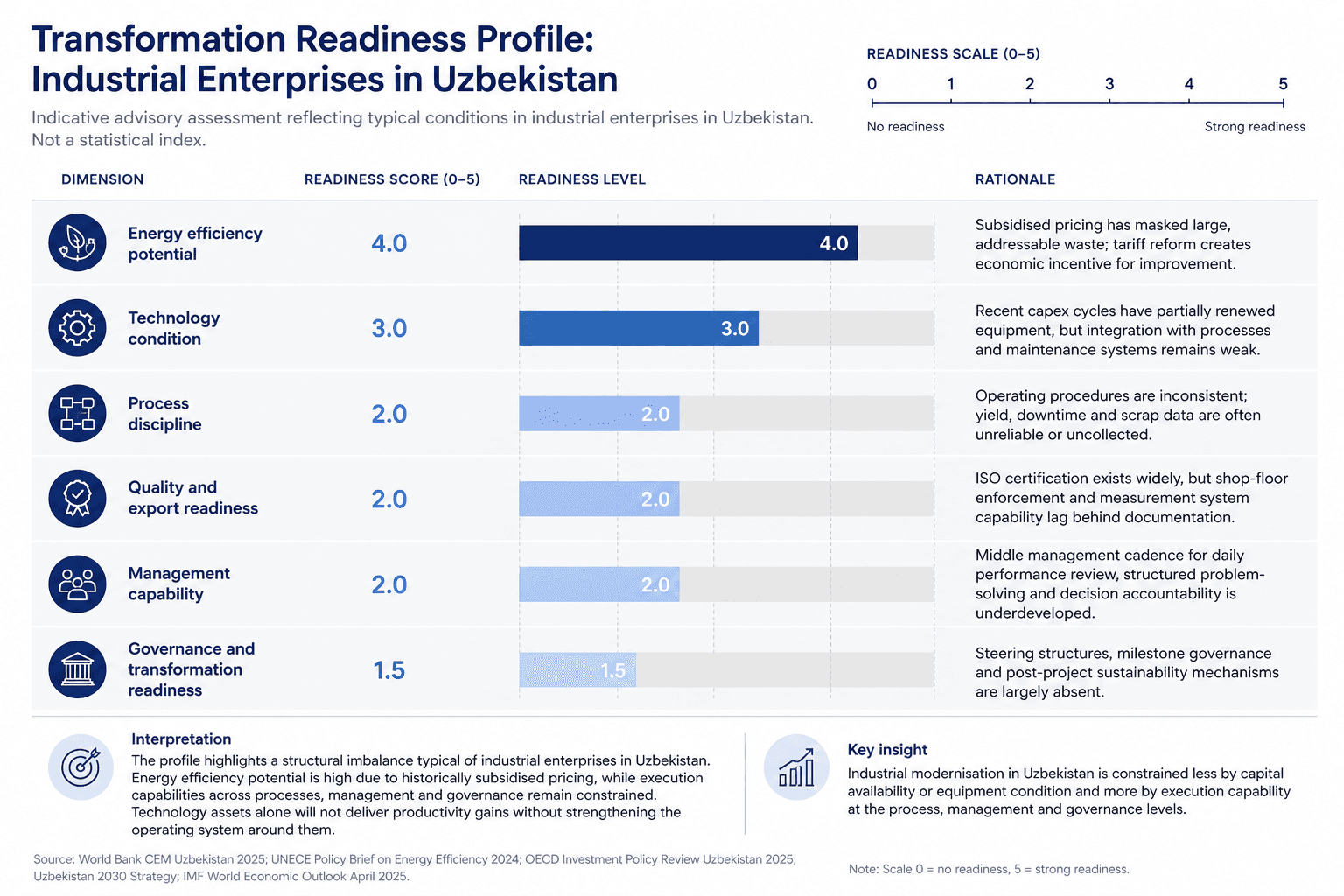
The profile illustrates a pattern that investors encounter repeatedly. Energy efficiency potential scores highest because the gap between current consumption and achievable levels is large and economically addressable. Technology condition scores moderately because capital has been deployed, but process discipline, quality enforcement, management capability and governance readiness remain the binding constraints. Enterprise modernisation in Uzbekistan is constrained less by equipment age than by the operating system around the equipment.
What Boards Should Measure Before Approving a Modernisation Programme
To fully realise its potential, a focus on implementation quality, institutional co-ordination, legal clarity and regulatory stability will be essential. That OECD assessment of the national investment climate applies with equal force at the enterprise level. Before approving a modernisation programme, boards and investors should require structured answers to the following questions, each of which determines whether capital will be converted into operational performance or absorbed into an unreformed system.
Is the enterprise underperforming because of its technology, its processes, its management or its market position? These are different problems with different solutions and different timelines. Which improvements can create measurable impact within the first 90 to 180 days and thereby build internal credibility and stakeholder support for the broader programme? Is the existing management team capable of executing transformation under pressure, or does the enterprise need operational involvement during enterprise transformation and implementation?
Are workforce changes required, and if so, how sensitive are they in the regional employment context? Does the enterprise have reliable access to suppliers, technical service providers and maintenance capability for upgraded equipment, particularly outside Tashkent? Are quality standards aligned with the requirements of target export customers, keeping in mind that despite trade openness currently only 6% of Uzbek firms manage to export?
What governance model will keep the transformation accountable after the first phase concludes? Without a steering structure, milestone discipline and clear escalation rights, modernisation initiatives lose momentum within months, and the enterprise reverts to inherited routines.
The continued momentum of reform signals, including the UzNIF IPO in May 2026 with a valuation of about $1.95 billion and minority interests in 13 state-owned companies, confirms that the state’s commitment to economic opening and industrial reform in Uzbekistan is deepening. But for individual enterprises, the decisive question remains operational: not whether modernisation is needed, but whether the governance, management routines and operating model of the enterprise can absorb modernisation without turning new capital into stranded or underutilised capacity.
Conclusion
Uzbekistan’s industrial reform will depend not only on investment, new equipment or policy ambition but on the ability of individual enterprises to improve productivity, quality, management capability and execution discipline. Enterprise modernisation in Uzbekistan requires a practical transformation approach that connects diagnostic work, process redesign, technology choices, workforce planning and governance. For investors and owners, the key question is not whether modernisation is needed but how it can be implemented without losing momentum after the first phase. Advisory for enterprise transformation in Uzbekistan must be grounded in operating realities, measured by production outcomes and sustained by governance structures that outlast the initial engagement.
For investors, owners and industrial companies modernising enterprises in Uzbekistan, Tretiakov Consulting provides senior advisory support across diagnostic assessment, operating model redesign, transformation governance and implementation planning.