ILLIA TRETIAKOV
Founder

Doing Business in Uzbekistan and the Operating Reality Behind the Guides
At the beginning of February 2026 Uzbekistan had 18,513 operating enterprises with foreign capital, close to twice the number of five years earlier. Chinese, Russian and Turkish owners accounted for 10,557 of them. The legal and tax guides to doing business in Uzbekistan explain accurately how such companies are formed, and on the measures that matter at the point of arrival the country performs well. In the World Bank's Business Ready assessment published for 2025, business entry is Uzbekistan's strongest topic at 91 out of 100, with a domestic company registered in four days and an electricity connection obtained in five.
The same assessment scores business insolvency at 50, market competition at 53 and dispute resolution at 61. None of those three has much to do with arriving and all of them have a great deal to do with operating. They describe whether a signed contract is worth its face value, whether a competitor is funded on comparable terms and what happens when a counterparty stops paying.
That gap between arriving and operating is the subject of this article. Doing business in Uzbekistan has become markedly easier to begin without becoming uniformly predictable to continue, and the places where prediction breaks down can be named and measured. What follows is part of Tretiakov Consulting's wider work in Uzbekistan and sets out where the written framework is a reliable guide to outcomes, where it is not, and what the difference asks of a foreign company's operating model.
Entry Is Measured Well and Operation Is Measured Poorly
A word on what is being measured, because the evidence base changed shape during the period under review. The World Bank discontinued the Doing Business report on 16 September 2021, so there is no continuous international series for Uzbekistan across the past five years. Its replacement, Business Ready, first covered Uzbekistan in the 2025 edition and scores each topic on three separate pillars, covering the quality of the regulatory framework, the public services that support it and the operational efficiency actually observed. Figures given in soum in this article are nominal and are not adjusted for inflation. Where a soum amount is converted, the rate used is the Central Bank official rate of 11,809.82 soum to the dollar on 22 September 2026.
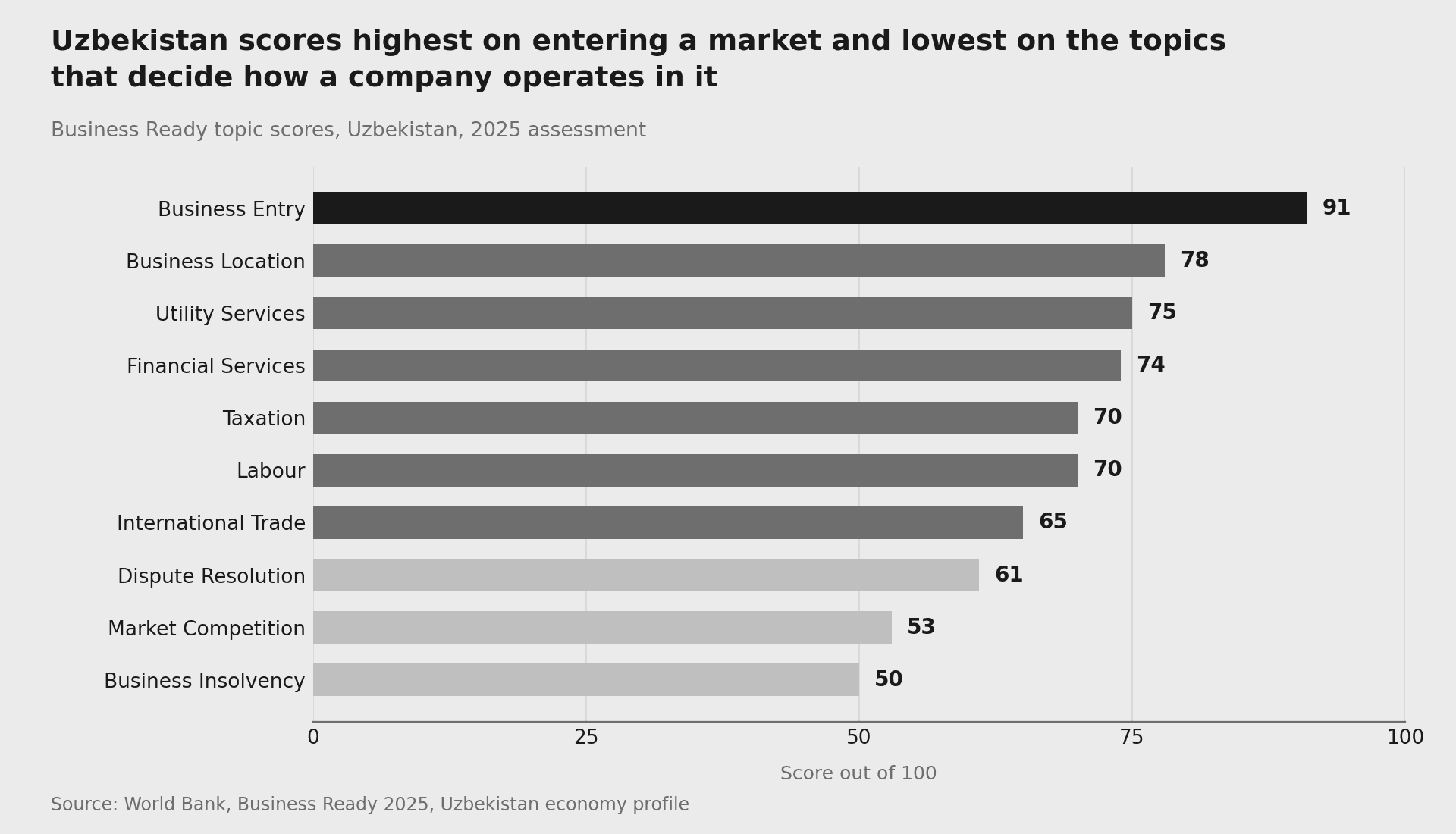
Uzbekistan's ten topic scores in the 2025 assessment. World Bank, Business Ready 2025, Uzbekistan economy profile
The three-pillar structure is where this becomes useful, because it separates the rule from the result. On business entry the rules score 93.10 and observed operational efficiency scores 95.59, so the framework and the outcome agree almost exactly. On financial services the public services pillar reaches 90.50 while operational efficiency falls to 56.38, a spread of 34 points within a single topic. The same downward step appears on labour and on market competition. It runs the other way on utility services, where observed efficiency of 94.48 sits well above a regulatory framework scored at 63.07, so the divergence is not uniformly in one direction.
Topic | Regulatory framework | Public services | Operational efficiency |
|---|---|---|---|
Business entry | 93.10 | 83.50 | 95.59 |
Utility services | 63.07 | 69.44 | 94.48 |
Business location | 80.03 | 69.05 | 84.41 |
Labour | 77.08 | 70.56 | 63.76 |
Financial services | 75.87 | 90.50 | 56.38 |
Market competition | 57.40 | 55.22 | 45.68 |
Pillar scores out of 100, Uzbekistan, 2025 assessment. World Bank, Business Ready 2025, Uzbekistan economy profile
The elapsed times in that assessment show a similar spread. Export customs clearance runs to four days against 11 for imports. A first instance judgment comes in 60 days, while recognition of a foreign judgment needs 90. A property transfer completes in four days and a building permit in 120. Each pairing places a relatively fast procedure next to one that requires a longer institutional chain. The figures do not by themselves establish why the second procedure takes longer. They do show why headline measures of procedural speed give an incomplete picture of operating execution. The choice of entry route and partner model is a separate question, treated elsewhere, and the analysis here begins after that choice has been made.
State Control Has Narrowed Sharply and the Newest Protection Turns on Size
The single most quoted feature of the Uzbek operating environment is the retreat of the inspection regime, and it is real. Unscheduled and counter-inspections were abolished by presidential decree UP-4848 of 5 October 2016, with effect from 1 January 2017. Decree UP-5490 of 27 July 2018 removed planned inspections unrelated to financial and economic activity from 1 September 2018 and introduced selection by risk analysis together with a unified electronic register of inspections. Responsibility for that register moved from the Prosecutor General's Office to the Business Ombudsman on 1 April 2019. Resolution PP-374 of 13 September 2022 reduced the lawful grounds for an inspection to two. An inspection may now follow either the output of the risk-analysis system, with ten working days of advance notice, or a specific factual threat to life, health, public safety or the environment.
It is worth reading that history precisely, because the common description of a long-standing general moratorium does not match the decrees. What happened between 2016 and 2025 was a sequential narrowing of categories, one decree at a time. The broadest general moratorium of the period arrived with decree UP-175 of 27 August 2026, in force from 28 August 2026 until 28 August 2029, whose operative clause declares a moratorium on any inspection of the activity of small business entities. Medium and large enterprises remain outside it and continue under the ordinary regime. Foreign investors therefore need to establish whether their Uzbek entity falls within the applicable small-business classification, because the protection follows from size under that classification and not from foreign ownership or investment status.
What the same decree gives every other company is narrower and still valuable. Any repeat inspection of a business entity within one year now requires the permission of the Business Ombudsman. Separate measures announced with it take effect later, and their status matters more than their content.
Measure | Applies to | Effective from | Status |
|---|---|---|---|
Moratorium on any inspection | Small business only | 28 August 2026 | In force to 28 August 2029 |
Repeat inspection needs Ombudsman permission | All business entities | 28 August 2026 | In force |
Low-risk firms not inspected | All risk-rated firms | 1 January 2025 | In force |
Top-rated firms exempt from tax audit | AAA rating holders | 1 April 2024 | In force |
Initiative audit replacing tax audit | Medium and large business | 1 January 2027 | Adopted, not yet effective |
Presumption of the entrepreneur's innocence | All business entities | 2027 | Announced, procedure not published |
Selected state control measures by scope and effective date. Decree UP-175 of 27 August 2026, lex.uz
The exclusions from the 2026 moratorium are wide enough to matter even to the small companies it covers. Inspections within criminal proceedings, health impact assessments, labour law compliance, checks triggered by citizens' complaints, verification of VAT refund claims and liquidation-related inspections all remain available. Two of those grounds sit outside the risk-analysis system altogether, since a labour-compliance check and a citizen's complaint can each be initiated independently of it.
The volumes show how far the regime has contracted. More than 148,000 inspections were coordinated through the Ombudsman's system in 2025, and the same review identified 567 that were unlawful. Tax Committee inspections then fell 14.5% to 51,000 in the first half of 2026. Deep tax audits have become rare, with 2,146 entities audited in 2024, equal to 0.4% of taxpayers. Repetition is where the burden now concentrates, since 6,350 businesses were inspected more than once between 1 January and 18 July 2026, and the Tax Committee accounted for 72% of those repeat visits.
Survey evidence collected at firm level puts that burden into proportion. In the World Bank Enterprise Survey conducted in Uzbekistan between February and October 2024, 9.1% of firms named corruption a major constraint and 4.0% named tax administration, against 9.8% and 4.3% across Europe and Central Asia. On both measures Uzbekistan reads slightly better than its region. One indicator runs the other way, since firms visited by or required to meet tax officials came to 23.7% against 20.2%, a difference of 3.5 percentage points. The weight of administration is close to regional norms, and the tax authority is the part of it a foreign company meets most often.
The State Publishes Its Own Map of Where the Friction Sits
The Business Ombudsman was created by law ZRU-440 of 29 August 2017 and can issue warnings to officials, submit binding representations carrying a 15-day response deadline, and bring claims in the interests of business entities without paying court fees. It cannot suspend an act of a state body, a power that sits instead with the Anti-Corruption Agency under decree UP-6013 of 29 June 2020. That distinction decides which door a company knocks on when an adverse decision needs to be stopped rather than reviewed.
The institution's caseload is the closest thing Uzbekistan publishes to a systematic account of what goes wrong for companies. It received 9,555 appeals in 2025 and satisfied roughly 48% of those it reviewed, a proportion almost unchanged from the 9,850 complaints and 48% success rate recorded for 2022. The ranked categories for 2025 were tax, land and cadastre, decisions of officials of state bodies, inspections, and banking and credit matters. Among the outcomes were 220 unlawful decisions annulled and 1,072 administrative measures taken against officials.
Two conclusions follow from that caseload for a foreign company. The first is that the published record is led by tax, land and the decisions of officials, while the inspection regime attracts most of the commentary. The second is a limit of the evidence that should be stated plainly. No breakdown of these appeals by foreign-invested company was found in the sources reviewed, and the published material does not explain why the satisfaction rate is identical in the two years for which it was located.
A Judgment Arrives Quickly and the Money Arrives Slowly
Uzbek economic courts are fast and they carry a very large caseload. They heard 436,102 cases at first instance in 2024and awarded 27.5 trn soum, against 271,748 cases and 23.5 trn soum in 2023. The case count rose by 60% in that single year while the sums awarded rose by 17%, and the court releases reviewed offer no explanation for the difference. Only 6,257 of those decisions went to appeal, a rate of 1.43%. Business Ready measures a first instance judgment at 60 days and enforcement of a final judgment at 30, so on paper this is a commercial court system operating at speed.
Collection is a different process with a different record. At a presidential meeting on 17 November 2020 it was reported that of approximately 4 m enforcement documents in the first ten months of that year, 1.2 m remained unenforced. Those outstanding writs covered 17 trn soum, of which 9.7 trn soum was owed to individuals and legal entities. A more recent figure measures value instead of document count and points the same way. In Karakalpakstan and its territorial subdivisions, enforcement was secured on 180,925 documents covering 1,669 bn soum in the year to 5 August 2026, and 679.889 bn soum was actually recovered, equal to 40.7% of the amount claimed. The two figures are not a series, since one counts documents nationally in 2020 and the other counts value in one region in 2026.
The problem is raised by companies themselves in unusually high numbers. In a survey of 5,072 entrepreneurs across all regions conducted ahead of the August 2026 presidential dialogue, 73% reported that bureaucratic procedures had a negative effect on the enforcement of court decisions. A separate question in the same survey found 53% reporting a rise in production costs. A company that measures its Uzbek receivable risk by the probability of winning is measuring the wrong variable, because the litigated outcome and the cash outcome diverge at the enforcement stage and not at judgment.
Three instruments change what a company can do about this. The Registry of Obligations, live since 1 December 2024 and retaining entries for ten years, allows a counterparty to be screened for unsatisfied enforcement debts before a contract is signed. Electronic writs of execution became mandatory for economic court judgments from 1 May 2024. And decree UP-176 of 27 August 2026 opened a one-off national settlement of overdue export receivables running to 1 January 2027, under which unpaid non-repatriation penalties are cancelled in proportion to sums recovered. Legal entities with state ownership of 50% or more are excluded from that programme, so it cannot be assumed to reach receivables owed by that category of counterparty.
For disputes that justify staying outside the local system, the position is better than the collection data suggests. Uzbekistan acceded to the New York Convention on 7 February 1996 without reservations, so there is no reciprocity or commercial-relationship carve-out. A case-file study of applications between December 2018 and June 2024 found 78 applications to enforce foreign arbitral awards, of which around 53 were granted and six refused. Eighteen of those granted succeeded only on appeal to the Supreme Court, and none of the six refusals rested on grounds of public policy. The appellate stage therefore carries a material share of the outcome, and an enforcement timetable built around a single hearing understates the likely duration. Investors that have committed at least USD 20 m may also elect to bring a claim at first instance before the Supreme Court's chamber for investment disputes, created by decree UP-6034 of 24 July 2020 with effect from 1 January 2021. Article 19 of the Law on Investments and Investment Activity of 25 December 2019provides a ten-year stabilisation guarantee running from registration or from execution of an investment agreement with the government.
Working Capital Is Priced by a Banking System That Remains Mostly State Owned
State-controlled banks held 63% of banking assets and 67% of loans at the end of 2025, on the IMF's measure. Published figures for earlier years differ by a few points, because sources vary in whether they count majority ownership or any public participation. The reform strategy for 2020 to 2025 aimed to lift the privately held share of assets to 60% by the end of that period, and the target was missed. One systemically significant sale has closed, being the transfer of a 73.71% stake in a mortgage bank to a foreign banking group on 13 June 2023. The control sale of the largest remaining candidate lost its deadline in 2025 and was re-routed through a sovereign fund listing. The wider transformation of the banking sector is a longer subject, and its consequence for an operating company fits in one line. On the record of the past five years, a foreign company should plan on its principal banking counterparties remaining state controlled for the rest of the decade.
For an operating company, price and availability matter considerably more than ownership. The weighted average rate on bank lending to legal entities in soum stood at 21.8% in June 2026, against consumer price inflation of 6.2% in August 2026. The policy rate has been held at 14% since March 2025 and was left unchanged through 2026. A real cost of funds near 15% is the first fact of any local financing plan. The second is the direction in which credit is flowing. Total bank lending grew 11% year on year at 1 May 2026, while lending to industry fell 14% over the same period. Banks are rotating out of corporate industrial credit while the aggregate continues to expand. Between 24% and 30% of the loan book at the end of 2024 was still directed or subsidised, on IMF and World Bank estimates respectively. No act reviewed here sets a date for ending that practice, and a foreign manufacturer competing against a domestic rival funded on those terms is competing against a state balance sheet.
Currency has become more predictable in law and less predictable in direction. Article 17 of the 2019 investment law guarantees free transfer of foreign exchange into and out of the country subject to payment of taxes, with suspension confined to insolvency, bankruptcy and violation of creditors' rights. Settlement in hard currency for goods and services inside Uzbekistan remains prohibited, and it may be bought and sold only through Uzbek banks. The rate itself broke its long pattern in 2025. Having weakened in every year since the liberalisation of September 2017, the soum appreciated 6.93% during 2025 and stood at 11,809.82 to the dollar on 22 September 2026, against 12,920.48 at the end of 2024. The IMF reclassified the regime from crawl-like to floating in April 2025. A parent funding soum costs out of dollars found that those dollars bought about 9% fewer soum in September 2026 than at the end of 2024, while soum revenue translated into more dollars. Currency exposure now runs in both directions, which unwinds the one-way depreciation assumption that the record from 2017 to 2024 would otherwise support.
One further cost of sale is now fixed by regulation. From 1 July 2026 every trade and service business must accept the national QR payment scheme, at a merchant fee of 0.65% per transaction, alongside the online cash register requirement in force since 2019 and mandatory electronic invoicing since 2020. The practical effect is a non-optional deduction from gross margin and a revenue line visible to the tax authority in close to real time.
Land Is Leased and Energy Is Allocated
Foreign legal entities, foreign individuals and enterprises with foreign investment cannot own land in Uzbekistan. Under articles 17 and 18 of the Land Code they may hold it only on lease, for a maximum term of 25 years. The Law on the Privatisation of Non-Agricultural Land Plots, ZRU-728 of 15 November 2021, opened ownership of plots beneath buildings to domestic persons and expressly excluded all three of those categories from acquiring it.
Two consequences follow for the balance sheet and for the investment horizon. The first concerns financing, because a company whose principal fixed asset sits on leased land has materially less collateral to offer a local lender already charging above 21% in soum. The second concerns horizon, because a 25-year maximum lease is shorter than the economic life of most industrial plant, so the renewal decision falls inside the investment case rather than after it. Business Ready scores Uzbekistan 78 on business location, with a property transfer completed in four days. How quickly title moves is a different question from what a foreign lessee can pledge as security.
Energy is the constraint that the formal indicators measure least well. Uzbekistan connects a new consumer to the electricity grid in five days, and the operational efficiency pillar for utility services scores 94.48, the second highest such score of any topic. Connection speed is therefore not the binding constraint, and contracted supply volume is.
The reason for that distinction sits upstream of the connection point. Annual natural gas production has fallen from roughly 64 billion cubic metres (bcm) in 2010 to about 45 bcm in 2023, and the decline has since accelerated. Output in the first five months of 2026 came to 15.8 bcm, down 14% on the same months of 2025, while coal output over the same months fell 32.5%. Imported gas has replaced the shortfall at a rising cost, with Russian deliveries up around 30% during 2025 to more than 7 bcm. The bill for gas imports in the first quarter of 2026 reached USD 360.5 m, some 2.2 times the figure a year earlier.
Because supply is finite, business consumption is contracted in volumes and not simply purchased on demand. Under Cabinet of Ministers resolution 894 of 27 December 2024, a legal entity's electricity and gas entitlement is set in its supply contract. Consumption up to 20% above the contracted volume is billed at the base tariff, and volumes beyond that attract 120% of the base tariff. The preceding rule was harsher, charging double rates above a 10% tolerance. Prices themselves now move on an annual schedule set each spring, and from 1 June 2026 the tariff for legal entities rose 10% for electricity and 11.1% for natural gas. Preparation for the 2026 to 2027 heating season, reported to the President on 6 July 2026, covered pipeline and compressor repairs and the allocation of 4.16 m tonnes of coal to thermal power plants. In the 2026 entrepreneur survey, supply interruptions, low voltage and low gas pressure were raised directly by respondents.
An operating conclusion follows for any process that consumes energy intensively. The binding question is not the tariff but the contracted volume and the behaviour of supply between December and February, and it belongs in the feasibility model rather than in the utilities line of the budget. Project-level exposure of this kind is examined further in the analysis of infrastructure investment in Uzbekistan.
Labour Costs Compound Faster Than Most Budgets Assume
The average monthly nominal wage reached 7,091,000 soum in the first half of 2026, an increase of 18.4% on the same period of 2025. Nominal growth has not fallen below 14.8% in any year since 2020, and real growth accelerated as inflation fell, reaching 11.6% in 2025 against 6.9% in 2024.
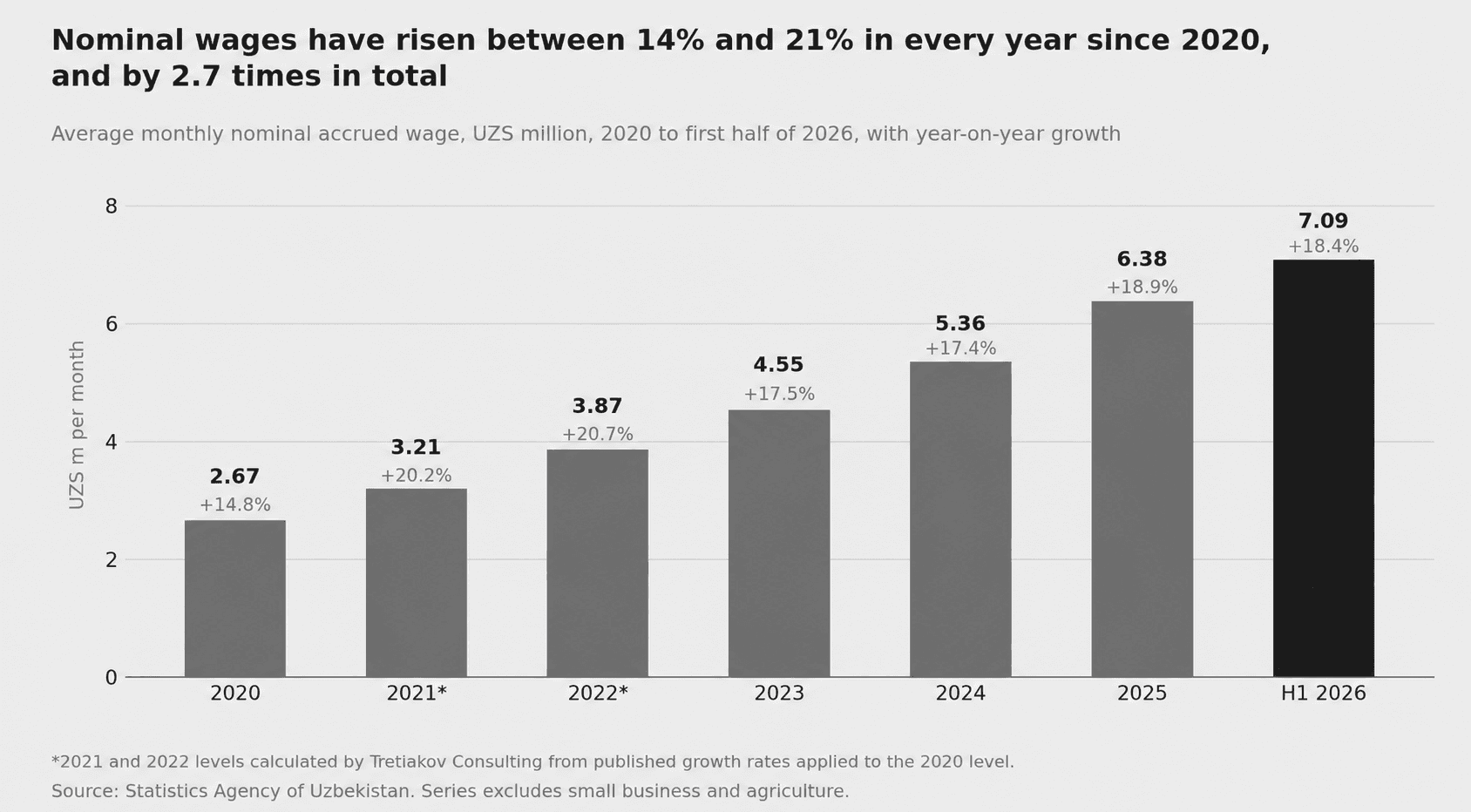
Average monthly nominal accrued wage with year-on-year growth. Series excludes small business and agriculture. Statistics Agency of Uzbekistan, via published releases
The compounding matters here more than any single year's increase. A company that set its Uzbek payroll assumptions on the 2023 average of 4,551,000 soum was budgeting against a market that stood 56% higher by the first half of 2026. Two qualifications belong with the series and both change how it should be read. It excludes small business and agriculture, so it is weighted towards formal and public-sector employment and does not describe the whole labour market. It also averages across a wide internal spread, with Tashkent city at 12,014,000 soum in the first half of 2026 against the national figure of 7,091,000, a gap of 1.7 times. A cost model built on the national average will be wrong in both directions depending on where the operation sits.
The supply of labour is large and unevenly available across the country. The labour force reached 14.64 m in 2025, while informal employment was put at 4.8 m, or 33% of those in work, in the third quarter of 2025. Around 1.4 m citizens were working abroad as at August 2026. Youth unemployment among those aged between 15 and 24 stood at 11.38% in 2025. The national unemployment series is not used here, because the published fall coincides with an announced change of methodology and the segments either side of it are not comparable.
On skills the survey evidence is more moderate than the shortage commentary suggests. In the 2024 Enterprise Survey 10.5% of firms named an inadequately educated workforce as their single biggest obstacle, above the regional figure of 7.2% and well below the 16.9% recorded across lower-middle-income countries.
The statutory employment framework itself has moved towards the employer since 2023. The Labour Code in force since 30 April 2023 sets notice at two months, two weeks or three days depending on the ground. It caps severance at 200% of one month's average earnings even after more than fifteen years of service, which places the top of the redundancy scale at roughly four months of pay. Employment of a foreign national is itself a statutory ground for a fixed-term contract. Against that, every contract must be registered in the national labour system within five working days. A presidential decree of 4 August 2025 directed that penalties for informal employment be set at 30 base calculation units for a first offence and 100 for a repeat.
Hiring foreign managers is governed mainly by price and by qualification. No numerical cap on foreign workers was found in the sources reviewed, and what the reviewed acts do establish is a fee gradient and a salary threshold. Under Cabinet of Ministers resolution 86 of 22 February 2022 a work confirmation for an ordinary foreign worker costs 30 base calculation units and lasts one year. A highly qualified specialist pays one unit and receives three years renewable, and the employer permit costing 50 units is not required at all for the qualified categories. The thresholds that open the cheaper route were set in 2018 at annual remuneration of USD 60,000 for a highly qualified specialist and USD 30,000 for a qualified one. Processing takes 15 working days and is handled electronically through the state portal. Residents of the IT Park need no permit at all for foreign staff, though the privilege travels with the residency. Between January and mid-September 2026, 943 resident companies were struck off that register for compliance failures, and the exemption lapses with the status.
The Primary Record Sits in a Language the Parent Cannot Read
Records management, accounting, statistical and financial documentation must be maintained in the state language in all organisations, with no exemption based on ownership. Other languages may be used alongside Uzbek where most employees do not speak it, which is a permission to add rather than to substitute. A chief accountant must also hold three years of relevant experience within the last five, or seven within the last ten. In practice those two requirements together create a strong need for Uzbek-language capability inside the local finance function or immediately supporting it. The primary record set of an Uzbek subsidiary therefore contains a mandatory Uzbek-language layer, which a foreign parent cannot review independently unless it maintains that capability itself.
That is a control problem and not merely an administrative one, and it sits alongside three obligations that enlarge the record. International Financial Reporting Standards have been mandatory since 1 January 2021 for joint stock companies, banks, insurers, large taxpayers and entities with state participation, under resolution PP-4611 of 24 February 2020. The Law on Audit Activity of 25 February 2021 brought statutory audits onto international standards through registered audit organisations. Electronic invoicing through the state platform has been compulsory since 2020. Those reporting standards do not reach every company, since an ordinary mid-market subsidiary outside the listed categories converts for the group itself. Either way the statements a foreign parent reads are prepared in one language and one framework on top of a record kept in another, by people working to different rules.
Compliance exposure has recently been sharpened in a way that reaches contracts directly. Law ZRU-1155 of 22 June 2026 allows courts to invalidate contracts arising from corruption violations and restricts persons entered on the corruption register from participating in state procurement. The compliance-structure obligations introduced alongside it fall on state bodies and not on private companies, and no statute imposing an anti-corruption compliance function on private companies was found in the sources reviewed. The exposure a company carries is therefore contractual and procurement-related rather than organisational, which changes where the control has to sit.
Several of the Most Quoted Improvements Are Dated 2027 or Later
The distinction between what is in force, what is funded and what is declared decides how much of the improving picture can be relied on in a plan that starts now.
In force and operating are the risk-based inspection regime from 1 January 2025 and the Registry of Obligations from 1 December 2024. So are the QR payment mandate from 1 July 2026, the annual energy tariff schedule and the three-year inspection moratorium for small business from 28 August 2026. Adopted but not yet effective are the initiative audit for medium and large business from 1 January 2027 and the shift of the evidential burden towards state bodies in disputes with entrepreneurs, also indicated for 2027, whose implementing procedure has not been published.
Declared as goals, and carrying no enforceable entitlement for any company, are the targets in the national strategy to 2030. The 2023 instrument that carried them, decree UP-158 of 11 September 2023, was repealed with effect from 17 February 2026 and replaced by decree UP-21 of 16 February 2026, which approved an updated strategy for the period from 2026 to 2030. Its operating-environment content raises the private sector to 85% of the economy, reduces enterprises with state participation from about 2,300 to 383 and targets USD 250 bn of investment. Citing the 2023 decree as the live instrument after February 2026 is citing a repealed act.
Accession to the World Trade Organization sits between the two categories. The thirteenth working party meeting was held on 27 and 28 July 2026, by which point 31 of 34 bilateral market access agreements had been submitted to the Secretariat and 190 legal and regulatory acts had been aligned. The government restated its objective of completing accession during 2026 while acknowledging that adoption of several laws was slower than expected. Membership would bind tariff and regulatory commitments that are currently policy, which is precisely why the distinction between a stated target date and a concluded protocol matters to anyone modelling import costs beyond 2027.
Monetary policy carries a similar caveat, which concerns dates and not direction. The Central Bank's 5% inflation target is now pointed at 2027, having been re-dated before, while the bank reduced its own forecast for the end of 2026 from about 7% to 6.5%. The IMF projects 6.8% for 2026 and 5.0% for 2027, and the Asian Development Bank projects 6.5% and 5.0%. The direction is agreed across the forecasters, and the arrival date has moved.
One counter-current deserves attention because it works against the general devolution narrative. A law of 17 October 2024 barred khokims from chairing local councils, separating executive and representative roles. A presidential decree of 21 October 2025 then folded the local units of nine ministries into khokim structures across 45 districts and cities from 1 January 2026. Khokims gained the power to appoint and dismiss that staff under a performance regime that adds 15% to the infrastructure budget on hitting targets. The first public ranking of khokims by investment efficiency was published in May 2026 on 2025 data, measuring capital actually deployed and project launch rates. A foreign investor's construction timetable is, in that system, a named official's personal performance indicator, which cuts in both directions depending on whether the project is on schedule.
What Decides Whether the Framework Predicts a Company's Outcome
The evidence reviewed points to a small number of variables that determine how far the written rules will describe what a particular company experiences. A board able to answer these can say where its Uzbek exposure actually sits.
Counterparty composition. The divergence between judgment and collection, and the exclusion of majority state-owned entities from the 2026 receivables settlement, both indicate that exposure concentrates by counterparty type more than by sector. A revenue base weighted towards state and quasi-state buyers carries a different working capital profile from one weighted towards private distributors.
Dependence on allocated physical inputs. Land is leased for a maximum of 25 years and cannot be owned. Energy is contracted in volumes with a 20% tolerance. Where a business model depends on either, the binding constraint is administrative allocation and not price, and it belongs in the feasibility case.
Source of working capital. A real cost of soum funds near 15%, industrial credit contracting while total credit expands, and no dated end to directed lending together mean that onshore local-currency funding of capital expenditure is a weak assumption for a mid-market operation.
Location of the decision and of the record. Primary records carry a mandatory Uzbek-language layer, and the wage gap between the capital and the national average runs to 1.7 times. Both push towards a deliberate answer on which decisions are taken in country and how the parent verifies them, which is where decision rights become an operating model questionrather than a staffing one.
Sensitivity to the 2027 changes. The evidential burden in disputes with state bodies, the audit regime for medium and large business and the outcome of accession negotiations all land in or after 2027. A company whose case depends on them is relying on measures that have been re-dated before.
Conclusion
The formal framework for doing business in Uzbekistan has improved substantially and is described accurately by the available guides. State control over operating companies has contracted to a fraction of its former reach, more than 400,000 commercial cases reached the economic courts in 2024, and the procedures a company meets on arrival are fast and largely digital. Nothing in the evidence reviewed contradicts that account of the rules.
The answer to the question this article set is that the framework predicts the first half of a process and stops predicting the second. Obtaining a judgment is a sixty-day procedure, while converting it into cash depends on an enforcement record that 73% of surveyed entrepreneurs raised as a problem in 2026. Obtaining an electricity connection takes five days, while the contracted volume behind that connection is negotiated against domestic gas output that has fallen for more than a decade. Even the protections work this way, since the moratorium announced in August 2026 turns on the small-business classification and reaches a larger company only through the narrower requirement that repeat inspections be authorised.
That makes the management task narrower than country risk and more specific than compliance. It is to identify which of a company's processes depend on an institution whose outputs the written rules do not predict. The counterparty terms, the funding structure, the input contracts and the decision rights are then designed around those processes rather than around the framework as published. The guides remain the right place to start, and they stop at the point where most of the operating result is determined.
Tretiakov Consulting advises owners, boards and executives on operating in Uzbekistan and across Central Asia. Discuss a live mandate.