
ILLIA TRETIAKOV
Founder

On 1 September 2026, 4,758 of the 21,490 operating enterprises with foreign capital in Uzbekistan were joint ventures, a share of 22.1%. In August 2018 joint ventures were still the majority, at 54.5% of the total, and since then the number of wholly foreign-owned enterprises has grown almost sixfold. A joint venture in Uzbekistan is therefore no longer the default way into the market. It has become a deliberate choice, made most often in industry and, relative to their overall presence, by investors from the United Kingdom, Germany and the United States.
That choice is now made under a new set of corporate and state rules. Law ZRU-1137 on limited liability companies, in force since 22 July 2026, replaced a statute from 2001 and reset the rules on boards, related-party deals, deadlock, minority rights and exit in the corporate form that most ventures use. The state, which holds stakes in ventures across the automotive, energy and chemical industries, is meanwhile selling some holdings and tightening control over others. This article examines what a foreign investor can establish about a partner before signing, what a stake in an Uzbek joint venture then secures in control, exit and access to cash, and what changes when the partner is state-owned. It draws on register data to 1 September 2026 and on the texts of the new law and of the decrees on state holdings, as part of our work on Uzbekistan.

Share of joint ventures in operating enterprises with foreign capital, August 2018 to September 2026, based on National Statistics Committee releases for 1 September 2026 and 1 January 2026, with earlier points as published for January 2025, January 2024, June 2023 and August 2018.
The Joint Venture Is Now a Minority Route That Holds Up Best in Industry
The enterprise counts in this article come from the monthly register releases of the National Statistics Committee, which count operating enterprises and say nothing about capital invested or revenue. The releases divide these enterprises into joint ventures, which also have Uzbek participants, and foreign enterprises, which are wholly owned by foreign investors. Money values elsewhere in the article are nominal and shown in the currency the source reports, with USD equivalents only where the source gives them. The series breaks in 2023, when the count fell from 15,801 on 1 January to 12,807 on 1 June, so levels on either side of that year are not directly comparable.
Measured as a share of all foreign-capital enterprises, the decline has been uninterrupted. The Committee's release for 1 September 2026 states that the wholly foreign-owned share rose from 56.2% to 77.9% over five years, which puts the joint venture share at 43.8% in September 2021. The change came mainly from the growth of wholly owned entry, since the number of joint ventures rose by just over a third between August 2018 and September 2026.
In absolute terms the count has been less stable than the share. Joint ventures fell from 4,657 on 1 January 2024 to 3,965 a year later, and the reviewed releases give no official explanation for the drop. The number then recovered to 4,758 by 1 September 2026, rising by 12.0% in the first eight months of 2026 alone. Wholly foreign-owned enterprises grew faster over the same months, which is why the share kept falling while the count rose.
The form has held up best in the production sectors of the economy. Industry accounts for about a third of all joint ventures, and more than a third of industrial enterprises with foreign capital take this form, against about one in seven in trade and in information and communication. An earlier note described the joint venture as the pragmatic default in many sectors, and the register bears that out for industry and agriculture far more than for services. The form is also more common outside the capital, where it accounted for 27.1% of foreign-capital enterprises on 1 September 2026, against 19.1% in Tashkent city.
The origin of capital separates investors even more sharply than sector does. Investors from the United Kingdom, Germany and the United States organise more than 40% of their Uzbek enterprises as joint ventures, about twice the share across all countries. Chinese capital, now the largest source by number of enterprises, uses the form in about one case in seven, while Russian capital holds the largest number of joint ventures in absolute terms. The statistics do not explain these differences, and none of the sources reviewed links them to sector mix or deal size.
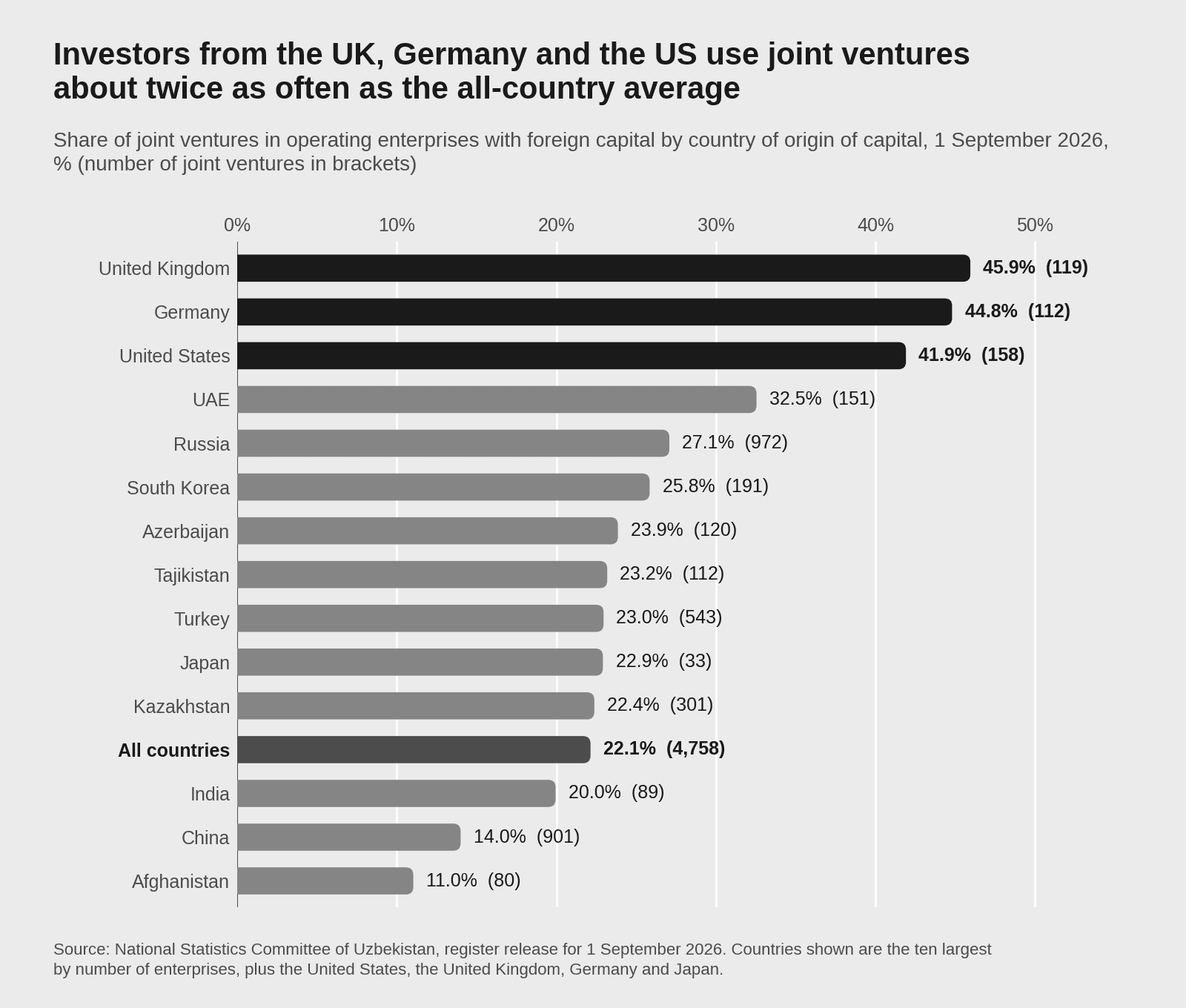
Share of joint ventures by country of origin of capital on 1 September 2026, calculated from the country table in the National Statistics Committee register release.
One question the register cannot answer is who the Uzbek partner is. No published series separates joint ventures with state-owned partners from those with private ones, and no count of state enterprises with foreign partners was found in the official sources or in the International Monetary Fund (IMF) reports reviewed. The rest of this article works from the legal framework and from individual ventures whose ownership is public.
What Can Be Established About a Partner Before Signing
Selecting a partner starts with the state register, which under the new law is the reference point for ownership. A stake in a limited liability company (LLC) passes to a new holder only when the change is entered in the Unified State Register, so the participants of a partner's company are the ones recorded there. Registration on its own says much less about whether a company actually trades. On 1 January 2026, almost three in ten registered enterprises were classed as inactive. Of the 3,836 enterprises with foreign investment created between January and August 2026, only 568 had started to earn income by 1 September, the Committee's release shows.
What a partner brings into the venture is tested at founding. The new law requires all participants to confirm the value of non-cash contributions unanimously, and contributions worth more than 10,000 times the base calculation amount must be valued by an appraisal organisation. Each participant pays in full within the term set in the founding agreement, which cannot exceed one year from registration. A participant that falls short can be excluded through the courts on an application by the executive body where the shortfall obstructs the company's work. Where a partner contributes property instead of cash, these rules decide the value at which it enters the charter capital.
Related parties are easier to trace once the venture exists, because the new law defines the company's affiliated persons and requires deals with them to be disclosed. A state partner raises a separate question of financial capacity, since the IMF found that fewer than half of the 2,148 state enterprises it reviewed reported a profit in 2024. The wider test of whether a partner's advantage can be inspected and will last is set out in our analysis of entry routes into Uzbekistan. Screening, governance terms and the cost of exit belong to the same stage of partner selection and joint venture governance, before a charter is agreed.
What a Stake Buys Under the 2026 LLC Law
Most joint ventures sit inside an LLC, and the register's own arithmetic supports that. On 1 September 2026 Uzbekistan had 366,051 operating LLCs, 80.2% of all business entities, and only 648 joint stock companies (JSCs). Even if every JSC in the country had a foreign shareholder, at least 86% of joint ventures would be organised in another form, which for a company with several participants points to the LLC.
Law ZRU-1137 of 21 April 2026 entered into force on 22 July 2026 and replaced law 310-II, which had governed limited liability companies since 2001. An amendment made by the constitutional law on the Tashkent International Financial Centre (TIFC) took effect three days later. According to a July 2026 review of the law, it contains no requirement for existing companies to re-register or replace their charters by a set date.
The law allows the charter to separate the size of a stake from the weight of its vote. Each participant votes in proportion to its share of the company's capital, but a different order may be set at founding or later by a unanimous decision of all participants. A core group of decisions, including any capital increase, needs at least two-thirds of all participants' votes, and the charter may add matters to that list or raise the threshold.
For a joint venture this makes the charter the place where control is set. Where votes stay proportional to stakes, a partner holding 51% decides the matters left to a simple majority, and a partner holding two-thirds carries every matter left at the statutory threshold. Any other allocation of votes changes both of these results. The protection of the smaller partner then depends on which decisions the charter moves into the qualified list or places under a higher bar, so the same equity split can support very different balances of control.
The supervisory board remains optional, and where the charter creates one it defines the board's powers, which may include appointing the executive body and approving major transactions. The quorum cannot be set below 75% of elected members, decisions by written poll need two-thirds of members unless the charter provides otherwise, and a member cannot pass a vote to anyone else. Board terms run for three years unless the constituent documents say otherwise.
The quorum rule has a practical consequence for a venture with two partners. On a three-member board every member must attend for a meeting to be valid, and on a five-member board a partner with two seats can keep a meeting from being quorate. The law itself does not describe this effect of the quorum as a veto. In practice the arithmetic still gives board composition a weight that the equity split does not show.
Management appointments follow the same logic, because the general meeting appoints the executive body unless the charter passes that power to the supervisory board. Once appointed, the director owes the fiduciary duties now set out in Article 44, which commentaries on the law describe as duties to act in good faith, reasonably and in the company's interests. Where unlawful acts by a director, a board member or a participant cause insolvency, Article 4 allows subsidiary liability, which becomes joint where several persons caused the harm. For a director seconded by one partner, the first duty runs to the company, and the nominating partner's influence works through the charter and the board. The distance between formal authority and the authority a partner actually exercises is examined in our note on decision rights inside Uzbek businesses.
Agreements between the partners now rest on a firmer legal base. Since May 2025 Article 358-1 of the Civil Code has recognised a corporate agreement, under which participants may agree to vote in a coordinated way, to manage the company jointly, and to buy or sell stakes at a set price or when defined circumstances occur. The agreement binds only its parties, and terms that oblige parties to vote as the company's bodies instruct, or that set the structure and powers of those bodies, are void.
Two further rules decide in which document each negotiated term belongs. The new law gives the charter priority over the founding agreement for participants and third parties, and under Article 358-1 the parties to a corporate agreement must notify the company within 15 days that it exists, without disclosing its content. Reserved matters meant to bind the company therefore belong in the charter, while options, lock-ups and voting commitments between the partners belong in the corporate agreement.
The new procedure for affiliated-party deals matters wherever a partner supplies technology, inputs or services to the venture it co-owns. Articles 55 to 59 define the company's affiliated persons and require deals with them to be disclosed, studied before signing and approved, and a July 2026 review of the law adds that the results go into the company's annual report. A person with an interest in the deal may not take part in its discussion, and an advisory firm's note describes limits on such persons' voting and the right to challenge the deal.
For a deal worth 10% or more of net assets, the law also brings in an appraisal organisation and an audit organisation, which the same note describes as a market valuation and an external auditor's review of the terms. Approval of such contracts rests with the other side of the venture, since the interested party cannot vote on them. In a venture built around supply or licence agreements with one partner, the procedure covers the contracts on which the venture's economics rest.
The new statute widens the protection available to minority participants in several ways. Any single participant can now demand an extraordinary general meeting, and the law allows minority participants to form a committee that, according to a law firm's overview, the supervisory board and executive bodies cannot interfere with. A person that acquires 50% or more, other than the state, must offer to buy the remaining participants' stakes at market value, and the deadline for that offer has been halved.
The 2026 law updates the statutory rules on exit, deadlock and minority rights
Selected rules for limited liability companies before and after 22 July 2026
Rule | Law 310-II of 2001 | Law ZRU-1137 of 2026 |
|---|---|---|
Withdrawal of a participant | At any time, without consent | Without consent, in the manner set by the law and constituent documents |
Deadlock between participants | Court | Court, or mediation or arbitration if the constituent documents provide |
Extraordinary general meeting | Participants with 10% of votes | Any single participant |
Buy-out offer after acquiring 50% | Within 30 days | Within 15 days |
Minority participants' committee | Not provided | Provided for |
Compiled from the texts of law ZRU-1137 and law 310-II, with the earlier rule on extraordinary meetings as described in a May 2026 advisory firm review.
A State-Owned Partner Brings Rules That Sit Outside the Charter
The state still accounts for a large part of the economy, and its own portfolio of enterprises is changing. The official count presented at a presidential meeting on 6 April 2026 was 1,685 state-owned enterprises in operation, with the state's share of the economy put at 42%. The IMF's June 2026 analysis of state-owned enterprises, which uses the database of the Agency for Management of State Assets, gives a higher count for the end of February 2026, and the sources do not reconcile the two.
The same IMF analysis shows how much the portfolio has changed shape since 2020. Liquidation and reorganisation account for most exits from the database, privatisation for fewer than one in five, and more enterprises entered the database than left it through liquidation. As a result, the partner a foreign investor signs with may be restructured, merged into another holding or transferred during the life of the venture.
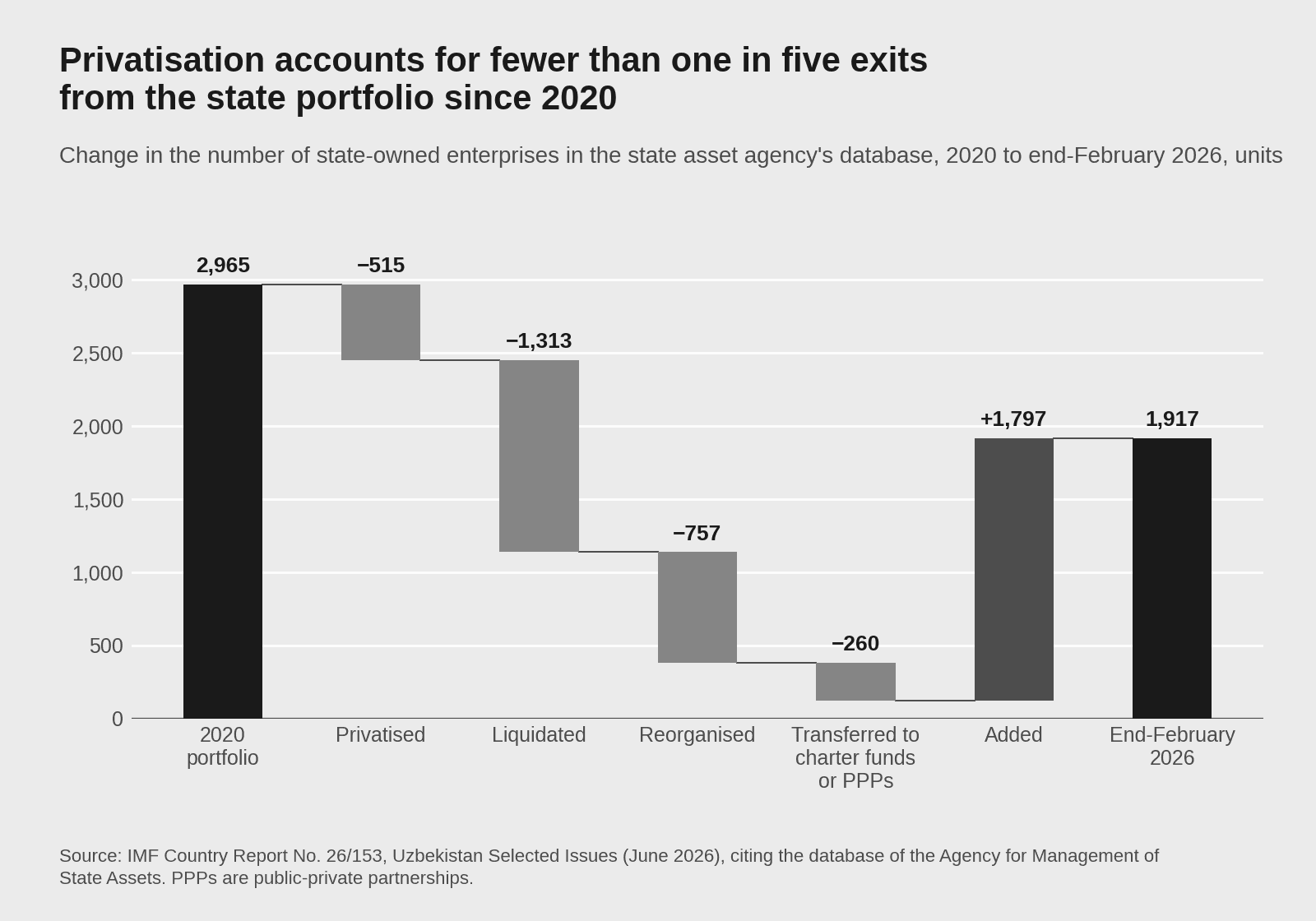
Change in the number of state-owned enterprises in the state asset agency's database from 2020 to end-February 2026, from the IMF Selected Issues paper on Uzbekistan, June 2026.
Whether a joint venture itself falls under the state asset rules depends on the size of the state's stake relative to the other partners. Law ZRU-821 on the management of state property treats as an enterprise with state participation any company in which the state holds more than 50%, or a stake larger than that of each other participant. A venture in which a state body, such as the state asset agency, holds the largest single stake falls within the regime even without a majority.
Creating such a venture has become harder since 2025. Decree UP-70 of 21 April 2025 imposed a moratorium on new enterprises with state participation that runs to the end of the decade, with exceptions for defence and security and for cases decided by the President. An amendment of 28 February 2025 also bars the creation of state enterprises and their affiliates in markets where five or more private companies already operate. Where a new venture does qualify, it needs an order of the state asset agency, and third-party investment into an existing state enterprise is agreed with the agency under resolution PP-101.
Once the state holds half of a venture or more, its purchasing changes as well. The public procurement law treats companies with a state share of 50% or more, and companies at least half owned by them, as corporate customers bound by its procedures. Above 50% the new LLC law also requires at least one independent member on the supervisory board. For a foreign partner that supplies such a venture, the procurement rules and the affiliated-party procedure can apply to the same contract.
A state partner carries dividend expectations of its own. Under resolution PP-101 the dividend on a state stake is proposed to the general meeting in agreement with the state asset agency. Companies at least half owned by the state that have sold shares to the public must pay out at least 30% of net profit for at least seven years under resolution PP-291.
Behind a state partner there is often more than one layer of ownership. State stakes in 31 large companies were placed under the management of the investment company UzAssets by resolution PP-83 of 1 March 2023, and the National Investment Fund holds minority stakes in 13 companies. Sector holdings also own stakes in ventures within their industries, as Uzavtosanoat does in an electric vehicle plant built with a Chinese carmaker and Uzkimyosanoat in a green hydrogen venture. The body that signs the joint venture agreement can differ from the one that approves the budget, appoints board members or receives dividends.
Equal ownership has not settled control where the partner is a state holding with its own reporting lines. In August 2026, at a meeting chaired by its head, Uzbekneftegaz required the upstream ventures in which it holds 50% to agree all planned activities, investment projects and work processes with it, after annual declines in output and incomplete dividend payments. The ventures concerned include partnerships with Chinese and Russian state oil companies and with a private holding. The decision moved day-to-day approvals towards the state partner while its 50% stakes stayed unchanged.
Deadlock and Exit Now Depend on the Constituent Documents
The new law addresses deadlock between participants directly, in Article 8. Where irreconcilable differences leave the participants without enough votes to decide, the conflict goes to court or, if the constituent documents provide for it, to mediation or arbitration. Under a law of 20 October 2025, a mediation agreement can be enforced through a court writ if the application is made within six months, which shortens the route from a mediated settlement to enforcement.
A domestic forum for that arbitration has developed at the same time. The director of the Tashkent International Arbitration Centre (TIAC) reported that more than 60% of cases registered in the first half of 2026 involved two foreign parties, and that every TIAC award submitted to Uzbek courts for enforcement had been enforced. These figures are self-reported by the centre, and no official year-by-year caseload appears in the sources available.
Exit through the company remains a statutory right under the new law. Article 9 lets a participant leave without the consent of the others, in the manner set by the law and the constituent documents, and the charter must describe the procedure and consequences of withdrawal. The company then pays the actual value of the share, based on its accounts for the last reporting period, and cannot distribute profit until it has done so.
For a joint venture the right therefore sits in the statute, while the terms of its exercise sit in the charter and in the founding agreement, which must also set out how participants leave. The law does not say whether the company's documents can rule withdrawal out, and commentators read the removal of the words 'at any time' as giving those documents and the partners' agreements more weight over how a partner leaves. How far they can constrain the right is not settled by the texts reviewed, so neither an unconditional exit nor an outright ban can be taken for granted.
Sales between partners and to outsiders follow a different track. The other participants hold a pre-emptive right for one month, a sale to a third party is allowed unless the charter prohibits it, and the charter may require the consent of the company or the participants. Options and buy-out triggers agreed in a corporate agreement sit on top of these rules. Participants holding 10% together can ask a court to exclude a participant that fails its obligations or obstructs the company's work.
A buy-out between partners can also require clearance from the competition authority. Under the competition law, acquiring more than a third of an LLC's charter capital or more than 25% of a JSC's voting shares needs prior consent where the parties' assets or revenue exceed set thresholds. Founders forming a new company are exempt from this requirement. Forming a joint venture falls outside this consent, while a later buy-out of one partner by the other can fall within it. A companion note traces how the same questions are handled in joint ventures in Kazakhstan.
A State Sale Can Change the Partner During the Life of the Venture
Privatisation can turn a state partner into a seller during the life of a venture. Decree UP-177 of 28 August 2026 set targets for 2026 to sell stakes in 84 companies and 1,242 property assets, with lists of assets for sale in 2026 and 2027. The lists include stakes in at least two joint ventures, among them a 54.76% stake in a cylinder-making venture.
The decree also introduces a temporary special right that the state may keep in strategic companies after their sale, and the content of that right is not specified in the decree beyond its disclosure before a sale. Buyers can pay 15% within 30 daysand, if half the price is paid within six months, spread the rest interest-free over up to seven years. The sale itself follows privatisation law ZRU-907, in force since 16 May 2024, which provides for auctions, tenders, public invitations to negotiate, competitive dialogue and exchange trading. It also allows direct sale at market value by a presidential act. How pre-emptive rights under the LLC and joint stock company laws interact with a privatisation auction is not spelled out in the texts reviewed, and practice since 2025 has produced three different outcomes.
In a bus and truck maker in Samarkand, where the state held 75.2%, the stake was offered through negotiations with a single bidder, a Turkish commercial vehicle maker, with an open auction as the fallback. The buyer paid USD 80 m and committed a further USD 80 m of investment, and the Japanese partners in that venture backed the sale of their own stakes to the same buyer. The purchase agreement was signed in November 2025, and the deal closed the following month. In a tobacco joint stock company almost wholly owned by a British group, the foreign majority used its pre-emptive right in September 2025 to buy the state's remaining 2.6% for USD 22.3 m.
The third case, in automotive components, ended with a new domestic partner for the foreign investors. The venture was owned half by the state asset agency and half by two Korean companies. The state's stake went to an open electronic auction on 1 June 2026 and sold for UZS 585.82 bn, about USD 49 m, 50% above the starting price. The winner, a domestic automotive group, must keep the company's main activity for at least ten years, and no purchase by the Korean partners was reported.
In one case a state sale brought in a negotiated buyer to which the foreign partners agreed to sell as well, and in another it left a foreign majority with virtually the whole company. In the third it introduced a new domestic partner chosen at auction. Each outcome followed from the sale method the state chose and from whether a partner exercised a pre-emptive right. The bidding process for such stakes, from valuation to the changes that follow an acquisition, is examined in our note on how foreign investors take part in privatisation.
Dividends Pass Several Tests Before Cash Leaves Uzbekistan
Under the new law an LLC may decide to distribute profit quarterly, half-yearly or annually, the general meeting takes the decision, and payment is due within 60 days. Article 26 divides profit in proportion to stakes and, unlike the voting rule, contains no exception allowing the charter to set a different split. Distribution is barred while charter capital is unpaid, while a departing participant has not been paid, when the company shows signs of insolvency, or when net assets fall below charter capital and the reserve fund.
For ventures in which the partners' contributions differ in kind, this means the statute lets voting depart from stakes but keeps profit tied to them. Any return that does not follow the stake then comes through contracts with the venture, and those contracts pass through the affiliated-party procedure described above. The state partner adds its own pressure on payout, as the Uzbekneftegaz decision and the minimum payout for listed state companies show.
Once declared, a dividend can be converted and transferred abroad under Article 17 of the investment law, which guarantees the free transfer of foreign currency out of Uzbekistan once taxes are paid. The state may suspend such transfers on grounds that include insolvency and court decisions. How conversion, court judgments and the enforcement of arbitral awards work in practice is set out in our analysis of operating conditions in Uzbekistan.
Tax then separates the two corporate forms that joint ventures use. Dividends paid from an LLC to a non-resident bear a 10% withholding tax. Dividends on JSC shares paid to non-resident companies are taxed at 5% under resolution PP-90, a relief that resolution PP-291 extended to 31 December 2028, and an extension to 2038 was proposed in August 2026. A non-resident's gain on selling a stake is taxed at 20%, subject to double tax treaties, which makes the exit route a tax question as well as a governance one.
What Is Scheduled Between Now and 2031
For 2026 as a whole, the pace of January to August allows a simple estimate. Extending the average monthly change of those eight months to a full year gives about 5,000 joint ventures and about 23,150 enterprises with foreign capital on 1 January 2027, a joint venture share of about 21.7% (Source: Tretiakov Consulting). The estimate assumes that the pace of the first eight months holds for the last four.
Beyond 2026 no published forecast covers the number of joint ventures, and extending the trend would introduce an assumption that the data do not support. The policy calendar around state partners and holding structures, by contrast, can be dated with some confidence. The table below lists the measures that will shape a joint venture in Uzbekistan over the next five years, with the status of each on 24 September 2026.
Most dated measures affecting joint ventures fall between 2026 and 2030
Scheduled measures and their status on 24 September 2026
Measure | Timing | Status |
|---|---|---|
Sale of state holdings under decree UP-177, including joint venture stakes | 2026 to 2027 | In force since 8 September 2026 |
Privatisation receipts of at least UZS 14 trn | By the end of 2026 | Expected by the state asset agency |
Listing of Uzbekistan Airways | 2027 | Planned, according to the Deputy Prime Minister |
Listings of Almalyk Mining and Metallurgical Complex and state energy, telecom and airport companies | 2027 to 2028 | Scheduled in resolution PP-145 |
Moratorium on new enterprises with state participation | Until 1 January 2030 | In force |
Non-state share of the economy at 85% | 2030 | Target in decree UP-70 |
Tashkent International Financial Centre under English common law | From 25 July 2026 | In force, bodies being formed |
Compiled from decree UP-177, the state asset agency's September 2026 statement, the government's statement on the airline listing, resolution PP-145, decree UP-70 and law ZRU-1158.
The TIFC adds a new structural option for joint ventures and their holding companies. Its constitutional law applies the common law and equity of England and Wales within the centre, creates the Tashkent International Commercial Court, lists holding companies and special purpose vehicles among permitted activities, and carves the centre out of the LLC law. A decree of 10 September 2026 set out the first organisational steps. Whether an operating venture, or only its holding company, can use the centre depends on participant requirements that the centre's council has yet to set.
On the state side the calendar points one way. The moratorium limits new ventures in which the state would hold a majority or the largest stake, while the sale programmes and the planned listings move existing stakes towards private and public shareholders. The National Investment Fund, which initially raised USD 603.6 m in its May 2026 listing, with an over-allotment option that could take the total to USD 692 m, shows that part of that schedule is already being carried out.
Conclusion
The register describes a form that foreign investors choose less often than in 2018 but still use widely in industry and relatively more often outside the capital. Before signing, the register shows who holds a partner's company and the rules on contributions fix what it brings, while the regime for affiliated persons exposes related parties once the venture operates. Under the law in force since July 2026, votes can be separated from stakes through the charter, board powers and quorum are regulated in detail, deadlock can be sent to mediation or arbitration, and options between partners rest on the Civil Code. What a stake secures therefore depends on the charter and the corporate agreement written around it, and the same 51% can carry firm control in one venture and very little in another.
Some rules still sit above anything the partners write into the documents. Profit is divided in proportion to stakes under Article 26, which contains no exception, and a corporate agreement binds only the partners who sign it, which is why terms meant to bind the company have to sit in the charter. The right to leave without the others' consent also remains in the statute, although its procedure now depends on the company's documents and the texts reviewed do not settle how far they can narrow it.
With a state-owned partner, part of the answer lies outside the venture's documents. The stake at which a venture becomes a state enterprise and the procurement rules that apply at 50% or more are set by law. The dividend agreed with the state asset agency and the chance that the state's stake is sold at auction are set by decrees and sale lists. A private partner's commitments can be written into the charter and the corporate agreement, while part of a state partner's position is fixed in acts of the state that the venture's documents cannot change.
Tretiakov Consulting advises foreign investors on partner screening, joint venture governance and the cost of exit in Uzbekistan. Discuss a live mandate
Our insights