

Production Localisation in Kazakhstan: In-Country Value, Offtake and Market Access
Production localisation in Kazakhstan is not a single rule, and it has not been one since 2021. It is a set of instruments that decide which suppliers are allowed to compete for institutional demand, how domestic production is recognised, and how future purchasing is committed before a plant exists. Those instruments were rebuilt between 2020 and 2026, and the money attached to them moved faster than the rules themselves.
The scale of that movement is visible in the one series published on a consistent basis. In 2023 the companies of the Samruk-Kazyna group signed contracts worth KZT 625bn with Kazakhstani producers for the supply of goods. In 2025 the same figure was KZT 2,177bn across 8,917 contracts, with in-country value in those purchases reported at 83%. Over the same five years the two documents that established who counted as a Kazakhstani producer were both abolished, the requirement that had underpinned local content in goods for the extractive sector was removed altogether, and the share of domestic supply in regulated procurement first fell and then recovered.
That sequence is the subject of this analysis, and it is easier to read against the wider operating and investment environment in Kazakhstan. The country did not simply raise a localisation requirement between 2020 and 2026. It dismantled one instrument under its World Trade Organisation commitments and built a different architecture in its place, one that works through eligibility, producer recognition and guaranteed offtake rather than through a headline percentage. The practical question for a foreign manufacturer is therefore not whether Kazakhstan requires local production, because in most product categories it does not. It is which pools of institutional demand open once production is recognised as Kazakhstani, and what that recognition now costs to obtain and to keep.
The period opens with the removal of local content, not its tightening
The starting position in 2020 was the end of a transition period rather than the beginning of an industrial campaign. Under the terms of accession to the World Trade Organisation, Kazakhstan undertook to phase out preferences tied to local origin, and from 1 January 2021 the requirement for local content in goods purchased by subsoil users was excluded. The country retained the right to set local content in works and services under subsoil contracts at a level of up to 50%, and the conditional discount applied to Kazakhstani suppliers of works and services was redefined at the same time.
The instrument that replaced it was descriptive before it became prescriptive. The Law on Industrial Policy of 27 December 2021, No. 86-VII, introduced in-country value as a defined and monitored category, together with offtake contracts, industrial assembly agreements and the register instruments that would later carry producer status. QazIndustry, the national industrial development institute, sets out the sequence plainly, noting that the amendments introducing in-country value followed the end of the WTO transition period and the removal of the local content requirement and were intended to allow monitoring and the design of new stimulation measures.
The measured effect of that transition was negative for domestic supply before it turned. Purchases by entities subject to in-country value monitoring amounted to KZT 19.3trn in 2021, and in-country value accounted for 56.2% of that spending. The share then fell to 53.5% in 2022 and to 49.7% in 2023, the first time in that period it had dropped below half, while the total volume of monitored purchasing grew by roughly a half over five years. By the first nine months of 2024 the share had recovered to 51.8% on purchases of KZT 21.2trn. Anyone dating the start of Kazakhstan's localisation drive to 2021 is therefore reading the policy correctly and the outcome incorrectly. The share of domestic supply fell for two years after the old instrument was withdrawn, and it began to recover only once the replacement instruments were operating.
Year | Change | Mechanism | Significance |
|---|---|---|---|
2021 | Local content in goods removed for subsoil users | Statutory requirement withdrawn under WTO accession terms | The central instrument of the previous system ceased to operate |
2021 | Law on Industrial Policy adopted | In-country value, offtake contracts, industrial assembly agreements | Localisation became a monitored outcome rather than a purchase condition |
2022 to 2024 | National regime exemption lists introduced and widened | Foreign goods excluded from eligibility by product group | Access turned binary by product rather than graded by percentage |
2024 | New Law on Public Procurement, effective 1 January 2025 | Single platform, exemptions, offtake from a single source | Support for domestic producers made explicit within treaty limits |
2024 to 2025 | Subsoil procurement rules amended | Minimum in-country value of 50% in works and services, 80% in design | A quantified requirement returned, in services rather than goods |
2025 | Preference in natural monopoly procurement | Conditional 10% reduction of the bid price | A graded advantage in demand funded through regulated tariffs |
2026 | Register of Kazakhstani Producers replaces the certificates | Continuously verified digital status | Producer recognition became conditional, monitored and revocable |

Figure 1. Sources. Reported data on in-country value in regulated purchasing, and the rules on industrial assembly agreements for motor vehicles.
What replaced the percentage was eligibility
The most consequential instrument of the current system is not a preference margin but the exclusion of foreign goods from eligibility in defined product categories. Government resolutions establish exemptions from the national regime for goods originating in foreign states, by list, with the standard formulation admitting goods produced by suppliers included in the register of domestic producers and excluding the rest. Exemptions run for up to two years and are renewed and extended by product group, most recently for light industry goods, works and services by government resolution of 4 March 2026. Ministry data reported at the end of 2024 recorded a more than threefold expansion of the covered list during that year, to 4,536 items.
The Law on Public Procurement of 1 July 2024, in force from 1 January 2025, carries the same logic into its statement of principles, which includes support for Kazakhstani producers of goods, works and services to the extent that this does not contradict international treaties ratified by Kazakhstan. That qualification is not decorative, and it explains why the architecture relies on product-level exemptions, registers and contractual instruments rather than on the economy-wide percentage removed in 2021.
Below that level the advantages differ substantially between procurement regimes, and a producer recognised in one pool does not automatically hold the same position in another. In public procurement the mechanism is eligibility itself, since foreign goods in listed categories cannot be offered at all, while producers included in the register also benefit from priority purchasing, advance payment and shortened payment terms. Within the Samruk-Kazyna group recognition opens a wider set of commercial instruments, including sixteen support measures in the fund's procurement rules, long-term contracts and offtake awarded from a single source, alongside the import substitution programme through which new products are brought into the fund's purchasing.
The natural monopoly regime is the one place where the system retains an explicit price advantage rather than an eligibility rule. Under the amended rules on the activities of natural monopoly entities, the tender commission applies a conditional reduction of ten per cent to the bid prices of Kazakhstani producers with effect from 9 September 2025. The same amendment replaced the previous term for domestic producer with a definition tied to inclusion in the new register. Two-stage tender procedures for domestic producers were introduced in the same body of rules a year earlier.
Subsoil users occupy a fourth position, and it is the only regime in which a quantified requirement has been restored. Recent amendments oblige subsoil users to procure among Kazakhstani producers where a domestic producer of the item exists, allow single-source purchases in those cases, and set minimum in-country value at 50% for works and services and 80% for design work. Those two percentages are frequently quoted as though they described Kazakhstan as a whole, which they do not. They apply to procurement by subsoil users and their contractors, a large pool of demand but a specific one, and they apply to services rather than to the supply of goods.
Producer recognition was rebuilt in 2026
The second structural change of the period concerns how production is verified. Until the end of 2025 Kazakhstani origin was evidenced by a certificate of origin in form ST-KZ, issued through the national chamber of entrepreneurs, and by an industrial certificate introduced under the Law on Industrial Policy. The scale of the older system was substantial and lightly differentiated, with around 70,000 ST-KZ certificates and roughly 1,500 industrial certificates issued since 2019.
The law of 19 May 2025 on the determination of the country of origin of goods replaced both. It introduced the Register of Kazakhstani Producers as an object of the electronic government infrastructure, containing information on Kazakhstani producers and the goods they make. Producers included in the register gain access to state support measures and to public and quasi-public procurement, and ST-KZ certificates and industrial certificates were removed from the legal framework. The register is maintained by the Ministry of Industry and Construction, developed and serviced by the single operator in public procurement, and published at e-ondiris.gov.kz, and the provisions establishing it took effect on 1 January 2026.
The operating rules, approved by ministerial order of 27 August 2025, are where the change of substance sits. An application requires information on the conditions of production and on the production and technological operations performed, including video material demonstrating the declared technological process. It also requires the in-country value share for each declared product, the identity of suppliers of raw materials and components, the cost of foreign-origin inputs, the cost of the finished good and the production capacity for each item. In-country value is calculated as one hundred per cent less the ratio of the cost of foreign materials to the cost of the good. Assessment may include an on-site inspection of the production facility, and the conditions and technological operations themselves are set by a separate ministerial order of 25 September 2025, with an appeals commission established by a further order of the same period.
Two features distinguish the register from the certificates it replaced. Status is now continuously verified rather than granted for a term, with monitoring by digital verification at least once a quarter and exclusion from the register if identified non-compliance is not remedied. The register also carries the in-country value percentage for each product, which previously sat on the certificate, and reporting forms in procurement have been amended so that the percentage is drawn from the register extract or, historically, from the ST-KZ certificate, with a value of zero recorded where neither exists.
The transition has been rapid in registration terms. More than 1,800 holders of industrial certificates were migrated automatically into the register in December 2025 to preserve continuity of status. By May 2026 the ministry reported 5,800 enterprises in the register, described as producers that had passed assessment of their production activity, and by the autumn of 2026 close to 7,000 producers had passed digital verification. Set against roughly 70,000 certificates of origin issued under the previous arrangements, the register describes a much narrower and more production-specific population, which is consistent with its stated purpose of confirming actual manufacturing rather than the origin of a consignment.
Requirements are set product by product, and some rise on a schedule
There is no single national localisation threshold in Kazakhstan, and constructing one would misrepresent the system. What exists instead is a set of conditions and technological operations defined for each product group, approved by ministerial order, against which an applicant's process is assessed. That is why the familiar framing of assembly against full production does not map onto the legislation, since the binding question is whether the specific operations required for that product are carried out in Kazakhstan.
Where the system does impose a rising path, it does so in named sectors and on dated terms, as the right-hand panel of Figure 1 shows. The rules on industrial assembly agreements for motor vehicles set a ladder for passenger cars and buses. From 2025 a producer must carry out welding and painting operations on not less than thirty per cent of the vehicles produced under the relevant customs code. From 2026 the threshold rises to forty per cent, with the alternatives of producing at least three models with welding and painting or using at least four components made by a Kazakh holder of a component assembly agreement. From 2027 it rises to fifty per cent, with the corresponding alternatives set at four models and four components. This is a genuine deepening requirement, but it is confined to vehicle assembly and its alternatives allow model coverage or component sourcing to substitute for the headline percentage.
Reported outcomes in adjacent sectors remain well below full localisation. The Ministry of Industry and Construction has reported that the level of localisation for individual product types in rail engineering has reached 35% to 40%. Within the Samruk-Kazyna group, in-country value in machinery procurement was reported at 46% for 2025, against a share of purchases directed to domestic producers of 76% in the same category. The gap between those two figures is the analytically important part, because a high share of procurement directed to domestic producers is entirely compatible with a moderate share of value actually created in Kazakhstan, since a recognised producer may still import the majority of the input cost.
The scale of procurement linked to domestic production
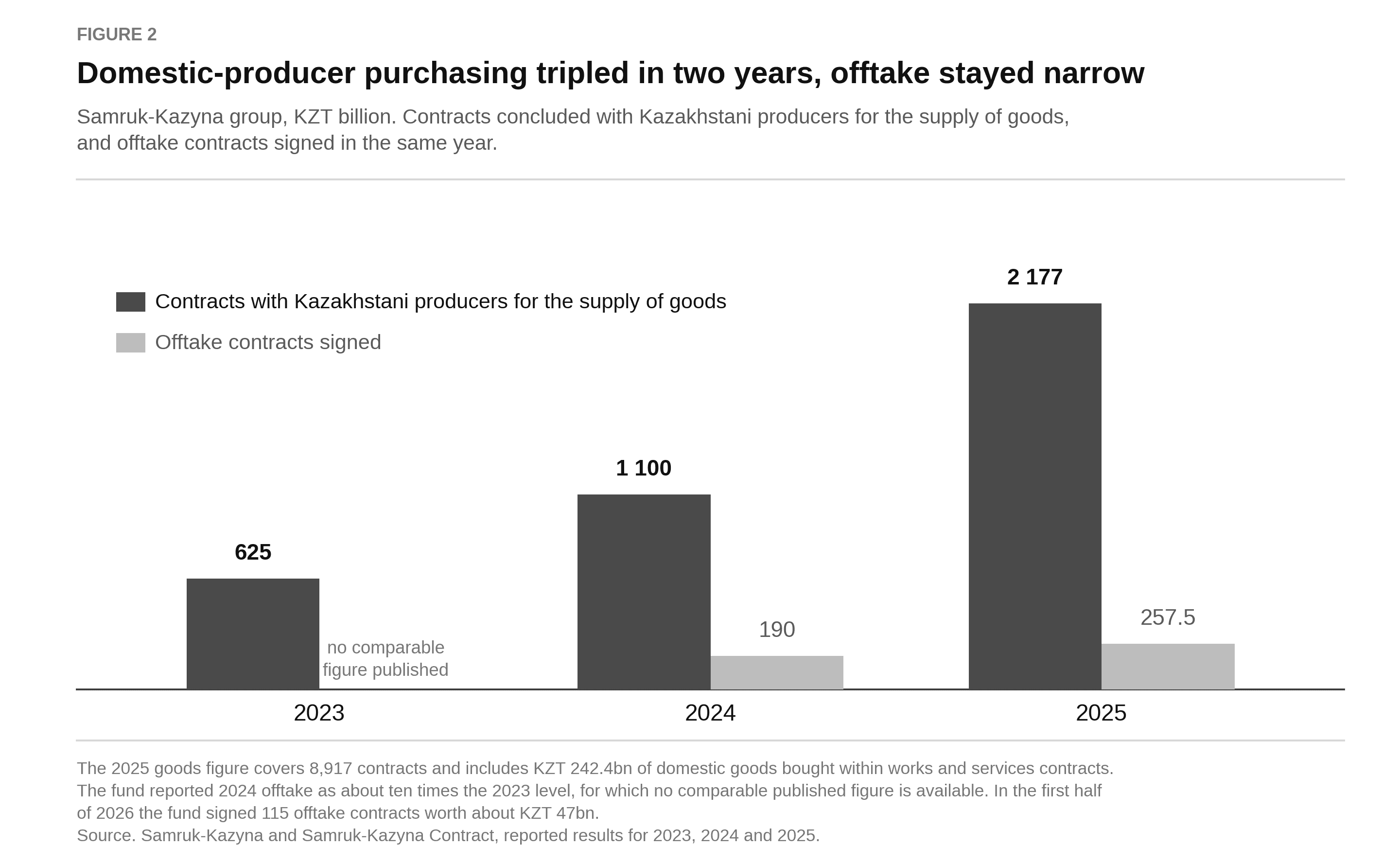
Figure 2. Source. Samruk-Kazyna and Samruk-Kazyna Contract reported results.
Series, KZT bn unless stated | 2023 | 2024 | 2025 | 2026, part year |
|---|---|---|---|---|
Samruk-Kazyna contracts with Kazakhstani producers for goods | 625 | 1,100 | 2,177 | not published |
Samruk-Kazyna offtake contracts signed | about a tenth of the 2024 level | 190 | 257.5 | 47 in the first half |
Number of offtake contracts signed | not published | 367 | 363 | 115 in the first half |
Public procurement contracts with Kazakhstani producers | not published | 370 | 456 | 97 to 31 July |
Number of those contracts, thousand | not published | 145 | 169 | 68 to 31 July |
These series measure different things and should not be added together. The fund's figure counts contracts concluded rather than deliveries completed, and the 2025 total includes KZT 242.4bn of domestic goods bought within works and services contracts. The finance ministry's figure covers a narrower perimeter than public procurement as a whole, since it counts only contracts with recognised producers, and the basis for that recognition changed on 1 January 2026 when the register replaced the certificates. The part-year figure for 2026 is well below the pace of 2025 and coincides with the first months of the new system, but the published data do not establish a causal link, and a single transitional observation should not be read as a trend.
The aggregate picture for 2025 shows how small these domestic-producer flows remain relative to the whole. Purchases of goods, works and services by entities subject to in-country value monitoring reached KZT 32.7trn in 2025, of which state bodies accounted for KZT 11.4trn. Within that, goods purchased by state bodies amounted to KZT 1.5trn with an in-country value share of 34.5%, or about KZT 0.5trn. Goods are consistently the weakest part of the picture, and that is precisely where the exemption lists and the register are aimed.
Offtake became a larger but still narrow link to future demand
An offtake contract is defined in Kazakh law as an agreement between a customer and a potential supplier on the guaranteed future purchase of goods planned for production, and the Law on Industrial Policy also provides for a digital register recording offtake contracts, their holders and the goods produced. The instrument is designed for the case in which a production line does not yet exist, which distinguishes it from a long-term supply contract with an operating plant.
Within the Samruk-Kazyna group the series is short but internally consistent. The fund reported 367 offtake contracts worth KZT 190bn in 2024, which it described as roughly ten times the level of the previous year, followed by 363 contracts worth KZT 257.5bn in 2025, an increase of 35% in value on an almost unchanged number of contracts. A further 115 contracts worth about KZT 47bn were signed in the first half of 2026. The fund also reports cumulative figures of 1,218 offtake contracts worth more than KZT 567bn between 2018 and 2025, and 108 approved projects for new production worth KZT 610bn over seven years. One official statement gives 348 rather than 367 contracts for 2024, so the contract count for that year should be treated as approximate even though the value is consistently reported.
The flat contract count against rising value is the most interesting feature of the series, because the average offtake contract roughly doubled in size between 2024 and 2025. The published record does not explain why, and the plausible readings, which include a shift towards larger equipment categories and towards longer contract terms of up to twenty years, are consistent with the numbers without being established by them. The observation is worth more on its own than it would be with an invented cause.
Offtake is also no longer confined to the fund. Reported results for the first half of 2026 put offtake contracts concluded by subsoil users and the large state sector at KZT 466bn, roughly ten times the fund's own half-year total and on a wider perimeter. In the extractive sector the direction is visible in the earlier data as well. Subsoil users in solid minerals concluded 248 long-term contracts worth KZT 111.1bn and 42 offtake contracts worth KZT 27.8bn with domestic producers in the first eleven months of 2024. In the same period of 2023 the comparable figures were 35 long-term contracts worth KZT 47.5bn and 10 offtake contracts worth KZT 4.8bn.
What offtake changes is the certainty of demand for a defined volume over a defined period. The Asia Trafo high-voltage transformer plant is the case the fund itself cites, where long-term guaranteed orders from national companies supported an investment of KZT 19bn by the Alageum holding, 220 jobs and a design capacity of 120 high-voltage transformers a year. What offtake does not change is anything on the supply side. It does not remove construction and commissioning risk, technology transfer risk, input cost exposure, financing cost or the possibility that the contracted price proves insufficient once the plant is running. The fund's own aggregates make the same point from another direction, since 2025 offtake activity is associated with around 500 new jobs and KZT 150bn of investment, which is a modest industrial footprint relative to KZT 257.5bn of contracted value.
Market access has strengthened, investment economics remain product-specific
National evidence supports a bounded set of conclusions. Recognition as a Kazakhstani producer now determines eligibility rather than merely improving competitiveness in several substantial pools of demand, because in listed categories foreign goods cannot be offered in public procurement at all. It carries a quantified price advantage of ten per cent in natural monopoly procurement. It is a precondition for supplying subsoil users in categories where a domestic producer exists, and it is the gateway to the support measures, long-term contracts and offtake instruments operated within the Samruk-Kazyna group. The addressable institutional demand behind those channels is large, with purchases by monitored entities at KZT 32.7trn in 2025.
National evidence does not support any conclusion about whether a specific plant should be built. It cannot establish the volume at which a given product becomes viable in Kazakhstan, the capital expenditure required to meet the technological operations set for that product group, or the in-country value achievable with the domestic inputs actually available. Nor can it establish the cost position against imports from China or Russia once transport and tariffs are accounted for, or the utilisation a producer can expect once offtake volumes expire. Those are enterprise-level and product-level questions, and the published national series contain no proxy for them. A buyer of guaranteed demand still has to establish the economics of the capital commitment itself, which is a separate exercise from mapping the regulated demand pool, and the distinction between assessing the national environment and testing a specific industrial investment in Kazakhstan is the boundary at which this analysis deliberately stops.
The direction to 2029 is increasingly defined
The forward position is best read in categories, because the certainty attached to each element differs and the distinction matters commercially.
Three elements are already effective and operating. The Register of Kazakhstani Producers has been in force since 1 January 2026, with close to 7,000 verified producers, quarterly digital verification and exclusion for unremedied non-compliance. Exemptions from the national regime continue to be set and renewed by product group for periods of up to two years, which means the list of categories closed to foreign goods is revisited rather than fixed. The conditional ten per cent preference in natural monopoly procurement has applied since September 2025.
Two elements are adopted and still being implemented. The vehicle assembly threshold rises to fifty per cent of output from 2027, or to four models or four locally made components, which is the only dated escalation of a production requirement currently on the statute book. In subsoil procurement the minimum in-country value of 50% in works and services and 80% in design was introduced through the 2024 and 2025 rule amendments, alongside strengthened liability for in-country value obligations, and its practical effect will depend on enforcement rather than on further drafting.
The largest confirmed source of future demand is programmatic rather than regulatory. The National Infrastructure Plan, approved by government resolution of 25 July 2024, covers 204 projects across energy, transport, water and digital infrastructure, with 46 projects in energy alone. Planned investment exceeds KZT 40trn, of which KZT 36.6trn is extra-budgetary, energy sector investment to 2029 is set at KZT 6,208bn and the plan envisages 7.3 GW of additional generating capacity. The separate national project on the modernisation of the energy and utilities sectors runs to the same horizon. These programmes create the demand that the localisation architecture is designed to direct towards domestic producers, and they are the reason the share of Kazakhstani content in infrastructure procurement has become a policy indicator rather than an industrial aspiration. Approval is not delivery, however, and the extra-budgetary share of the funding means that a material part of the programme depends on investment decisions that have not yet been taken.
Claims about where the domestic share will end up should be handled with more care than they usually receive. The figures of 60% to 64% in goods and up to 95% in works and services that circulate in relation to the infrastructure plan originate in expert commentary rather than in an adopted target, and they rest on a forecast of project composition. The adopted measures described above are sufficient on their own to indicate the direction, which is towards further formalisation of producer status, further product-by-product restriction of foreign eligibility and closer integration between industrial policy and the systems that spend public and quasi-public money.
Conclusion
Between 2020 and 2026 Kazakhstan replaced a percentage-based local content regime, which its WTO commitments obliged it to withdraw, with an architecture built on three different foundations. Eligibility is controlled through product-specific exemptions from the national regime. Producer status is established through a continuously verified digital register that took effect on 1 January 2026. Future demand is committed through offtake and long-term contracts concentrated in the quasi-state sector and, increasingly, among subsoil users.
The measured scale of that architecture has grown quickly in the most recent two years. The fund's purchases from Kazakhstani producers rose from KZT 625bn to KZT 2,177bn between 2023 and 2025, while the in-country value share of regulated purchasing as a whole has recovered only part of the ground it lost, standing at 51.8% in the first nine months of 2024 against 56.2% in 2021. Those two facts are not in conflict, because the instruments are concentrated in particular buyers and particular product groups, and the aggregate share moves slowly in a procurement base dominated by works and services, where goods remain the weakest component.
For a foreign manufacturer the practical consequence is specific. Local production is not a general condition of selling into Kazakhstan, but in a widening list of product categories it has become the condition of being eligible to bid at all, and the status that confers eligibility is now assessed against named technological operations and monitored every quarter. That is a market access question with a documented answer. Whether the plant that would satisfy it earns an adequate return on the volumes actually available is a different question, and the national evidence, however detailed it has become, does not answer it.