
ILLIA TRETIAKOV
Founder

A total of 21,490 enterprises with foreign capital were operating in Uzbekistan, 18.3% more than at the start of the year, according to National Statistics Committee data. Almost four in five were wholly owned by foreign investors, against just over half at the beginning of 2022. When such a company needs interim management in Uzbekistan, the decision on who leads it now usually rests with its foreign owners.
On the state side, the portfolio of companies is contracting. A 2026 International Monetary Fund (IMF) review finds that the number of state-owned enterprises (SOEs) fell by more than a third between 2020 and February 2026, and a presidential decree of 28 August 2026 targets the sale of stakes in 84 more companies this year. A change of owner or partner can reopen the question of who runs the company, without creating a vacancy by itself.
The rules on foreign workers do not appear to restrict that choice, since no numerical cap was found in the sources reviewed and qualified specialists can hold a work confirmation for up to three years. Each case turns instead on timing and on the legal form of the appointment, questions that recur in our work in Uzbekistan. This article examines how quickly a foreign owner can install interim leadership in a subsidiary, joint venture or privatised company, and in what legal form that leader holds authority. It also tests where reforms since 2021 make that route more relevant than a permanent hire.
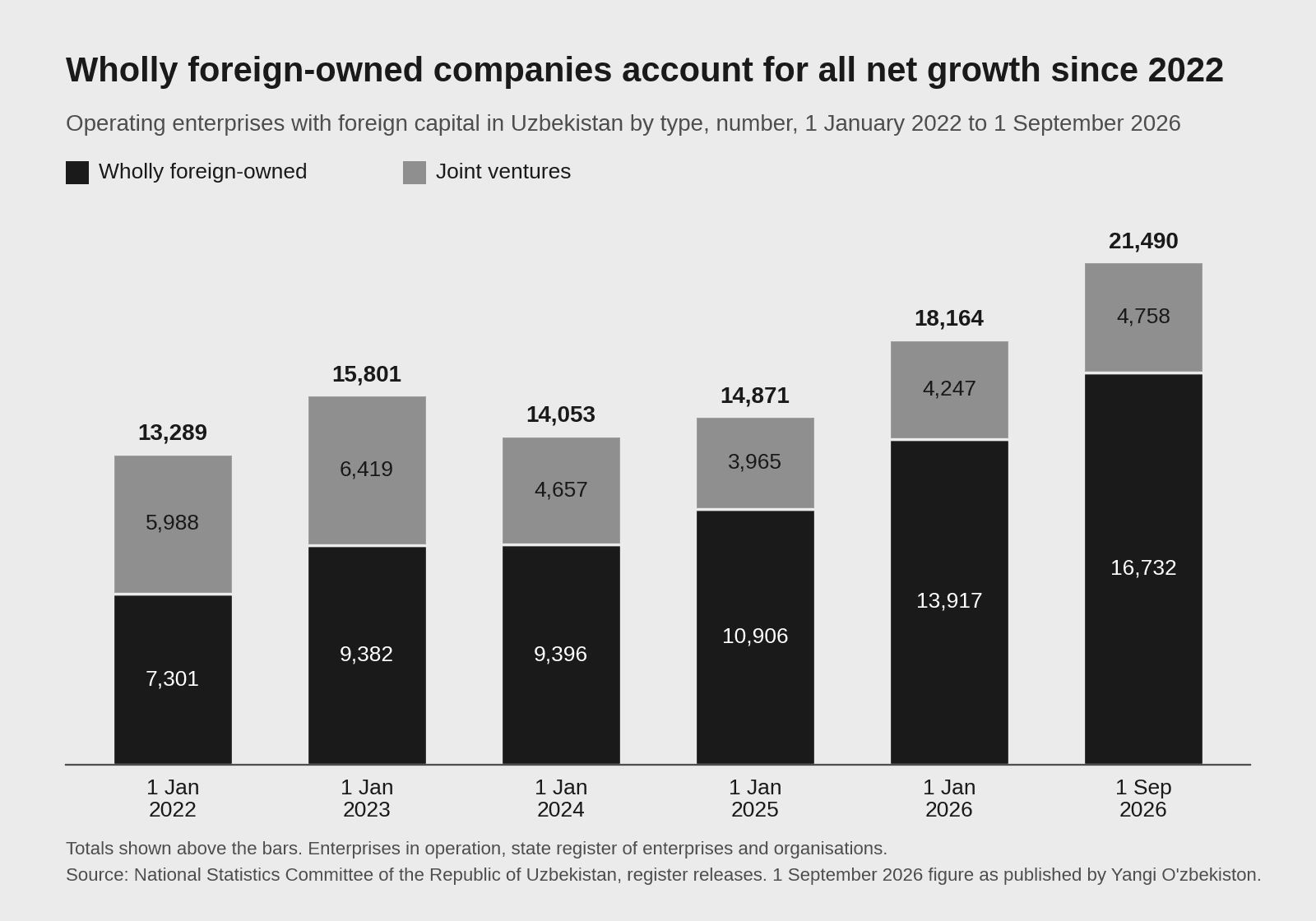
Source: National Statistics Committee register release as of 1 January 2026 and earlier releases, with data as of 1 September 2026 published by Yangi O'zbekiston.
Foreign Capital Has Shifted to Wholly Foreign-Owned Companies
Interim management in this article means a full-time executive appointment for a defined period, with decision rights and an agreed end, which separates it from advisory work and from part-time roles. Enterprise counts refer to operating enterprises with foreign capital in the state register, taken at the start of each year and, for 2026, on 1 September, and shares and growth rates are Tretiakov Consulting calculations from the published levels. Monetary amounts appear in US dollars (USD), as the original sources state them, with no exchange rate conversion or inflation adjustment, so all values are nominal. Presidential decrees are cited with the prefix UP and presidential resolutions with PP, following their official numbering.
The stock of such enterprises has grown by 82% since 1 January 2021, and all of the net growth since 2022 has come from wholly foreign-owned companies. Over the same period the share of joint ventures (JVs) fell from 45.1% to 22.1%, measured on 1 September 2026. The shift leaves a growing number of foreign-capital companies with no local shareholder who has a say in who runs them.
The sharpest change came in 2023, when the number of JVs fell by 1,762 while the number of wholly owned companies barely changed. No reason for the fall was given in the register releases, so the series records a change in composition without showing its cause. The decline continued at a slower pace in 2024, and JV numbers have risen again only since the start of 2025.
Net growth in the stock has picked up in the current year. The net increase of 3,326 enterprises from January to August 2026 already exceeds the increase for the whole of 2025. At that monthly pace the stock would pass 23,000 by the end of the year, an estimate made in the absence of an official forecast (Source: Tretiakov Consulting, straight-line projection from eight months of data).
China accounted for 29.9% of foreign-capital enterprises on 1 September 2026, having overtaken Russia during 2024, and Russia, Türkiye, Kazakhstan and the Republic of Korea complete the five largest countries of origin. Tashkent city held 63.2% of these enterprises at the start of 2026. The releases explain neither the change in ranking nor the concentration, and they carry no information on management, so these cuts locate foreign owners but say nothing about how they staff their companies.
Ownership structure matters for leadership because of who appoints the head. Under Article 127 of the Labour Code, the head of an organisation is hired directly by the owner or by the body its founding documents authorise. In a wholly foreign-owned company the foreign owners can therefore fill a vacancy without a local partner, while in a JV the choice passes through the partners and the charter they agreed. This reading rests on the code alone, and the register statistics say nothing about how often company heads change.
The State Is Selling Assets and Recruiting Managers in the Same Cycle
The state sector is shrinking through several routes at once. The IMF review counts 2,965 SOEs in 2020 and 1,917 at the end of February 2026, a net figure in which newly created entities partly offset the exits. Sales to private owners were the smaller part of those exits, and liquidations outnumbered privatisations by more than two to one.
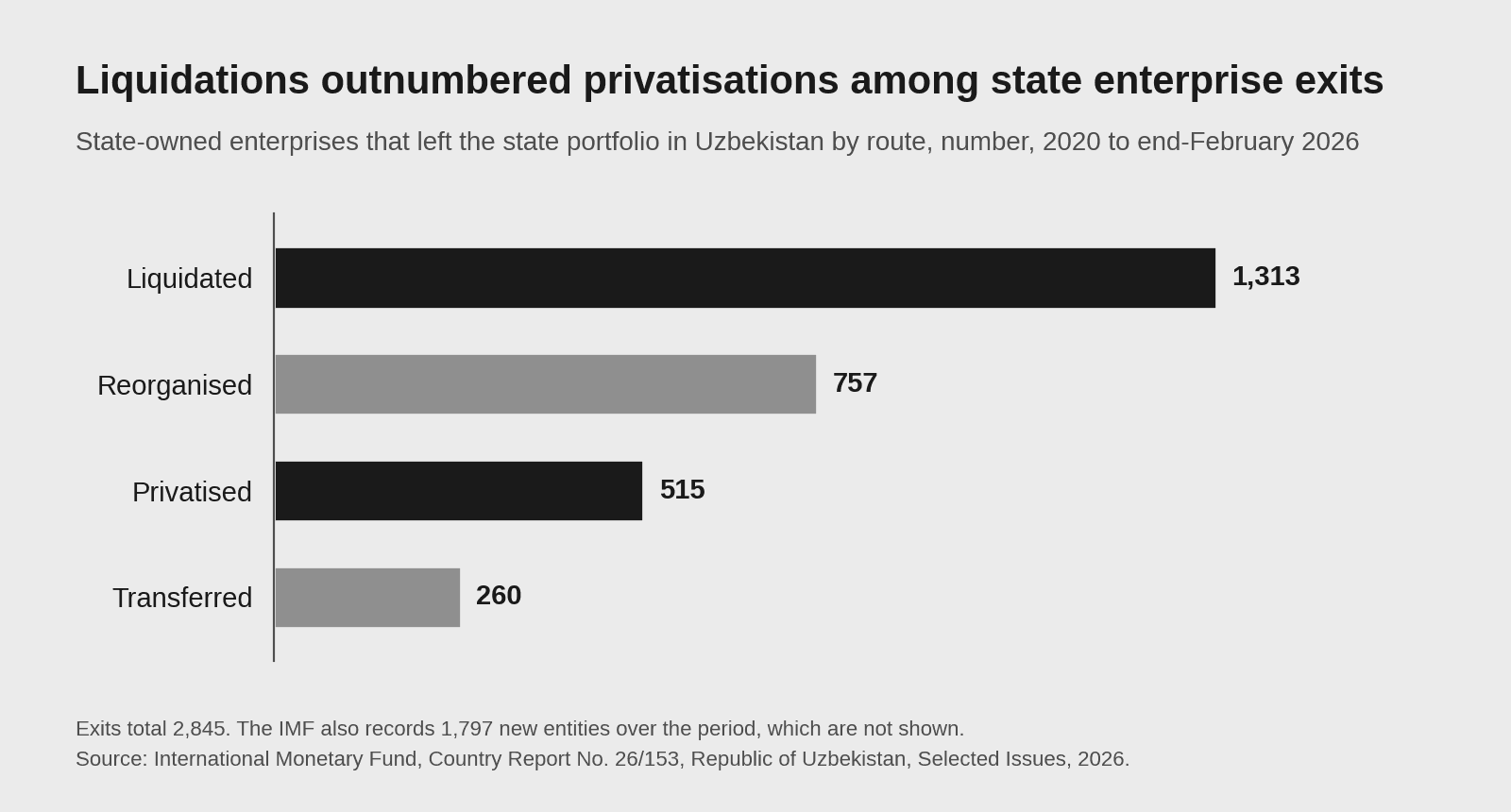
Source: IMF Country Report No. 26/153, Republic of Uzbekistan, Selected Issues, 2026.
Official figures on the state sector are compiled on other bases. The President's office reported 1,685 SOEs in operation in April 2026, and the State Assets Management Agency (UzSAMA) reported a fall of 61% for the period from 2021 to 2025 without stating its baseline. Neither figure can be compared directly with the IMF series, although UzSAMA's figure also shows a fall. The exit routes differ in their effect on leadership, as only a privatisation hands a company to a private owner who then decides who runs it.
The current year has added a new sales programme to these routes. Decree UP-177 of 28 August 2026, in force since 8 September, sets a target of offering the stakes mentioned above together with 1,242 property assets for sale in 2026. The decree introduces a temporary special right of state participation, often called a golden share, which the government can retain in strategic enterprises after privatisation. An incoming owner may still share some decisions with the state after closing.
About 35% of the National Investment Fund of Uzbekistan (UzNIF) was sold for USD 691.5 m in May 2026, once the over-allotment option had been exercised in full. It was the country's first international initial public offering (IPO), with listings in London and Tashkent. Other sales have moved more slowly, as UzSAMA said in September 2026 that 99.7% of UzAuto Motors would be offered through an open international tender and that the sale of Asakabank would most likely not be completed in 2026. Bidding rules and buyer obligations are set out in our note on how foreign investors take part in privatisation. Each completed sale of a controlling stake gives a new owner the decision on whether the incumbent management stays.
Foreign managers have been written into state policy for more than a decade. Presidential decree UP-4720 of April 2015 opened the competitive selection of heads of executive bodies in joint-stock companies (JSCs) with a state share to foreign managers. Decree UP-6096 of October 2020 went further, requiring large SOEs to fill at least 30% of supervisory board seats and at least three management posts through international competition by 1 July 2021.
Rules on company boards have followed a similar course since then. From 20 April 2023, amendments to the Law on Joint-Stock Companies have required at least one independent board member in listed JSCs and in JSCs where the state holds more than half. Resolution PP-74 of 25 February 2026 sets goals of raising independent members to 50% of supervisory boards and of attracting foreign specialists, including compatriots living abroad, through international selection. For companies in the UzNIF portfolio, it required the heads and their deputies for finance, transformation and privatisation to be assessed by 1 July 2026, with internationally selected candidates proposed where needed.
Evidence on how far these mandates have been implemented is limited. The IMF's 2026 Article IV staff report records boards with a majority of independent members at three state banks and independent chief executives at two. The review cited above finds that the SOE strategy for 2021 to 2025 fell short of its original target, a 75% reduction in state presence in competitive sectors. No official count of foreign managers hired under these acts was found, and neither the rules on their pay nor any report on the July 2026 assessment appears in the sources reviewed.
Work Authorisation Is Quick and the Longer Clocks Sit in Labour Law
A foreign general director normally works in Uzbekistan on an individual confirmation of the right to work, and the acts reviewed contain neither a quota nor a labour-market test. Since 1 December 2018, resolution PP-4008 has let highly qualified specialists, a category that requires pay of at least USD 60,000 a year among other criteria, hold a confirmation for up to three years. Qualified specialists, with a pay threshold of USD 30,000, have the same term, and both categories can renew without limit. Fees and the remaining criteria form part of the fee-and-qualification regime for foreign managers, which applies equally to an interim appointee. The table below sets the migration steps against the labour law periods that govern a change of leadership.
Labour law sets longer clocks than work authorisation
Periods that govern a change of senior leadership in Uzbekistan, as of 25 September 2026
Step | Period | Source |
|---|---|---|
Review of an application for a work confirmation | 15 working days | State services portal |
Work before a confirmation by founders of foreign enterprises and joint ventures, including first heads | Up to 3 months from the employment contract | Legal guides of 2024 and September 2026 |
Fixed-term employment contract | Up to 3 years | Labour Code, Art. 110 |
Resignation notice by a head | 2 months, or 1 month for a deputy or chief accountant | Labour Code, Art. 489 |
Termination of the head's contract by a new owner | Within 3 months of the acquisition | Labour Code, Art. 489 |
Written notice that a fixed-term contract will end | At least 3 calendar days | Labour Code, Art. 158 |
Update of the tax record after a change of head | Within 10 calendar days | Practitioners' guide, 2024 |
Sources: state services portal, Labour Code, a 2024 legal guide, a September 2026 legal guide and a practitioners' guide to a change of director.
The migration side of an appointment is measured in weeks. A 2024 legal guide to hiring foreign staff and a September 2026 guide to work permits both describe an exemption for founders of foreign enterprises and joint ventures, including first heads, who may start work before a confirmation is issued. Neither source says whether an executive hired from outside, who is not a founder, counts as a first head for this purpose. For such an appointee, the standard review remains the reference timeline.
Under Article 489 of the Labour Code, a head who resigns must give written notice, and a permanent successor who currently runs another company is bound by the same rule at the previous employer. A new owner has a limited window after an acquisition to end the contracts of the head, the deputies and the chief accountant on that ground alone. These periods run to months, and because no published data on how long senior hires take in Uzbekistan could be located, the comparison rests on the law's own deadlines.
Article 112 lists foreign citizens who have lawfully entered Uzbekistan to work among the cases in which a fixed-term contract is concluded, and Article 524 caps its term at the validity of the confirmation. A foreign executive working on a confirmation is therefore on a fixed-term contract whatever the owner intends, while foreigners with a residence permit fall under the general rules of the code. What separates an interim mandate from a longer posting is the end state agreed at the outset, as the contract type is identical in both cases.
Temporariness and concurrent employment are separate questions under the code. Article 526 lets highly qualified and qualified specialists take a second job without a further confirmation, while Article 487 requires a head to obtain the owner's permission before taking a second job with another employer. An arrangement that splits a sitting head's time between companies is thus a governance decision for the owner as well as a migration question.
Parliament moved in 2026 to tighten enforcement of the rules on foreign workers. In July the Legislative Chamber passed a bill that sets fines where foreigners work without a confirmation, citing more than 36,000 foreign workers who paid taxes as of 1 May 2026 against 9,514 who held documents. Senate approval and signature had not been confirmed by 25 September 2026, so the measure remains in progress. If enacted, the fines would raise the cost of any gap between the start of a mandate and the confirmation, and the reports on the bill do not say how it treats the exemption for founders.
The Form of the Appointment Decides What an Interim Executive Can Do
Uzbek law has no separate category for a temporary executive, and the legal texts reviewed do not use the term interim. The law looks instead at the employment contract and its term, at the work confirmation where one is needed and at the corporate form of the appointment. An interim chief executive appointed as the statutory head exercises executive authority in full, within the limits of the charter and the matters reserved to shareholders. A country or transformation manager acting under a power of attorney is limited to the powers delegated in it. The finance function adds a separate case, since an interim chief financial officer (CFO) carries a management title that brings the statutory accounting role only if the person is also appointed chief accountant.
Under Article 485 of the Labour Code, the head of an organisation manages it and performs the functions of its sole executive body. The new Law on Limited Liability Companies (LLCs), in force since 22 July 2026, adds fiduciary duties for members of the supervisory board and the executive bodies, according to a press summary published when the law was signed. These duties and the liability of the office apply to an interim appointee from the date of appointment, and no lighter regime for a temporary holder appears in the texts.
The statutory office is the source of most delegated powers in the company. Under Article 13 of the Law on Accounting, financial statements and cash documents are signed by the head or by designated persons, and Article 11 makes that officer responsible for organising the accounts. Under Article 138 of the Civil Code, a power of attorney from a company is issued over the head's signature, so it can be withdrawn without any change in the registered management.
A power of attorney is narrower by design, and the comparison below shows where the two positions diverge. An interim manager acting under one therefore depends on the continued support of the registered head. Anyone who must act in their own right, for example to issue powers of attorney or to designate who signs the accounts, needs the appointment to the office itself.
Only the statutory head holds authority in its own right
Statutory appointment and power of attorney compared under Uzbek law, as of 25 September 2026
Statutory head | Holder of a power of attorney | |
|---|---|---|
Source of authority | Appointment to the executive body | Written authorisation by the company |
Appointed or granted by | The owner or the body named in the founding documents | The statutory head |
Duration | Set by the charter or contract, and by law in a joint-stock company | Up to 3 years, or 1 year if no term is stated |
Personal liability | Full material liability for direct damage | Not subject to the head's special regime |
Signatures | Financial statements, cash documents and powers of attorney | Only the acts listed in the document |
How it ends | Dismissal, expiry or a new owner's decision | Expiry, or revocation with notice |
Sources: Labour Code, Civil Code and Law on Accounting of the Republic of Uzbekistan.
In a JSC the Labour Code requires a fixed-term contract with the head for a term set by law under Article 486, and the reporting line runs to the general meeting and the supervisory board. A foreign parent acts through the charter, its board seats and the matters reserved to shareholders, and an interim executive's decision rights are defined in the same documents. Where formal authority and actual decision-making diverge in practice is examined in our piece on decision rights inside Uzbek businesses. Independent members of the supervisory board, required by the 2023 amendments for JSCs and provided for in the new LLC law, add another level of oversight, and appointments in state companies also follow government acts such as PP-74.
An Interim CFO Is Not Automatically the Chief Accountant
The Law on Accounting gives the finance function a statutory core. The head organises accounting and may set up an accounting service led by a chief accountant, who reports directly to the head. In organisations subject to mandatory audit, the chief accountant must hold a degree and at least three years of relevant experience in the last five, rising to seven in the last ten where the degree is not in economics.
Nowhere in that law does the title of CFO appear. An interim CFO who is not appointed chief accountant therefore carries none of the chief accountant's statutory functions. One who is appointed must meet the qualification test and falls under the Labour Code rules for that post in Articles 486 to 489, which include full material liability and a notice period on resignation.
The reporting standard the finance function works to has changed since 2020. Resolution PP-4611 of February 2020 required joint-stock companies, commercial banks, insurers and large taxpayers to prepare accounts under International Financial Reporting Standards (IFRS) from their 2021 results. In March 2025, according to the presidential website, 22 large enterprises had still not moved to IFRS.
Resolution PP-282 of 15 September 2025 replaced that mandate from 17 December 2025 with a register of public interest entities (PIEs), published every year. The register for 2026, published in late June by the Ministry of Economy and Finance and the Central Bank, lists 425 organisations. They include listed companies, banks and other financial organisations, investment funds and exchanges, large enterprises with a state share of at least half, and large private companies. Each must keep IFRS accounts from 1 January 2027 and publish IFRS statements for 2028 together with an auditor's report.
The supply of certified finance staff is measured only in part. The ministry counted about 1,470 holders of international accounting certificates on 1 July 2025, and just over half of them held a pass in a single financial reporting exam paper. In the World Bank Enterprise Survey of 2024, 10.5% of firms named an inadequately educated workforce as their biggest obstacle, compared with 8.5% in the 2019 survey. Whether the certified workforce matches the needs of the register is not assessed in any official source located for this article.
Three Ownership Situations That Can Open a Leadership Gap
The rules above apply differently depending on who owns the company and how that ownership is changing. Three situations bring them together, and each places an interim executive in a different position. None of them creates a vacancy automatically, although each can open one when an incumbent is replaced or when a new owner wants transformation leadership for a defined period. The differences lie mainly in who can appoint and in what can end the mandate.
An Interim Chief Executive for a Wholly Owned Subsidiary
In a wholly owned subsidiary the parent hires the head directly, so the appointment depends on the parent's own decision and on the formalities in the charter. A confirmation for a highly qualified specialist can cover a mandate of several years, while the founders' exemption described above may not cover an interim head who is not a founder, a point the guides leave open. The interim chief executive officer (CEO) holds the post until a permanent successor has served notice at a previous employer and can take office. An interim CEO in this position answers to a single shareholder, which keeps the reporting line short. Parents that relied on expatriate cover for key roles in the first phase of market entry meet the same question later, when that first appointee leaves.
A Joint Venture Whose Partner Is the State
A JV with a state partner adds a public layer to the charter. Under the Law on the Management of State Property of March 2023, a company counts as an enterprise with state participation when the public share exceeds half or is larger than that of each other participant. That law also contains articles on selecting supervisory board candidates and on the executive body of such enterprises, so an interim appointment there follows statutory procedures as well as the charter.
In a JV organised as an LLC, the new law adds fiduciary duties for executives, which on a plain reading run to the company as a whole and not to the partner that made the nomination. Where UP-177 leads to the sale of a state stake, the other shareholder in a joint venture with a state-owned partner changes during the life of the venture. Until the new partner's position is settled, an interim executive works within the authority the existing charter still gives.
A Privatised Company Under Its New Owner
A privatisation changes the owner, and the new owner's window under Article 489 of the Labour Code runs from the date of acquisition. Under UP-177, buyers in larger transactions can spread part of the price over up to seven years, and Article 34 of the 2024 privatisation law sets consequences for a buyer that fails to meet the terms of the sale. A buyer's obligations can thus run for years after closing, alongside the change of management, although the published sources do not show how buyers report on meeting them. A large privatised company may also fall within the PIE register and its IFRS timetable. The integration questions that follow belong to the first hundred days after an acquisition in Uzbekistan.
In all three situations the appointment documents decide which of the forms described earlier applies, whatever the job title says. That choice sets the reach of the executive's decisions and the liability attached to them. The scope such mandates take in practice is described under interim management and operational leadership.
Handover in Uzbekistan Is Also a Registration Event
A change of director sets off administrative steps with their own deadlines. A practitioners' guide from October 2024 sets them out in order. They include an update of the company's record with the tax authority, the revocation of the electronic digital signature issued to the previous head and the issue of a new one to the successor, and a re-issued bank signature card. The guide describes practice and does not cite the legal basis for each step.
A change of head does not end powers of attorney, because it is not among the grounds on which the Civil Code ends one. Those signed by an outgoing interim head remain valid until they expire or are revoked, and the code requires notice of a revocation to the representative and to known third parties. This reading is drawn from the statutory text, and no court ruling or official commentary confirming it was located.
The end of the employment contract follows its own rules in the Labour Code. Under Article 158, a fixed-term contract becomes open-ended if the employee keeps working for a week after it expires and neither side objects. A local interim executive whose mandate runs on past its end date without a decision can end up employed indefinitely. Article 525 makes the expiry or annulment of a foreign executive's confirmation a ground for ending the contract. Under Article 159, the parties to any fixed-term contract may agree a penalty for early termination.
The Local Management Bench and Reference Points Abroad
The depth of the local management bench can be gauged only through survey data. The World Bank Enterprise Survey cited above found that top managers had on average 13.3 years of experience in their sector in 2024, against 14.2 in 2019, and that about one firm in five offered formal training to staff. The sources reviewed contain no data on executive development programmes or succession pools in Uzbek companies, so the pool from which a permanent successor would come cannot be sized.
Two reference points from other markets show how differently these questions are framed, and neither transfers to Uzbekistan. Kazakhstan allocates employer permits under a quota, which it raised to 0.3% of the labour force from 10 May 2026, so interim management in Kazakhstan starts from a permit decision of its own. The 2026 survey by the UK professional body for interim managers puts the average assignment at 10.0 months, against 9.6 a year earlier, and no comparable survey for Uzbekistan could be found.
Dated Commitments to 2030 and What They Leave Open
No official forecast of foreign-capital enterprise numbers beyond 2026 was found in the sources reviewed, so the outlook to 2030 rests on dated events and stated targets. Resolution PP-145 of April 2025 schedules public offerings in twelve state companies, and the UzNIF listing described above was the first to be completed. Each further listing brings outside shareholders into a company that has so far been wholly or mainly state-owned, and one offering has already been paused, as the table below shows.
Most pending state offerings are scheduled for 2027 and 2028
Public offerings of state companies scheduled by resolution PP-145, status as of 25 September 2026
Company | Planned period | Status |
|---|---|---|
Navoi Uran and Uzbekistan Airways | Second half of 2026 | Scheduled, no launch announced |
Almalyk Mining and Metallurgical Complex, National Electric Grid of Uzbekistan, Uzbektelecom and Uzbekhydroenergo | 2027 | Scheduled |
Regional electric networks, Uztransgaz, Uzbekistan Airports and Hududgaztaminot | 2028 | Scheduled |
Navoi Mining and Metallurgical Company | Second half of 2025 | Reported as paused in May 2026 |
Sources: presidential resolution PP-145, with the status of Navoi Mining and Metallurgical Company from a May 2026 press report.
Beyond the listing schedule, most commitments to 2030 are stated targets. In the August 2026 statement cited above, UzSAMA restated the aim of an 85% non-state share of the economy and a nearly sixfold reduction in the number of SOEs by 2030. The updated national development strategy is reported to set a target of reducing state banks from nine to four by 2030. A moratorium on creating new SOEs until 1 January 2030 is in force under decree UP-70.
Trade rules add no commitment on the entry of executives yet. Uzbekistan is not a member of the World Trade Organization (WTO), and its accession working party held its 13th meeting on 27 and 28 July 2026. Until accession there are no WTO commitments on the temporary presence of foreign managers.
Several questions remain open at the date of this analysis. The size of the interim market in Uzbekistan cannot be measured, because no public data on interim appointments or on turnover among company heads were available for this analysis. Senate approval of the fines bill had not been confirmed, and the paused offering of Navoi Mining and Metallurgical Company shows that the timetable for state listings can move.
Conclusion
For a foreign owner, the rules on work authorisation do not appear to restrict interim management in Uzbekistan. The acts reviewed set no numerical cap, and a specialist who meets the pay and experience thresholds can hold a confirmation long enough for a mandate of several years. The periods that shape a transition sit in the Labour Code instead, in the notice that binds a permanent successor and the limited window a new owner has after an acquisition.
The reforms since 2021 add to the occasions on which a leadership gap can open, although a change of ownership does not create one by itself. Where a new owner or partner replaces the incumbent, a permanent hire waits on the successor's notice period, and an interim appointment can cover the interval. Companies entering the PIE register add a finance deadline of their own, with an IFRS timetable fixed in advance.
With no separate legal category for an interim executive, authority depends on the form of the appointment. The new LLC law makes that choice weightier by adding fiduciary duties to the statutory office. Because a foreign executive on a confirmation has a fixed-term contract either way, the reach of an interim mandate turns on whether the executive holds the company's statutory office or acts under a power of attorney signed by the person who holds it.
Tretiakov Consulting provides interim management and operational leadership in Uzbekistan, from interim chief executive to country and subsidiary leadership, for foreign-owned companies, joint ventures and newly privatised businesses. Discuss a live mandate
Our insights