

Kazakhstan’s foreign-labour quota provides a useful indication of how imported executive capacity is regulated. The Ministry of Labour allocated 726 work permits to Category I, which covers the first heads of companies and their deputies. A year earlier the initial figure was 649. Both allocations were set before the ministry raised the overall quota for employer permits in the course of each year, to 0.25% of the labour force in August 2025 and to 0.3% in May 2026.
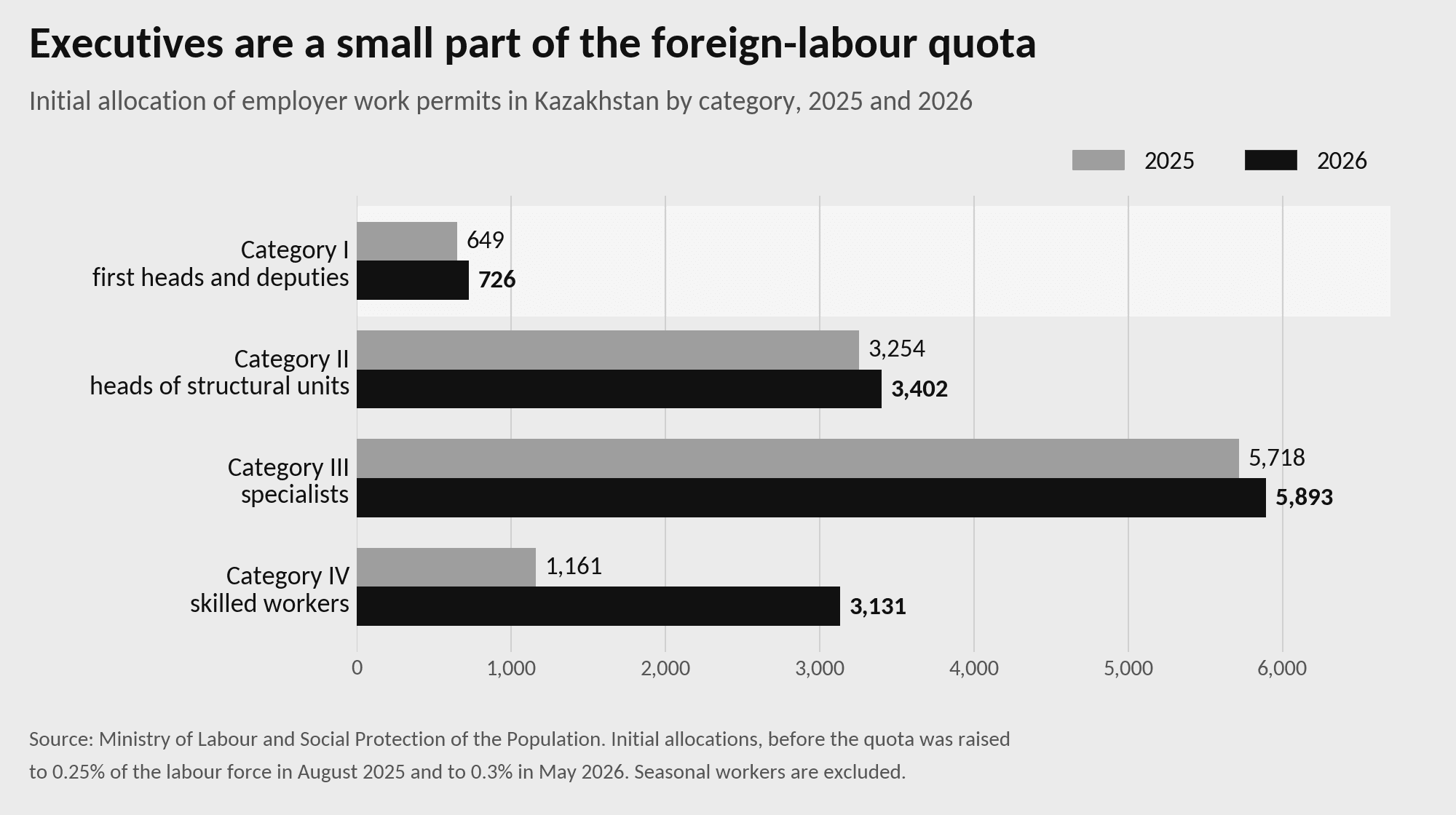
Initial allocations of employer work permits by category, from Ministry of Labour releases reported by BAQ.kz and Zhaikpress. Seasonal workers are excluded.
The figure is easy to misread, because it does not cap the number of foreign executives in the country. A Kazakhstan company that is wholly foreign-owned can employ a foreign first head and one deputy without a work permit, intra-corporate transfers fall outside the quota rules, and the permits issued and extended to employers in 2024 came to about two-thirds of that year's quota. What the numbers do show is that bringing leadership in from abroad is a regulated decision in its own right.
It also sits alongside a more basic decision, and that decision is the subject of this analysis of interim management in Kazakhstan. When does a company operating in the country need temporary executive authority rather than a permanent hire, a group secondment or part-time support, and what determines whether such a mandate can work? The analysis draws on legislation, secondary regulation and official data available in September 2026, and it places the question within the wider Kazakhstan operating environment.
A leadership gap is not always a recruitment problem
A leadership gap in a Kazakh subsidiary can take two quite different forms. In a vacancy, the organisation and the permanent role are already known, and the company needs someone to fill the position. In a transition, something about the organisation is changing, whether its controls, operating model, management team or strategic direction, while someone still has to exercise executive authority.
The distinction matters because recruitment solves only the first problem. A vacancy asks who should hold an enduring role. A transition may require someone to change the role, or the organisation around it, before the enduring appointment can be properly specified.
Transitional requirements arise in a recognisable set of circumstances. A General Director may leave unexpectedly, an acquired business may need to be brought under group controls, or a company may be entering the market, restructuring, stabilising an operation, rebuilding its reporting or preparing for a permanent search. These are analytical categories, and the public sources reviewed for this article contain no data on how often each occurs in Kazakhstan.
Kazakhstan's legal framework makes one of these transitions unusually concrete. Branches and representative offices of foreign companies are not legal entities, and their heads act under a power of attorney issued by the parent. A limited liability partnership is run by an executive body with authority of its own. A company that moves from a representative presence to an operating subsidiary therefore changes the legal basis on which its local leader acts. Situations of this kind, where a change in the business defines the mandate, are where interim management and operational leadership becomes a distinct option.
Four leadership structures answer different questions
Four structures can fill a senior leadership need, and they are best compared by the problem each one solves.
Four ways to fill a senior leadership need |
|---|
A permanent executive fills an enduring role whose mandate and place in the organisation are substantially known. The horizon is open-ended, foreign-labour rules matter only if the appointee is a foreign national, and the end state is continuing leadership. |
A group secondment transfers capability that already exists inside the group. It can run for a defined period or continue, it relies on the rules for intra-corporate transfers when the executive is a foreign national, and it ends in a return, a further transfer or a succession. |
An interim executive holds temporary executive authority during a transition. The mandate is defined by an outcome, a period or both, foreign-labour rules apply only to foreign appointees, and the end state is a handover. |
A fractional executive, sometimes described as a fractional country manager, provides less than full-time executive capacity where the organisation does not need a full-time role. The arrangement either continues or later grows into a full-time position. |
The last two labels are easily confused. Interim describes the duration and transitional purpose of a mandate, while fractional describes workload, so an interim executive can work part-time and a fractional executive can stay for years. Neither is a legal category in the Kazakhstan statutes reviewed here, and for joint-stock companies the law limits how far the fractional model can reach at the top. In a joint-stock company the head of the executive body may not also head the executive body of another legal entity, and any member of the executive body needs the board's consent to work elsewhere. A part-time adviser can support a statutory head, but that support remains advisory and does not carry the head's authority.
Kazakhstan makes imported leadership a separate decision
Foreign executives reach Kazakhstan companies by three main routes, and each affects the choice between an interim appointment and a secondment in a different way.
The first is the standard permit, issued by the local authority within the annual quota. Since September 2025 an employer must first advertise the vacancy on Enbek, the state's electronic labour exchange, and may apply only 15 calendar days later. Category I permits are issued for one, two or three years, and a breach of the rules can bar an employer from engaging foreign staff for 12 months, including through intra-corporate transfers. For a company that needs executive authority immediately, the advertising period alone sets a minimum lead time before an application can even be filed.
The second route is an exemption. The government's list of people who need no permit includes the first head and deputy of a Kazakhstan company that is 100% foreign-owned, and an amendment in August 2025 limited that exemption to one person in each position. The wording refers to Kazakhstan legal entities, which a branch of a foreign company is not. The list also covers business trips of up to 120 days in a calendar year and the first heads of companies holding investment contracts with the government worth more than USD 50 million. The ownership test has a practical consequence for an interim CEO of a Kazakhstan subsidiary. A wholly owned subsidiary can place one foreign head and one deputy without a permit, whereas a joint venture with a local partner cannot rely on the same exemption. A business trip lets a group executive spend time in the country, but it does not by itself make that person the head of the local entity.
The third route is the intra-corporate transfer. The migration law defines it as the temporary transfer of a head, manager or specialist from a company established in a World Trade Organization member state to that company's branch, subsidiary or representative office in Kazakhstan. The transfer lasts for the term of the employment contract, up to three years, with the right to extend it by one year. The route suits the secondment of an existing group executive, but it presupposes that such an executive exists and that the parent can release them.
None of the three routes answers the question of what kind of leadership the business needs. Eligibility, documents and procedure are matters for specialist immigration advice.
An interim title does not create executive authority
None of the Kazakhstan statutes reviewed for this article treats the interim manager as a separate legal category. The legal position of an interim executive is therefore whatever position the person actually holds, and the same commercial title can rest on very different foundations.
The Labour Code provides the starting point. Labour relations with the head of a company's executive body are governed by the Code, other laws, the constituent documents and the employment contract. The contract with such a head is concluded by the owner or its authorised body for the term and in the manner set by law, the charter or the parties' agreement, which leaves room for a mandate of defined length.
Company law then determines what the appointment carries. In a limited liability partnership the sole executive body acts on the partnership's behalf without a power of attorney. It issues powers of attorney, hires and dismisses staff, sets pay and exercises every power not reserved to the participants or supervisory bodies. The participants nevertheless keep a decisive lever, because the general meeting or a sole participant may take up any question about the partnership's activity, whatever the charter says. In a joint-stock company the head of the executive body also acts without a power of attorney, and the executive body must carry out the decisions of the shareholders and the board. The company can contest a transaction made beyond its internal restrictions only if it proves that the counterparty knew of them.
The title of interim CEO can therefore describe four different positions. It may belong to a statutory head appointed as the company's executive body, a branch manager acting under a power of attorney, an executive working under authority delegated by a statutory head who remains in post, or an adviser who can neither sign nor decide. These positions are not equivalent. Interim CEO names a commercial role, and the authority behind it depends on which of the four has been chosen.
Authority also has several layers, and they need not coincide.
Four layers of executive authority |
|---|
Corporate authority decides whether the executive can legally represent the Kazakhstan entity, sign on its behalf and issue powers of attorney. |
Financial authority sets which budgets, contracts, payments and capital commitments the executive can approve. |
People authority covers hiring, dismissal, pay and organisational design, and partnership law gives the first three to the executive body by default. |
Parent-company governance reserves matters to the shareholder, the board, a regional headquarters, group functions or an investment committee. |
A statutory head can hold broad authority under local law while group policies reserve significant decisions to headquarters. That arrangement is not a defect in itself, and where the reserved matters sit is a question of governance for foreign-owned businesses in Kazakhstan. The analytical test is whether the authority available matches the mandate assigned.
Two parts of that test deserve explicit treatment. The first is budget. A mandate has to state what the executive can spend and commit locally, which commitments need headquarters approval, and whether capital expenditure and restructuring costs fall inside it. Because a joint-stock company can contest an unauthorised transaction only when the counterparty knew of the restriction, limits that exist only in a group policy protect the group less than their wording suggests.
The second is the reporting line. An interim executive may report to a supervisory board, to the participants of a partnership, to a regional headquarters or to a global functional leader. None of these lines is inherently better. What matters is whether the body that holds the executive accountable is also the body that grants the authority needed to deliver the result. An executive who is accountable for an outcome without the authority to produce it holds a mandate with a contradiction built in. Finding an interim manager in Kazakhstan therefore means defining the authority the role can be given as well as identifying a suitable person.
The mandate depends on what has to change
Interim CEO, CFO and COO mandates show how the underlying transition shapes the authority required.
An interim CEO fits a mandate that needs entity-wide authority, whether to carry a leadership transition or to lead broad organisational change. Because the powers to sign, delegate, hire and dismiss sit with the executive body under partnership and joint-stock company law, such a mandate usually points to appointment as the statutory head rather than to an advisory role.
An interim CFO fits a transition that is primarily financial, such as rebuilding controls and reporting, managing liquidity, resetting budgets, bringing an acquired business into group finance or repairing the finance function. The authority this role needs is largely delegated through powers of attorney, signing rights and approval limits, so it has to be written down explicitly.
An interim COO fits a transition concerned with operational stabilisation, production or service delivery, performance and processes, including the operational turnaround of acquired assets. A turnaround addresses what must change in the operation. The interim mandate addresses who holds the authority to change it, over which people, budgets and sites.
These are not the only legitimate mandates, and one appointment may combine elements of all three.
Cost depends on the structure, not the job title
The question of what an interim manager costs in Kazakhstan has no reliable public answer. The sources reviewed for this article contain no robust benchmark for interim executive fees in the country, and the salary estimates published by international survey aggregators are modelled figures that do not describe interim mandates.
The more useful comparison is structural. An interim executive's cost combines the fee or remuneration, the length of the mandate, any provider fee, travel and accommodation where relevant, and the employment and tax arrangements chosen. A permanent executive brings salary, bonus, benefits, a search fee, onboarding and a continuing employment commitment. A secondment adds group compensation, mobility allowances, housing, relocation, travel, immigration costs and, where applicable, tax equalisation between the home and host countries.
Three recent Kazakhstan-specific changes bear on these structures. Where a permit is needed, the employer pays a fee set in monthly calculation indices, the statutory unit for fees and thresholds, under rates in force since 1 January 2026. From the same date a tax resident's salary income above 8,500 monthly calculation indices a year has been taxed at 15% instead of 10%, a threshold that senior packages can cross. Finally, since 8 June 2026 the Labour Code has prohibited a civil-law contract with an individual that contains any of the defining features of an employment contract. That narrows the room to engage an individual interim executive on a services basis when the role in substance looks like employment.
None of this makes one structure cheaper in general. The relevant measure is the cost of securing the required capability, and the authority that goes with it, for the period in which it is needed.
An interim mandate should be designed around its end state
It is tempting to define an interim mandate by its length. A stronger definition starts from the end state and works backwards, from the objective to the authority it requires, the accountability that follows, the milestones along the way and the successor who takes over.
The end state can be a calendar date, an outcome or both. Possible outcomes include the appointment of a permanent executive, the integration of an acquired business, rebuilt controls and reporting, a completed restructuring milestone, a stabilised operation, an established local management team or the transfer of a market-entry organisation to permanent leadership. Kazakhstan's Labour Code accommodates both kinds of end. Alongside fixed-term contracts it recognises contracts concluded for the duration of a specific piece of work, and for heads of executive bodies it lets the term follow the law, the charter or the parties' agreement. Whether an outcome-based term suits a particular appointment is a matter for legal advice.
The Code also shows why a date on its own does not end a mandate. When a fixed-term contract with the head of an executive body expires and neither side has given notice by the last working day, the contract does not simply lapse. Until recently it was extended for a year unless the owners' documents set another term. Under an amendment signed on 3 June 2026 and in force since 4 August 2026, the contract instead continues until the owners decide to appoint a new head or reappoint the same person, unless that decision sets a different term. For an interim head, the end state therefore has to be implemented through a corporate decision and a formal notice.
Handover belongs inside the mandate. A permanent successor needs the decision history, the financial position, open commitments and unresolved risks, an assessment of the management team, the reporting architecture, a map of stakeholders, current operating priorities and the decisions still outstanding. Where the interim executive was the statutory head, the successor also needs a record of the powers of attorney issued during the mandate, since issuing them is one of the executive body's functions. This follows from the logic of the mandate rather than from a specific legal requirement. The output of an interim executive is an operating result together with a position that permanent leadership can govern from its first day.
Interim leadership can precede permanent recruitment
Interim and permanent appointments need not be rival choices. They can form a sequence in which a leadership gap leads to an interim appointment, the interim executive stabilises the business or redefines the role, a permanent search runs on a clearer brief, and a handover completes the transition.
The distinction drawn at the start of this article indicates which path fits. Where the gap is a vacancy and the role is already defined, a permanent search can begin at once, and an interim appointment adds value only if the search would otherwise leave the business without executive authority for too long. Where the gap is a transition, the permanent role may not be definable until the transition has progressed, and recruiting before that point risks hiring for a role that is about to change.
Timing has a Kazakhstan dimension as well. The public sources reviewed here contain no robust benchmark for how long it takes to recruit a chief executive in the country. What the regulations do fix is part of the calendar for foreign appointees, from the 15-day advertising period for a standard permit to the need for an available group executive under an intra-corporate transfer and the one-person limit on the permit-free route for wholly owned subsidiaries.
Conclusion
The case for interim management turns on one distinction as some organisations already know the leadership model they need. Others need executive authority during the period in which that model is being changed or defined. For the second group interim management is a structural choice, while in a vacancy it can at most serve as a bridge to the permanent appointment.
Kazakhstan's foreign-labour regime shapes the options without deciding between them. The initial 2026 allocation gave Category I 726 permits, yet a wholly owned subsidiary can appoint a foreign head and one deputy without a permit, intra-corporate transfers sit outside the quota, and the permits issued in 2024 covered only about two-thirds of that year's quota. The regime affects how a foreign leader is deployed and how quickly. It does not show whether a transitional mandate is the right structure.
Whether such a mandate works depends on its architecture. The executive needs a legal position that carries the authority the outcome demands, as statutory head, branch head or delegate, and that authority has to be reconciled with the matters the parent reserves to itself. The mandate also needs an end state defined before it starts, implemented through a formal decision on the successor, and a handover that leaves permanent leadership with a position it can govern. Where authority and accountability point to the same place and the exit is clear, a temporary executive can carry a Kazakhstan business through its transition. Where they diverge, an interim appointment changes who holds the title without resolving the problem it was meant to solve.
Tretiakov Consulting provides interim management and operational leadership for companies in transition, including foreign-owned businesses in Kazakhstan. Discuss your situation with us.