
ILLIA TRETIAKOV
Founder

Uzbekistan has spent the past several years rewriting the rules under which foreign capital enters the country, and the pace of that rewriting has created a quiet but expensive problem for anyone deploying money or management attention here. Reform has moved faster than the operational, governance and reporting infrastructure of the typical company on the ground, which means that business consulting in Uzbekistan is no longer the market-entry exercise it was treated as five years ago. It has become an execution and governance exercise, and the distinction matters commercially because the gap between a reform that has been announced and a business that can actually absorb foreign ownership is precisely where capital is mispriced and transactions stall. For owners weighing a sale, investors underwriting a thesis, and boards sponsoring a transformation, the practical question is no longer whether the market is open. It is whether the specific company in front of them is genuinely ready to be bought, restructured or scaled, and that question is rarely answered by the reform headlines that brought them to the table.
Why business consulting in Uzbekistan now looks different from five years ago
The economy that international investors are looking at today is structurally different from the one that existed before 2017. Exchange-rate unification removed the most visible distortion, the WTO accession process is now a working track rather than an aspiration, and growth has been strong, with the Asian Development Bank recording an expansion of 7.7 per cent in 2025 and projecting 6.7 per cent in 2026 and 6.8 per cent in 2027. What that macro picture conceals is an implementation problem that operators feel immediately. The volume of legislative and regulatory change has been extraordinary, and the OECD’s 2025 investment policy roadmap describes the consequence directly, noting that around 23,000 regulatory acts have been adopted in the country since 2017, a pace it characterises as legislative overproduction. The mechanism that creates the problem is simple. Rules are written faster than the institutions meant to apply them can build the capacity to do so consistently, and the result is a market where the formal framework looks modern while the day-to-day application of that framework remains discretionary and uneven.
This is the environment in which business consulting in Uzbekistan now operates, and it changes what good advice looks like. An adviser who reads the reform agenda back to a client is describing the country that exists on paper. An adviser who can explain how a tax incentive is actually granted, how a licence is actually transferred, and how a regulator actually behaves when a foreign owner appears on the share register, is describing the country a transaction will live in. The first kind of work is commoditised. The second is scarce, and that scarcity is the real subject of this article.
The investor-readiness gap: market activity is not bankable opportunity
Visible activity in Uzbekistan is easy to mistake for investable opportunity, and the two are not the same thing. On the one hand, the country has become a genuine destination for greenfield capital. The UNCTAD World Investment Report 2025 places Uzbekistan as the leading landlocked developing economy for greenfield investment over the 2020 to 2024 period, with roughly 18 billion US dollars committed across more than forty projects, and records an inward foreign-direct-investment flow of 2.836 billion US dollars in 2024 on a balance-of-payments basis, with an inward stock of 16.7 billion US dollars at the end of that year. It is worth pausing on the definitional point, because the Central Bank of Uzbekistan reports a gross foreign-direct-investment figure of 11.9 billion US dollars for the same year, and the difference between the two numbers is a matter of methodology rather than contradiction. An adviser who quotes whichever figure flatters the pitch is not doing the client a service, because the gap between gross commitment and net realised flow is exactly the kind of distinction that separates a confident investment committee from a careful one.
On the other hand, the supply of bankable targets is constrained by a structural feature of the economy that reform has not yet dismantled. The World Bank’s 2025 Country Economic Memorandum records that, on its latest reading, the country still has more than two thousand centrally held state-owned enterprises with revenues equivalent to around 32 per cent of GDP, and that four out of five of these operate in sectors where private firms could compete more effectively. The commercial consequence for an investor is that a company appearing on a privatisation list is not the same as a company with accounts that survive due diligence, management reporting that a board can rely on, or a governance structure that does not collapse the moment an outside shareholder asks for it to function. The work of closing that distance, between a state asset that is technically for sale and a business that is genuinely investable, is operational rather than strategic, and it is the part of the journey most foreign buyers underestimate. The realities of enterprise modernisation in Uzbekistan sit squarely in this gap, and they are the reason that activity in the market should never be read as readiness on its own.
Strategy consulting in Uzbekistan: where international playbooks break
Imported strategy work tends to fail here for a reason that has nothing to do with the quality of the thinking and everything to do with the operating layer beneath it. A great deal of confusion is created by treating management consulting and strategy consulting as interchangeable, when in practice they answer different questions. Strategy consulting is concerned with where a business should compete and how it should win, while management consulting is concerned with how the organisation actually runs once that decision is made. In a mature market the handover between the two is reasonably clean. In Uzbekistan it is not, because the operating reality is so particular that a strategy designed without it is effectively untethered.
The particulars matter, because many mid-market companies remain dependent on state-owned enterprises somewhere in their supply chain, which introduces a single-buyer or single-supplier logic that no competitive strategy can assume away. Logistics still route through a small number of corridors, which concentrates execution risk in ways a standard market-attractiveness model does not capture. Currency and remittance exposure to the Russian economy remains material, and a strategy that ignores it is pricing a different country. Above all, decision-making in privately held firms is frequently concentrated in a founder, which means that key-person dependency is not a footnote in the risk register but the central fact of how the company is run. This is why strategy consulting for mid-market companies in Uzbekistan has to be built on an operating-model layer rather than on a clean sheet, and why the best strategy consulting firms in Uzbekistan are the ones that refuse to deliver a deck without first understanding how the business physically functions.
The point sharpens further with family ownership. Strategic advisory for family-owned companies in Uzbekistan routinely runs into opaque ownership trees, related-party transactions that are undocumented or only partly documented, and a governance culture in which authority and ownership are the same thing. A strategy that does not account for that structure will recommend actions the company cannot govern itself into executing. The pattern is not unique to this market, and the parallel logic in strategy consulting in Kazakhstan is instructive, but the specific weight of state dependency and founder concentration makes the Uzbek case its own.
The Uzbekistan consulting firm landscape: MBB, Big Four and boutique
Buyers often assume that the shortage in this market is one of coverage, and it is not. The major global firms are present. EY has operated in Tashkent since 1995 and Deloitte since 2002, with KPMG and PwC also established, so the Big Four advisory and audit footprint is real and longstanding. On the strategy side, Boston Consulting Group maintains a Tashkent office and has worked with the Agency for Strategic Reforms, while McKinsey has been engaged by the same agency on banking-sector reform in the context of the April 2024 presidential resolution that reshaped the sector. The honest description of the cohort is therefore that McKinsey and BCG anchor the strategy end, the Big Four anchor the audit, tax and large-programme end, and a layer of local consultancies sits beneath them.
What this landscape lacks is not firms but model-fit for a particular kind of client. The mid-market, investor-backed, family-owned and post-privatisation mandate does not naturally receive senior, mandate-specific attention from a global brand whose economics are built around large teams and standardised methodologies. That is the structural gap into which independent consulting boutiques in Uzbekistan and senior-led independents can credibly position, provided they bring genuine operating experience rather than a smaller version of the same generic offer. The table below sets out where each model actually wins, and the judgement it encodes is commercial rather than promotional.
Advisory model | Typical mandate | Where it fits in Uzbekistan | Structural weakness in this market | Best-fit client profile |
|---|---|---|---|---|
MBB (McKinsey, BCG) | National reform programmes, sector strategy, large corporate strategy | Government and large-SOE engagements; sector-level design work | Economics favour large teams and standard methods; thin senior time on smaller files | State bodies, sovereign asset holders, very large corporates |
Big Four (Deloitte, EY, KPMG, PwC) | Audit, tax, transaction services, large-scale transformation | Diligence, IFRS conversion, tax structuring, ERP and finance programmes | Coordination across service lines; partner attention diluted on mid-market files | Companies needing audit-grade diligence and compliance depth |
Global mid-tier | Cross-border functional projects | Specific functional or sector mandates | Limited in-country operating presence and continuity | Buyers needing a named functional capability |
Local Uzbek consultancies | Regulatory navigation, local market access | Licensing, local relationships, ground-level execution support | Variable governance standards; limited international transaction experience | Domestic firms and first-time local set-ups |
Senior-led independent advisory boutiques | Complex, investor-backed, mandate-specific work | Mid-market, family-owned and post-privatisation mandates needing daily senior involvement | Capacity is finite; cannot absorb very large multi-workstream programmes | Owners, sponsors and boards on high-stakes single mandates |
The reason the comparison matters is that the cost of choosing the wrong model is not measured in fees. It is measured in a mispriced transaction, a failed integration, or a transformation that stalls because the people who designed it were never going to be in the room when it had to be executed.
Business advisory services in Uzbekistan: the governance and execution layer that decides commercial outcomes
The part of an engagement that determines whether value is created or destroyed is rarely the strategy and almost always the governance and execution layer beneath it. This is where business advisory services in Uzbekistan earn their commercial keep, and it is also where the country’s specific weaknesses concentrate. The financial system illustrates the point with unusual clarity. The first joint IMF and World Bank Financial Sector Assessment Programme for Uzbekistan, published as IMF Country Report No. 25/227, documents that state-owned commercial banks still account for roughly two-thirds of banking-system assets, that supervision is moving from a compliance basis towards a risk basis, and that corporate governance across the state banks remains uneven. For a company that depends on those banks for working capital, the practical consequence is that the cost and availability of credit are shaped by directed-lending legacies rather than by the borrower’s own creditworthiness, and that is a constraint a strategy cannot wish away. The broader story of banking-sector transformation in Uzbekistan is therefore not an abstract reform narrative but a direct input into how any leveraged plan in the country actually works.
Inside the company the failure points are familiar to anyone who has done operational work here. Accounts are frequently kept on two tracks, one for tax and one for management, which means the numbers a buyer is shown and the numbers the business runs on are not the same. IFRS conversion is often done quickly and superficially ahead of a process, which leaves a buyer holding statements that look compliant but do not reflect how cash actually moves. Enterprise systems are fragmented, so consolidated reporting is reconstructed by hand and is only as reliable as the person doing the reconstruction. Management depth below the founder is thin, which turns every important decision into a key-person event. None of these is exotic, and all of them are governance and execution problems rather than strategic ones, which is why a credible adviser has to be able to do business transformation and operating model work rather than only diagnose it. The commercial mechanism is straightforward. Where reporting is unreliable, capital is mispriced; where management is shallow, integration fails; and where governance is informal, the value an investor underwrote on entry leaks out after completion.
A practical assessment framework for choosing a consulting partner in Uzbekistan
Choosing the right partner in this market is less about brand and more about a small number of attributes that predict whether a mandate will be executed rather than merely advised upon. The framework below sets out the six that matter, and it is deliberately demanding because the cost of getting this choice wrong is borne after the engagement, not during it.
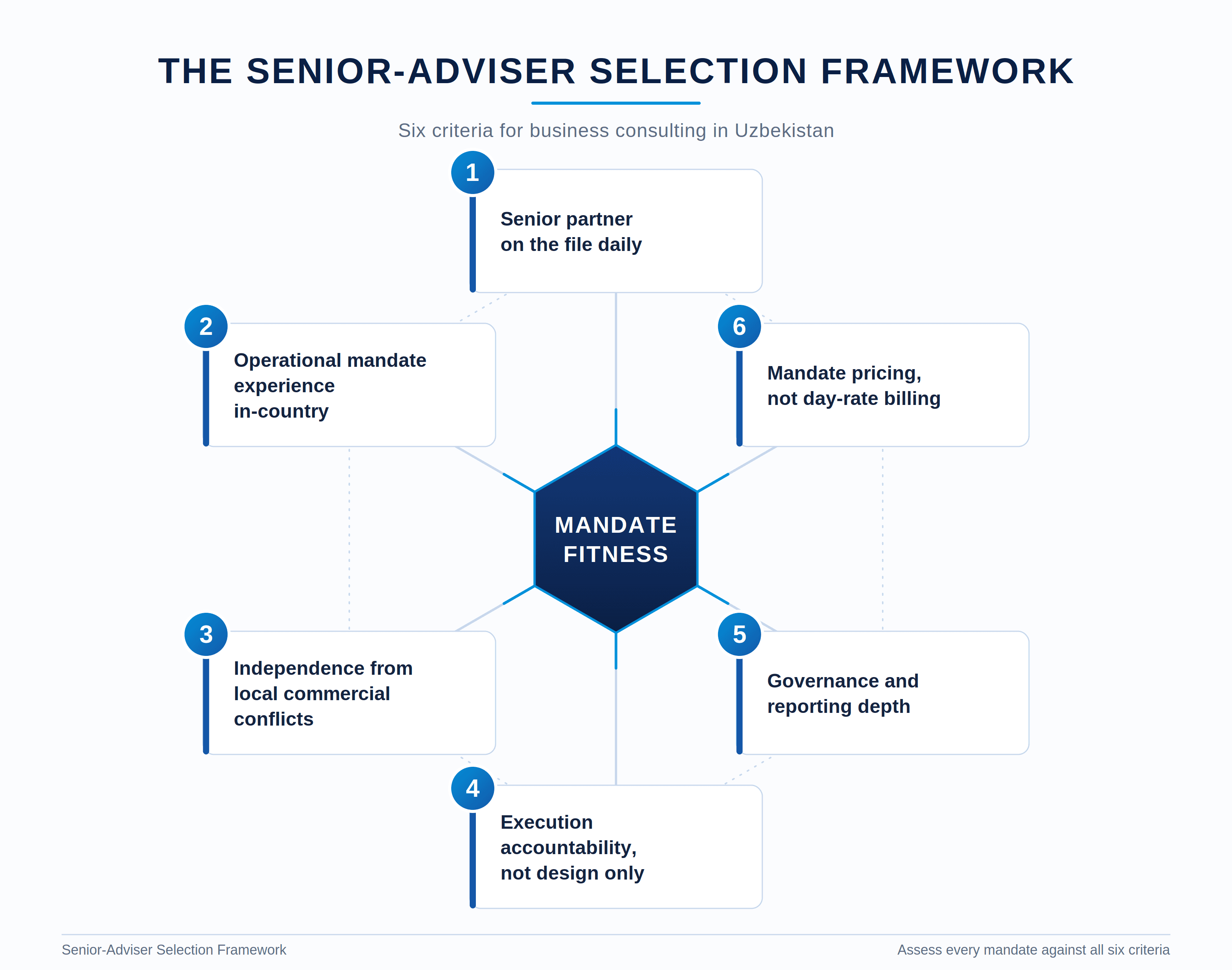
The first criterion is whether a senior partner is genuinely on the file day to day, because in a market this discretionary, judgement cannot be delegated to a junior team working from a template. The second is operational mandate experience in the country itself, since reading about how a licence transfers is not the same as having transferred one. The third is independence from local commercial conflicts, which is harder to verify than it sounds and matters enormously when an adviser is asked to value a counterparty they may also serve. The fourth is execution accountability, meaning the adviser is prepared to be measured on what actually happens rather than only on the quality of the design. The fifth is governance and reporting depth, because most value erosion runs through weak reporting. The sixth is a willingness to price the mandate rather than the day, which aligns the adviser with the outcome instead of the hours.
This is also the right place to be candid about cost, since clients reasonably want to know what management consulting costs here. The honest answer is that there is no single rate, and that the meaningful distinction is not the headline number but the pricing logic. Day-rate billing rewards effort and duration, while mandate or outcome pricing rewards results, and for a complex, investor-backed engagement the second is almost always the better alignment even where it looks more expensive at the outset. A useful test of any prospective partner is whether they can explain their own economics in those terms. If you want to understand how we work in Uzbekistan against these six criteria, that is the natural starting point for a conversation. Senior-led business consulting in Uzbekistan is defined precisely by the willingness to be held to this standard rather than to retreat behind a methodology.
M&A, privatisation and post-deal execution: where most value is lost
The largest single source of value destruction in Uzbek transactions is not the price paid at signing but the integration that follows it, and the reason is structural. The country is running an active divestment programme, and the EBRD’s Transition Report 2025–26 records that in April 2025 the President signed a resolution initiating the privatisation of major state-owned enterprises over the 2025 to 2028 period, with the government’s stake in a substantial number of companies earmarked for sale through public auction and listing. The disposal of state assets is administered by the State Asset Management Agency under the 2024 privatisation legislation, which provides for auctions, public offerings and direct sales. The pipeline is therefore real, and the privatisation pipeline that foreign investors now face is broader than at any point in the country’s open-economy history. The caution that an experienced adviser adds is that a privatisation timetable is an intention rather than a guarantee, and that timelines here have been extended before, so a transaction plan that assumes a specific completion date is building on sand.
The execution risk concentrates after signing, because acquired businesses frequently run parallel reporting systems that have to be reconciled before any consolidated view is possible. Human-resources structures are duplicated and politically sensitive to rationalise. Licences and land rights do not always transfer cleanly with the equity, and customs and trade-finance bottlenecks can choke a working-capital plan that looked sound on a spreadsheet. The IMF’s 2025 Article IV consultation is explicit that contingent liabilities sitting under state-owned enterprises, state banks and public-private partnerships are a material downside risk, and the OECD has separately warned that discretion in the negotiation of investment terms can produce rent-seeking and uneven contractual outcomes. The commercial translation of these institutional findings is that the obligations a buyer inherits are often larger and less visible than the headline price, and that the terms agreed in negotiation may not be the terms a different counterparty would receive. This is why credible M&A advisory and post-merger integration work treats the period after completion as the main event rather than an administrative afterthought, and why the diligence that matters most is the diligence that anticipates what integration will actually require.
The forward view: business consulting in Uzbekistan to 2027
The direction of travel is reasonably clear even if the pace is not. WTO accession remains on track and will, as the ADB observes, help to anchor the reform agenda by binding domestic policy to external commitments. The development banks are deeply committed to the private-sector transition, with the EBRD’s country strategy for 2024 to 2029 naming the transformation of state enterprises and banks, the strengthening of public-private-partnership governance, and a broader private-sector orientation as its central priorities, against a cumulative in-country investment that already runs into the billions of euros across more than two hundred projects. The Central Bank’s own banking-reform strategy set a target of raising the non-state share of banking-system assets towards 60 per cent, and the honest reading, supported by both the IMF and the bank’s own reporting, is that this target has been only partly achieved, which keeps the financial-sector constraint live well beyond its original deadline.
What changes for advisers and clients alike is the nature of the demand. The market-entry deck is becoming a commodity, and the work that commands a premium is the rebuilding of operating models, the redesign of governance, and the engineering of genuine investment readiness in companies that the reform agenda has made available but not yet made ready. Business consulting in Uzbekistan over the next two to three years will be defined less by access and more by the ability to convert visible opportunity into executable reality. The advisers who matter will be the ones who can stand between an international sponsor and an Uzbek operating reality and make the two work together.
Conclusion
The most useful thing an owner, investor or board can carry away from this market is a refusal to confuse the country on paper with the company in front of them. Reform has been real and rapid, the capital is arriving, and the privatisation and banking agendas are creating genuine opportunity, but none of that makes a specific business ready to be bought, restructured or scaled. The work of closing that distance is operational, governance-led and execution-bearing, and it is poorly served by generic advice. Business consulting in Uzbekistan has accordingly shifted from a market-entry conversation to an execution and governance conversation, and the firms that mid-market and investor-backed companies will increasingly choose are the ones that put a senior adviser on the file, accept accountability for what happens after the strategy is written, and price themselves against the outcome rather than the hours. That is the standard worth holding any partner to in this market.
Frequently asked questions
What is the difference between management consulting and strategy consulting in this market? Strategy consulting decides where a business should compete and how it should win, while management consulting addresses how the organisation actually runs once that decision is taken. In Uzbekistan the two cannot be cleanly separated, because the operating reality is so specific, including state-supplier dependency, founder concentration and fragmented reporting, that a strategy designed without the operating layer beneath it will recommend actions the company cannot govern itself into executing. For most owners and investors here, the binding constraint is execution rather than vision.
What does a business consultant actually do for an investor-backed company in Uzbekistan? Beyond analysis, the substantive work is closing the distance between a company that is technically for sale and a company that is genuinely investable. In practice that means testing whether reported numbers reflect how cash truly moves, assessing whether governance functions when an outside shareholder asks it to, identifying key-person and supplier dependencies, and planning the integration or transformation that follows a transaction. The value lies in anticipating where the deal or the change programme will actually break.
How much does management consulting cost in Uzbekistan? There is no single rate, and the headline number is less important than the pricing logic behind it. Day-rate billing rewards duration and effort, while mandate or outcome pricing aligns the adviser with the result. For complex, investor-backed engagements the second model is usually the better alignment even where it appears more expensive initially, because it ties the adviser’s economics to whether value is actually created rather than to how many hours are recorded.
How should an owner or board choose a consulting firm here? Test prospective partners against a small number of demanding criteria rather than against brand. Is a senior partner genuinely on the file day to day, do they have real operating experience in the country rather than only desk knowledge, are they independent of local commercial conflicts, will they accept accountability for execution and not only for design, do they have genuine governance and reporting depth, and can they explain their own economics in mandate rather than day-rate terms. A partner who cannot meet most of these is likely to advise rather than deliver.
MBB, Big Four or boutique, when does each win in Uzbekistan? The global strategy firms are best suited to national reform programmes and very large corporate or state mandates, the Big Four to audit-grade diligence, tax structuring and large finance and systems programmes, and senior-led independent boutiques to complex, mid-market, family-owned and post-privatisation work that needs daily senior involvement. The choice is not about prestige but about model-fit, and the cost of mismatching the model to the mandate is paid after the engagement in the form of mispriced deals and failed integration.
When should a mid-market or family-owned company hire a strategy consultant? The right trigger is a decision that the business cannot reverse cheaply, such as a sale, a major acquisition, a privatisation bid, a financing round or a structural change in the operating model. In a market where governance is informal and decision-making is concentrated in a founder, the value of bringing in a senior adviser early is that the operating and governance constraints are surfaced before capital is committed rather than discovered after completion, when they are far more expensive to address.
Speak to a senior adviser
If you are weighing a transaction, a transformation or an investment in this market and want a candid, senior-led assessment of operational and governance readiness, speak to a senior advisor at Tretiakov Consulting. We work on a small number of complex mandates at a time, with a senior partner on every file.
Our insights