
ILLIA TRETIAKOV
Founder
For most of the last decade, Kazakhstan was a market that foreign agricultural machinery manufacturers served through distributors. Machines were built elsewhere, imported, sold through dealers and financed, where the buyer qualified, through state-backed leasing. Local assembly existed but was marginal.
That model is closing, not because imports have been prohibited, but because the economics have been rebuilt around domestically produced machinery to the point where an import-led position can no longer compete for the part of demand that the state finances, and the state finances a very large part of it.
This article sets out what the data shows, where the numbers come from, and what the shift means for manufacturers, component suppliers and investors considering Kazakhstan. It draws on the same research base we use when advising clients as a consulting company in Kazakhstan.
What has changed, in one page
Five developments, each independently documented, point the same way.
Local tractor output has multiplied. Kazakhstan produced roughly a thousand tractors in 2019. By 2024 the figure was 6,421. The current run rate across the country's large agricultural machinery plants exceeds 8,000 tractors a year.
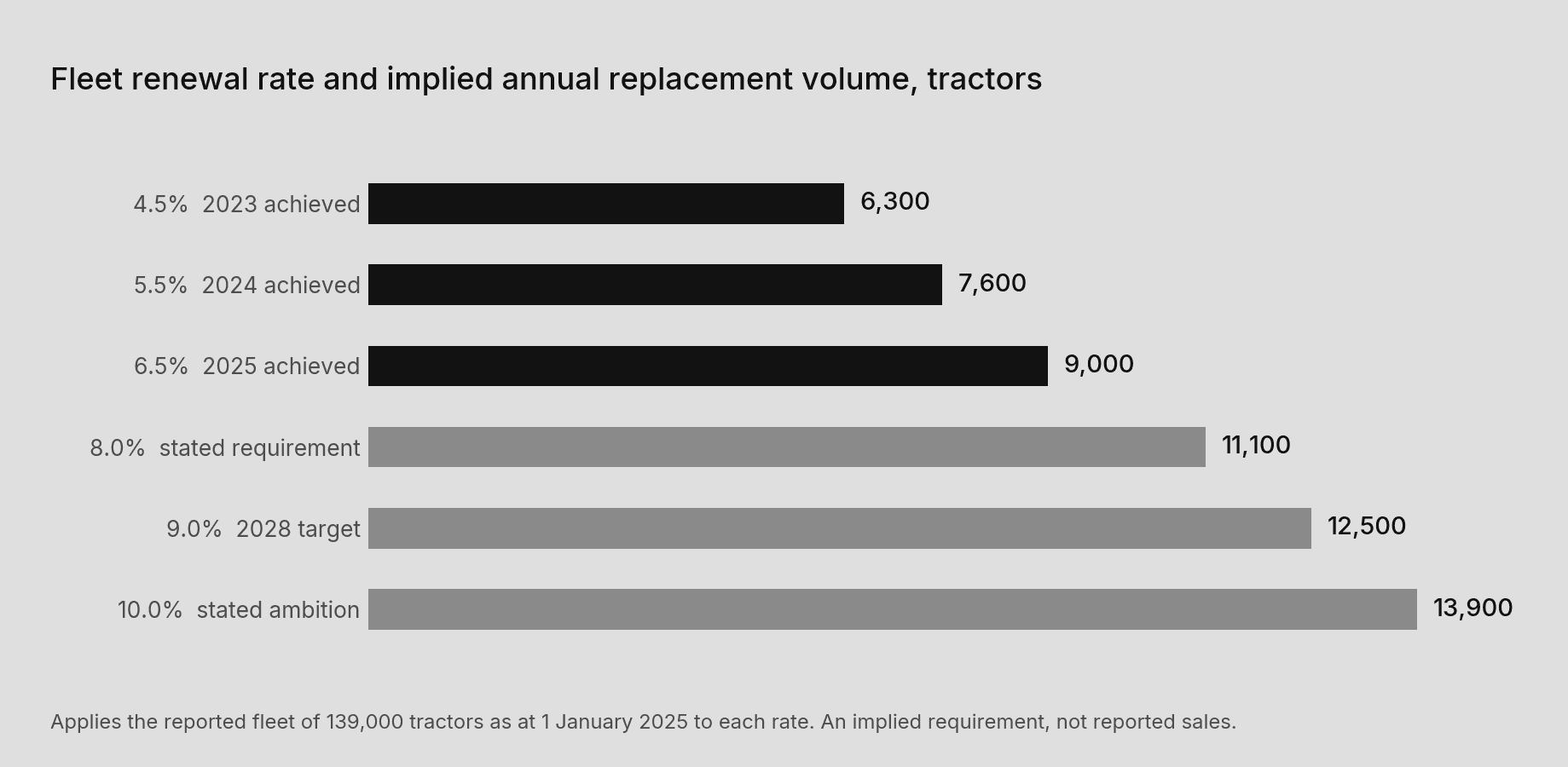
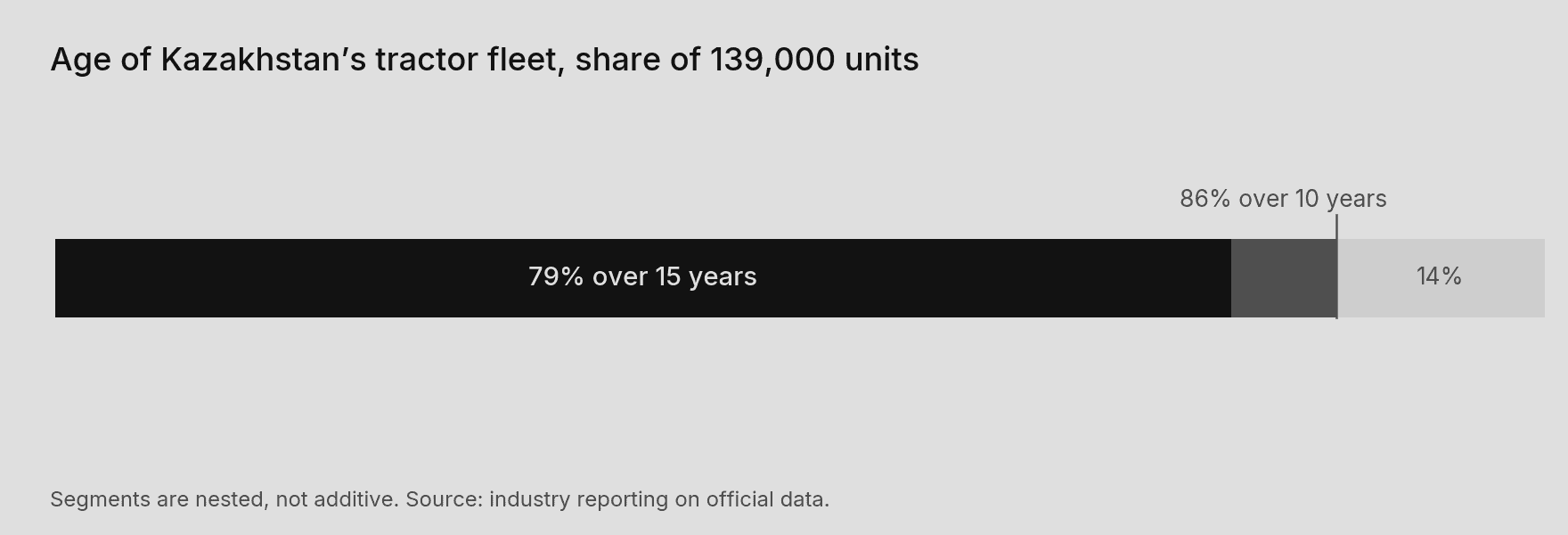
The fleet is old and the state has set a renewal target. Kazakhstan had 139,000 tractors as at 1 January 2025. The renewal rate rose from 4.5 % in 2023 to 5.5 % in 2024 and 6.5 % in 2025. The Ministry states that 8 to 10 % is required to maintain a technologically modern fleet, and is targeting 9 % by 2028. Baiterek has since stated an ambition of 10 % annually.
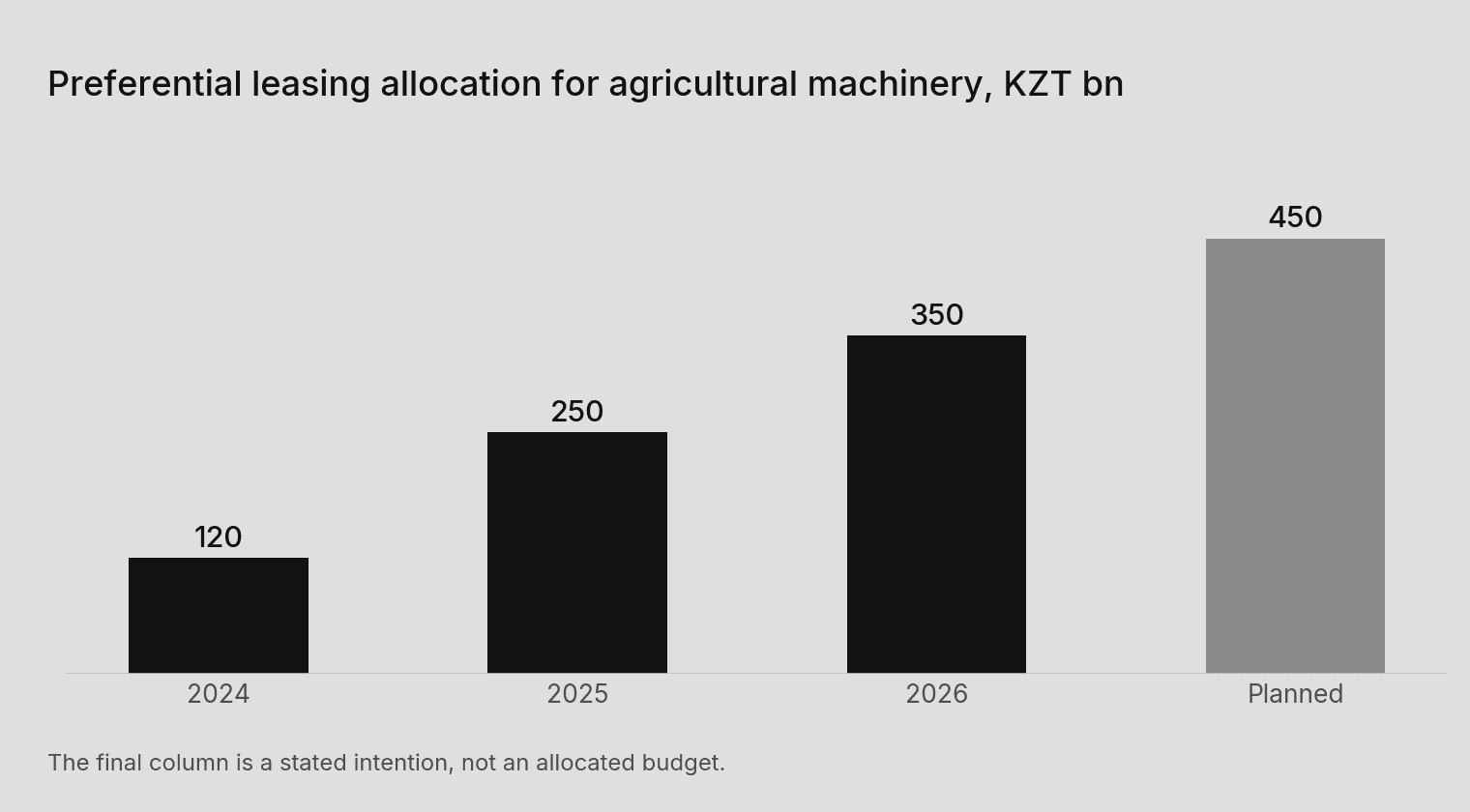
Demand is financed by the state to an unusual degree. Preferential leasing at 5 % was funded at KZT 250bn in 2025 and KZT 350bn in 2026, with a stated intention to reach KZT 450bn. In 2025 KazAgroFinance alone placed 10,393 units of agricultural machinery worth KZT 268.9bn.
That financing is weighted toward domestic machinery. In 2025, 91 % of KazAgroFinance's leasing volume by value went to equipment produced in Kazakhstan. The investment subsidy reimburses up to 30 %of the cost of locally built machinery against 15 to 25 % for imports. Domestically produced machinery reached roughly 90 % of the internal market.
The import channel was tightened further in 2026. From 8 May 2026 the utilisation fee for vehicles and self-propelled agricultural machinery is calculated with separate coefficient columns, one for machines built in Kazakhstan or imported from most countries, and a materially higher one for machines of Russian and Belarusian origin.
Taken together these are not five separate policies. They are one mechanism, and the mechanism has a direction. Demand is being routed toward machines that are built in Kazakhstan.
A note on the numbers
Anyone researching this market quickly discovers that published figures do not reconcile. This is not carelessness on the part of Kazakh statistical bodies. It is a consequence of four different things being counted by four different institutions for four different purposes.
Production is measured by the Bureau of National Statistics in physical units by category. It counts what leaves the factory, not what is sold.
Sales and purchases are reported by the Ministry of Agriculture, usually in aggregate for agricultural machinery, which includes tractors, combines, seeders, sprayers and tillage implements. A statement that farms bought 25,000 units in a year is not a tractor figure.
Leasing placements are reported by KazAgroFinance and reflect only machines financed through that channel. They are a subset of sales, not a proxy for the market.
Imports are recorded by customs under harmonised codes. The tractor code is broader than agricultural tractors and includes small units and road tractors. Kazakhstan recorded 14,481 imported tractors in 2025, down 43.3 %, worth 356.1 million dollars. That is an average of about 24,600 dollars per unit, far below any agricultural tractor of consequence. The figure cannot be subtracted from or added to production data to produce a market balance, and anyone who does so is constructing a number rather than measuring one.
This article therefore does not attempt an apparent-consumption calculation. Where a market size is needed, it is derived transparently from the fleet and the renewal rate, both of which are published by the government, and labelled as a derived requirement rather than a sales figure.
That distinction is the difference between analysis and arithmetic dressed up as analysis.
Local production: from marginal to structural
The production series is the clearest single indicator of what has happened.
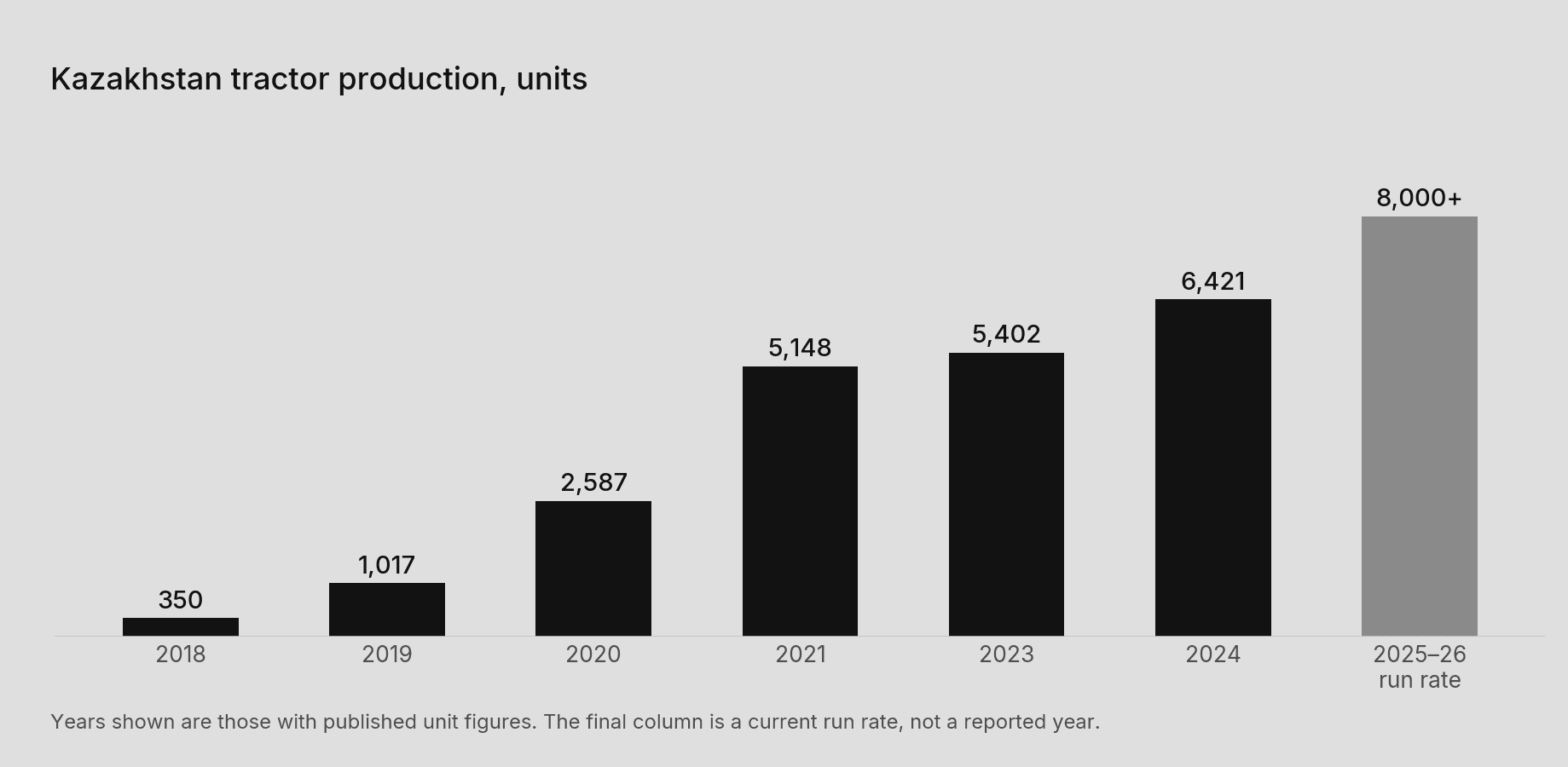
Two features deserve attention.
The step change happened between 2018 and 2021. Output multiplied roughly fifteen-fold in three years. This was not organic growth. It was the response to a policy package, principally the introduction of the utilisation fee in 2020 and the industrial assembly agreement framework, which together made importing finished machines materially less attractive than assembling them locally.
Growth then continued at a slower, steadier rate. From 5,402 units in 2023 to 6,421 in 2024 is an increase of 18.9 %. Strong, but a different kind of growth. The first phase was brands relocating assembly. The second is those assembly operations maturing and new brands arriving.
Three qualifications belong with this series. Unit figures for 2022 and 2025 are not published in a form comparable with the surrounding years, and interpolating them would introduce numbers that do not exist. The 2021 figure is the sum of reported brand volumes published by QazIndustry, not a single headline statistic, so it should be read as an order of magnitude rather than an exact count. The final column is the current annual output of the country's large plants as reported by Baiterek, not a calendar-year statistic, which is why it is shown differently.
The trajectory is clear enough without the missing years. For a foreign manufacturer the practical consequence is that local assembly in Kazakhstan is no longer a differentiator. It is the baseline. A brand without local production competes against nine or more platforms that have it, in a market where financing favours them.
The fleet and where replacement demand comes from
Kazakhstan's tractor demand is fundamentally replacement demand. The country is not adding farmland. It is replacing worn machines.
As at 1 January 2025, government figures put the fleet at 139,000 tractors, alongside 31,000 combines, 5,600 sowing complexes, 71,000 seeders and 141,000 tillage implements.
The age structure is the weakest-sourced significant figure in this article. It comes from industry reporting drawing on official data rather than from a primary statistical release, and should be treated as indicative. It is included because the direction is corroborated by the renewal targets themselves. A government does not set an 8 to 10 % replacement requirement for a young fleet.
The renewal rate produces a demand model that can be built from published government figures alone, without forecasting assumptions.
Each figure is the reported fleet multiplied by the stated rate. These are implied replacement requirements, not reported sales. They apply the current fleet to each rate for comparability, which is why the 2023 and 2024 rows should not be read as historical market size.
What the chart does establish is the gap between where the market is and where policy is pushing it. At the rate achieved in 2025 the requirement is roughly 9,000 tractors a year. At the Ministry's own 2028 target that becomes about 12,500. At the ambition Baiterek has articulated, close to 14,000.
The gap is the opportunity, and it is a policy-created gap. It exists because the state has decided the fleet is too old, not because farm incomes have risen. That has an important implication. The demand is durable as long as the policy holds, and it is exposed if fiscal priorities change.
How demand is financed
Kazakhstan's agricultural machinery market cannot be understood as a private-purchase market. A very large share of it moves through state-backed instruments, which makes any assessment of it partly an exercise in industrial investment advisory for capital projects rather than conventional market sizing.
Preferential leasing. Machinery is financed at 5 % annually for terms up to seven years.
In 2024 that funding allowed 3,870 producers to acquire 4,320 units of domestic machinery.
Investment subsidy. The state reimburses part of the purchase price, from 15 to 30 % depending on the category and priority of the machine, with the upper band reserved for domestically produced equipment.
Scale of the channel. In 2025 KazAgroFinance placed 10,393 units worth KZT 268.9bn, of which 4,249 were tractors worth KZT 104.8bn. In the first half of 2026 the same institution financed KZT 250.5bn, close to double the KZT 126.6bn of the equivalent period in 2025. By August 2026 it had signed 6,974 contracts worth KZT 265bn covering 7,925 machines.
The scale of this channel is substantial, though its exact share of tractor demand cannot be calculated from published data. KazAgroFinance is one financing institution among several, and total tractor sales are not reported separately from aggregate machinery purchases. What can be said is that a single state institution financed 4,249 tractors in a year when domestic plants were producing at a rate above 8,000, and that 91 % of its leasing volume by value went to locally produced equipment.
That is the commercially decisive point. Eligibility for the subsidised leasing and subsidy registers, not price, is the first gate a manufacturer has to pass, and eligibility is tied to domestic production status.
The localisation premium: what domestic status is worth
Kazakhstan does not restrict imports of agricultural machinery. It makes them uncompetitive in the financed segment. The mechanism has three components.
The industrial assembly agreement. A civil-law contract between the authorised state body and a Kazakh legal entity producing agricultural machinery. Entering this category gives access to incentive measures equivalent to the utilisation fee paid, which in effect neutralises a cost that importers bear in full.
The special investment contract. Concluded on the basis of the assembly agreement, it provides exemption from import customs duties and value added tax on components and equipment.
Differential subsidy and leasing treatment. Domestic machinery attracts the upper subsidy band and dominates the leasing register.
The combined effect is visible in the outcome data. In 2025, 91 % of KazAgroFinance's leasing volume by value went to domestically produced equipment. Domestic machinery reached approximately 90 % of the internal market. Over the two years to 2026, sales of Kazakh-built agricultural machinery rose 35 %, from 7,700 to 10,400 units, with demand shifting toward more complex and higher-specification machines.
These instruments are not incentives in the ordinary sense. They are not a bonus on top of a viable import business. They are the difference between competing for the whole market and competing for a tenth of it. For a foreign manufacturer the question is not whether localisation improves margins. It is whether the business exists at meaningful scale without it.
What changed in May 2026
The utilisation fee has been the principal instrument shaping this market since its introduction in 2020. In 2026 its calculation was reworked.
From 8 May 2026 the utilisation payment for vehicles and self-propelled agricultural machinery is calculated by multiplying a base rate, 50 monthly calculation indices or KZT 216,250 in 2026, by a coefficient. The coefficient table now has two columns. One applies to machines produced in Kazakhstan or imported from most countries. The second, materially higher, applies to machines of Russian and Belarusian origin.
The Ministry of Ecology has framed the measure as removing an imbalance relative to utilisation fee levels in Russia and Belarus and levelling access conditions for Kazakh-built vehicles across markets of the Eurasian Economic Union. The Ministry of Industry has been more specific about the commercial problem it addresses. Russian and Belarusian brands are assembled in Kazakhstan under licence, but finished machines were also arriving directly, bypassing those licensing arrangements.
Two implications are frequently misread.
First, this is not a measure that clears space for new entrants generally. It targets a specific parallel-import channel. Its direct beneficiaries are the licensed local assemblers of the affected brands, whose arrangements it protects.
Second, and more importantly for anyone outside that group, it confirms the direction of the whole framework rather than changing it. The state has now used the utilisation fee twice, in 2020 to move assembly into the country and in 2026 to close a route around the licensing that resulted. The consistent principle is that value should be created inside Kazakhstan, and the instrument has been shown to work.
The manufacturing landscape
Kazakhstan has a functioning agricultural machinery manufacturing base. Around ten enterprises produce tractors and combines, with eight to nine of them producing tractors specifically. Production is concentrated in four regions, Kostanay, Akmola around Kokshetau, North Kazakhstan around Petropavlovsk and East Kazakhstan around Semey, with one southern platform in Turkestan region.
The characteristic feature, and the one most often missed by foreign entrants, is that these are multi-brand contract assembly platforms rather than single-brand factories. Assessing them properly is closer to industrial and manufacturing advisory than to conventional market research.
The largest localisation centre in Kostanay assembles Lovol, Deutz-Fahr, Kirovets and, since May 2025, John Deere, alongside Gomselmash combines and implement brands including CLAAS and Amazone. A Semey platform launched conveyor assembly of YTO tractors under licence in 2024, with a design capacity of 3,500 tractors a year, while continuing to assemble commercial vehicles for GAZ, Shacman and DongFeng. A Kokshetau plant produces Rostselmash combines alongside YTO tractors. A Petropavlovsk joint venture assembles CLAAS combines and HORSCH seeding equipment and added a tractor line with capacity of up to 500 machines a year in 2024.
An existing OEM relationship does not close a platform to a further brand. The operating model is designed to carry several. But it does raise a commercial question that no amount of capacity analysis will answer, namely whether the platform's existing arrangements permit a competing brand in the same power band, and whether the owner wants one. Where the answer is no, acquiring a platform rather than partnering with one becomes the alternative, which brings its own buyer-side risks in Kazakhstan.
That question is the real constraint on partner selection in this market, and it is answered in conversation with the people who decide, not in a database. It is the same problem we address in industrial partnership structuring mandates in other sectors.
The OEM localisation wave
The clearest evidence that the policy framework works is the behaviour of manufacturers who have no obligation to comply with it.
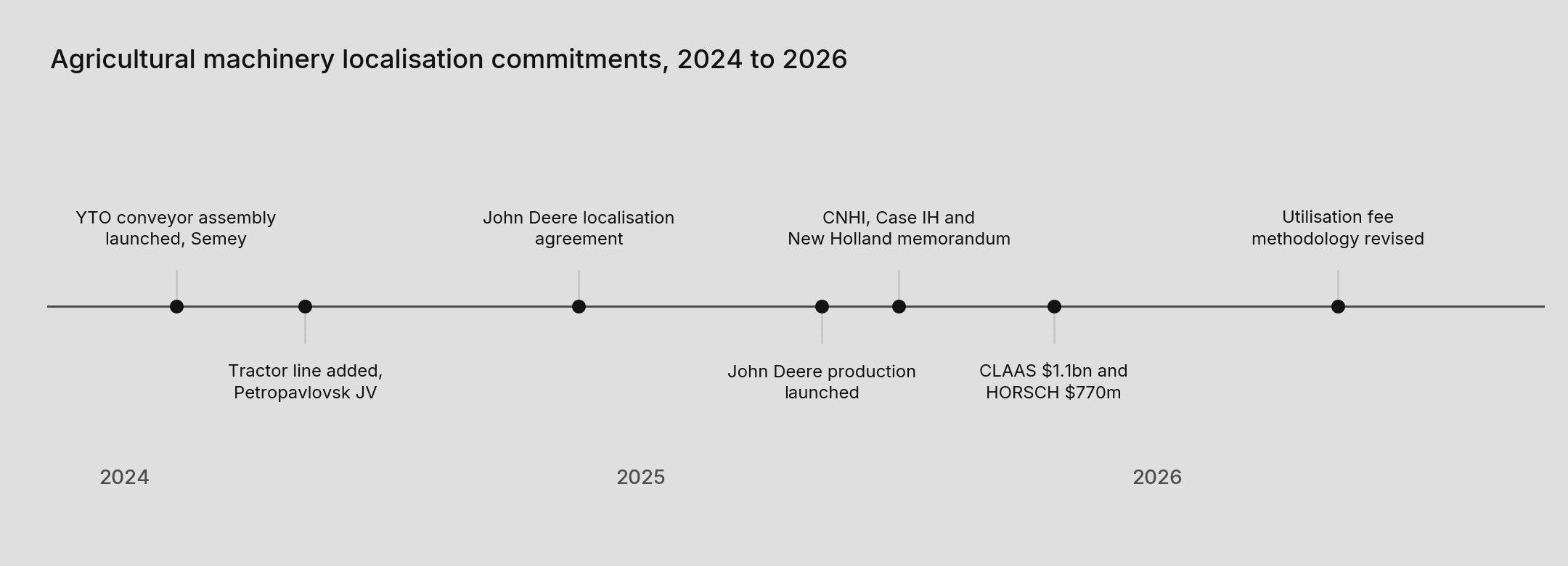
John Deere launched production at the Kostanay localisation centre in May 2025 and had built more than 290 units by November of that year. The strategic agreement signed subsequently provides for output to reach around 3,000 machines over five years across sites in Kostanay and Turkestan, the construction of three service centres, and recognition of Kazakhstan as the brand's regional hub for parts export across the CIS. John Deere has described Kazakhstan as its principal strategic partner in Central Asia.
CLAAS signed a project with Baiterek covering seeder and tractor production valued at 1.1 billion dollars, following discussions on local manufacturing.
HORSCH signed a cooperation agreement with Baiterek valued at 770 million dollars.
Amazonen-Werke agreed a 250 million dollar project with the Kostanay platform.
Zoomlion signed a licence agreement for tractor production at a Saran plant with planned capacity of up to 700 units a year. That facility already builds Yutong, Sinotruk and Scania vehicles, which makes it an example of a non-traditional industrial platform entering the sector.
CNHI International, together with Baiterek and BHK Agro, signed a memorandum on 2 July 2025 to assess assembly and localisation of Case IH and New Holland machinery, covering selection of a production site, investment volume and localisation parameters. This is an assessment agreement rather than a capital commitment, and belongs in a different category from the five above.
The pattern is worth stating plainly. Between 2024 and 2026, five major agricultural machinery manufacturers moved from selling into Kazakhstan to committing capital there, with a sixth evaluating it. They did not do so because assembly in Kazakhstan is cheaper than assembly in Germany. They did so because the alternative was to concede the financed segment of a growing market.
Structural drivers
Four forces support demand over the medium term, and they are of different quality.
Fleet age is the strongest and most durable. With the great majority of tractors over ten years old, replacement demand is not a cyclical phenomenon. It is a backlog, and backlogs clear slowly.
Policy commitment is strong but not permanent. The renewal targets, the leasing allocations and the subsidy rates are all decisions that can be revised. They have moved consistently in one direction for six years, which is meaningful evidence, but they are political rather than structural.
The regional export position is real but unproven at scale. Kazakhstan's location and trade connectivity make it a plausible base for serving Central Asia and the wider CIS. John Deere's designation of the country as a regional parts hub is the first substantive commitment to that logic by a major manufacturer. Whether machine exports follow at volume is not yet demonstrated.
Agricultural output growth is supportive but secondary. Demand here is driven more by the condition of the existing fleet and the availability of financing than by farm profitability in any given season.
Constraints and risks
An honest assessment has to name what could go wrong. Several of these are execution risks rather than market risks, and they mirror the issues we see across industrial investment in Kazakhstan more broadly.
Fiscal dependence. A market in which state-supported leasing carries a large share of volume is exposed to fiscal decisions. The allocation has risen every year since 2024, but budget priorities shift, and a reduction would be felt immediately.
Platform concentration. The number of platforms capable of hosting a serious tractor programme is limited, and several sit within related ownership structures. Practical choice is narrower than the plant count suggests.
Portfolio conflict. Most established platforms already carry brands within the 20 to 125 horsepower band where the volume sits. A new entrant is frequently asking a partner to compete with itself.
Localisation depth. Access to the domestic register requires progressive localisation of components, not simply final assembly. Kazakhstan's component supply base is thin, and meeting content requirements over time is a genuine engineering and sourcing challenge rather than a paperwork exercise.
Dealer and service coverage. A tractor without service capability in the northern grain regions does not sell, regardless of price or subsidy status. Building that network is a separate investment from building assembly capacity, and it is often underestimated. The economics of it are closer to distribution and channel strategy than to manufacturing.
Regulatory volatility. The utilisation fee has been reworked twice in six years. The direction has been consistent, but the specific coefficients are set by ministerial order and can change, which places a premium on governance and compliance for foreign-owned businesses.
Outlook to 2030
Two scenarios follow from the published data without requiring invented growth rates.
Base case. The renewal rate holds around its 2025 level of 6.5 %. Annual tractor replacement demand runs at roughly 9,000 units. Local production continues its recent trajectory and absorbs the great majority of it. Leasing allocations continue at current levels. The market grows slowly, and competition intensifies among platforms that already exist.
Policy-delivery case. The Ministry reaches its stated 9 per cent renewal target by 2028 and moves toward the 10 % ambition thereafter. Annual replacement demand rises to between 12,500 and 14,000 tractors. Leasing funding reaches the planned KZT 450bn. Local production capacity has to expand materially to meet it, and the current platform base becomes a constraint rather than a sufficiency.
The second scenario is the one that matters commercially, because it is the only one in which new manufacturing capacity is required. It is also the scenario the state has publicly committed to. The gap between the two, roughly 3,500 to 5,000 tractors a year, is the addressable space for new entrants. Precedents for building manufacturing capacity in the region on that logic exist, including manufacturing investment in Central Asia outside the machinery sector.
The honest caveat is that the base case has been the outcome more often than the target case. Renewal has risen consistently, but it has risen by about one percentage point a year, and reaching 9 % by 2028 requires that pace to continue without interruption.
What this means for international manufacturers
Six practical conclusions.
Import-led entry is no longer a scaling strategy. It remains possible to sell machines into Kazakhstan. It is not possible to build meaningful share while competing against domestically produced equipment for subsidised leasing and the upper subsidy band.
The entry decision is a localisation decision. The question is not whether to enter, but on what basis. Assembly with progressive localisation is the established route, and the framework of industrial assembly agreement, special investment contract and subsidy eligibility is designed around it. This is market entry and business expansion with a manufacturing commitment attached, and it should be planned as such from the outset. Our note on how foreign mid-market companies enter Kazakhstan covers the mechanics in more general terms.
Manufacturing capability is not the binding constraint. Kazakhstan has platforms with the equipment, the space and the workforce. The constraint is commercial, namely whether a given platform's existing arrangements allow a further brand and whether its owner has the appetite and the capital to co-invest.
Regulatory status matters more than regulatory relationships. A partner that already holds an industrial assembly agreement and a special investment contract starts years ahead of one that merely has good standing with the ministries. These are documents, not connections.
Distribution and service are part of the entry cost, not a later phase. The grain regions of the north are where the volume is, and coverage there is a precondition of competing rather than a consequence of succeeding.
Timing is a live consideration. The current wave of commitments is absorbing the platforms best suited to hosting new programmes. The number of credible partners is finite, and it is being reduced by decisions taken in 2025 and 2026.
How we work on mandates of this kind
Tretiakov Consulting advises foreign manufacturers, investors and industrial groups on entering, localising and building manufacturing positions in Kazakhstan and the wider region.
Work in this sector typically involves validating the realistic universe of industrial partners, verifying ownership and decision-making structures, reaching beneficial owners rather than commercial departments, and assessing each counterparty on manufacturing capability, investment appetite, localisation potential and preferred cooperation model, before any commitment is made.
That work is led personally at partner level, with regular presence on the ground, because a judgement on whether an owner will actually commit is not something that can be delegated or desk-researched.
If you are assessing Kazakhstan as a manufacturing, localisation or market-entry destination, we would be glad to discuss it with you.
Our insights