
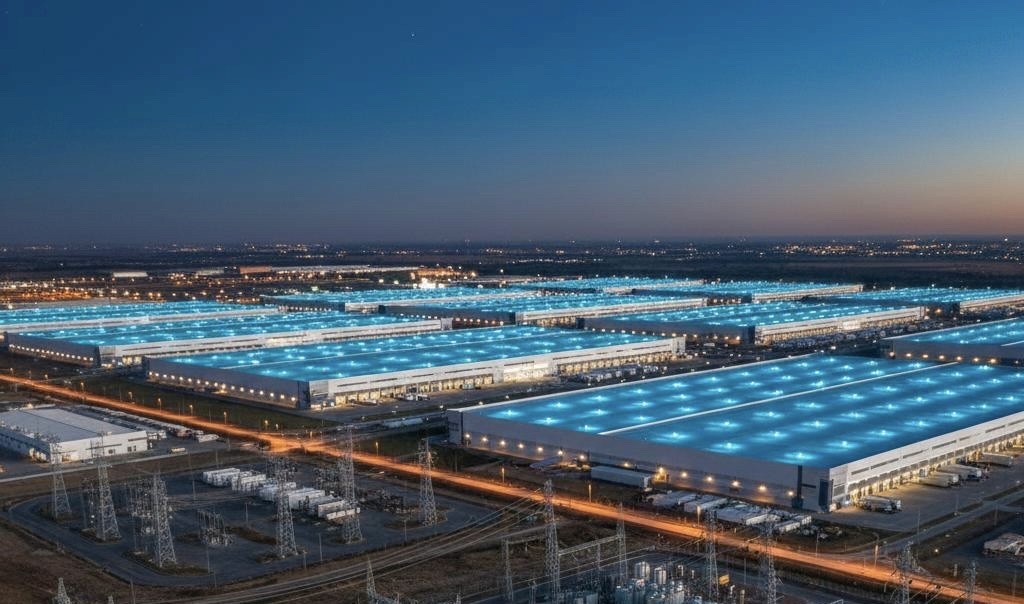
The number of places in Kazakhstan formally designated for industrial investment has grown quickly. In April 2026 QazIndustry, which runs the unified coordination centre for the zones, reported 17 special economic zones (SEZs) in 14 regions, three of them created in 2025, and its website lists 67 industrial zones. Four days after that count was published, the government established another SEZ in Zhambyl region, on the border with Kyrgyzstan.
The same period also produced a blunt official statement of what designation does not guarantee. At an expanded government meeting in February 2026, Prime Minister Olzhas Bektenov put average infrastructure provision at only 53% in SEZs and 48% in industrial zones and said KZT 1 trillion would be invested over three years, with funding raised through the Islamic Development Bank, to close the gap. At the same meeting the President called the existing SEZ model exhausted and warned that money alone would not resolve its systemic problems.
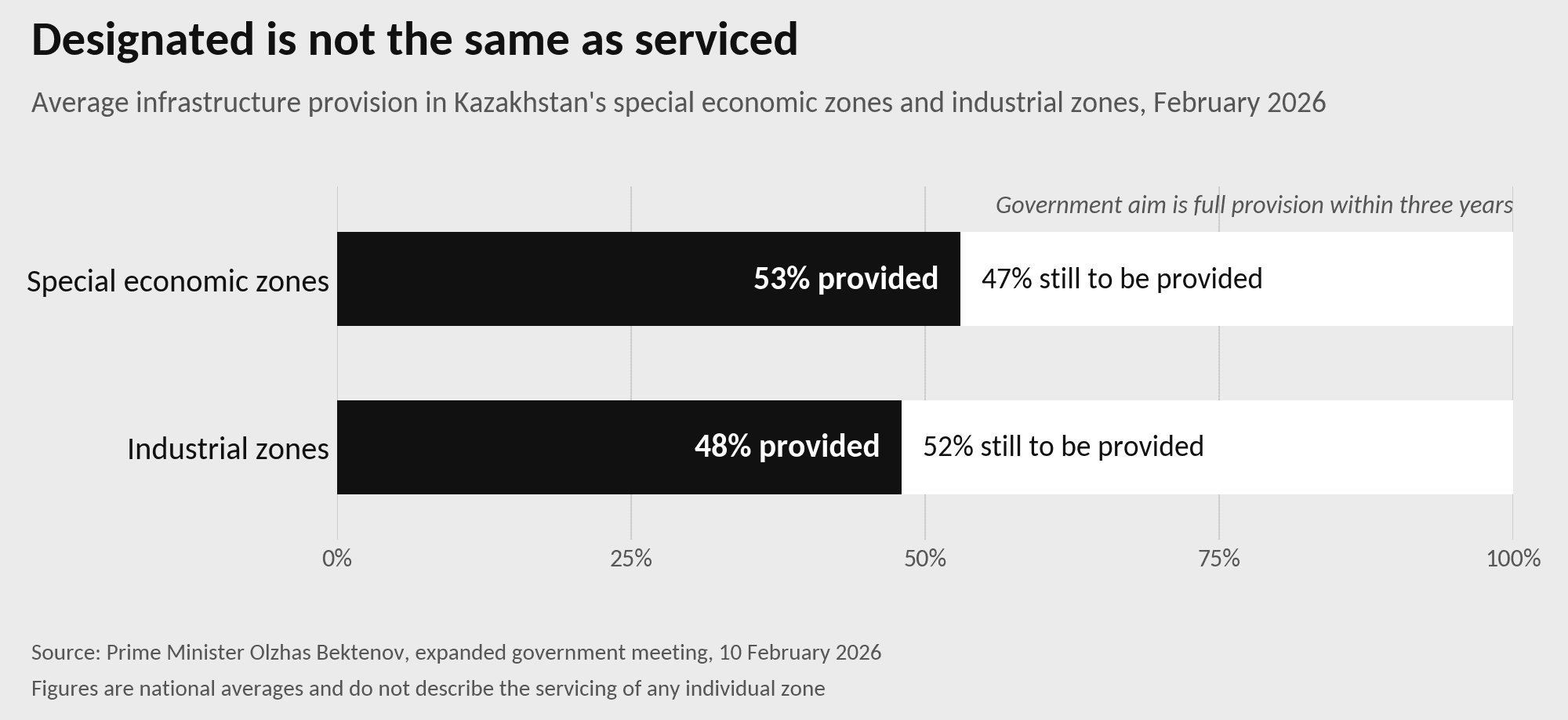
Average infrastructure provision in SEZs and industrial zones in February 2026, as reported by the Prime Minister. The figures are national averages.
For a manufacturer deciding where to build a plant in Kazakhstan, the implication is that designated industrial land is not the same thing as a production-ready site. Whether the country is an attractive and executable place to manufacture is a separate question, covered in our analysis of industrial investment in Kazakhstan and set within the wider Kazakhstan investment and business context. This article asks what materially changes when a manufacturer chooses one location rather than another, which of those differences public evidence could establish as of September 2026, and where project-specific due diligence has to take over.
Kazakhstan's manufacturing map has widened without becoming uniform
Manufacturing has gained weight within the industrial economy. According to the Bureau of National Statistics (BNS), it accounted for 49.8% of industrial output in 2025, up from 46.9% in 2023.
The geography of that capacity has changed far less. The Ministry of Industry and Construction's December 2025 review of the sector shows that Karaganda region, East Kazakhstan and Pavlodar region together produced about a third of the country's manufacturing output between 2020 and 2024, even though every region increased its output over the period. Employment follows the same pattern. The three regions with the largest manufacturing workforces, Karaganda region, Almaty city and Pavlodar region, held 31.1% of the sector's employment in 2022 and 29.8% in 2024, a fall of little more than one percentage point in two years.
New capital is spreading more widely than existing capacity. Manufacturing investment in 2025 was largest in Karaganda and Atyrau regions, followed by Zhambyl, Almaty, Kostanay and Pavlodar regions, while West Kazakhstan and Kyzylorda regions recorded increases of 5.5 and 4.2 times. Jumps of that size from a low base usually reflect a year of heavy project spending and do not yet make an industrial centre. Kyzylorda offers a longer signal, since the ministry records it as the region with the largest real increase in manufacturing output since 2020, but a growth rate says nothing about the size of the base it starts from. In December 2025 the Prime Minister stated that most of the country's industrial projects are being implemented in SEZs and industrial zones, which makes the condition of those zones central to where new capacity ends up.
Two cautions apply to any comparison over time. The creation of Abai, Zhetysu and Ulytau regions in 2022 divided the former East Kazakhstan, Almaty and Karaganda regions, so regional series do not always describe the same territory before and after that year. Output and employment also show where capacity already sits, whereas investment shows where it may sit if projects are completed. A newer location may therefore offer land and zone status without an industrial labour market or production base of the depth found in the established centres.
What actually differs between manufacturing geographies
The material differences do not require twenty regional profiles. The evidence supports six manufacturing geographies, grouped by where output, employment and investment are concentrated and by how each is positioned in transport and utility networks. They are analytical groupings rather than a ranking, and individual sites within each can differ sharply from its average.
Six manufacturing geographies at a glance |
|---|
Almaty city and the south-east, including Almaty and Zhetysu regions, has the second-largest manufacturing workforce and a growing cluster of vehicle and component plants. It is the largest urban labour market, with wages in Almaty city 24% above the national average. Freight to China runs through Altynkol–Khorgos, and the area borders Kyrgyzstan. The main constraint is the southern power zone, which relies on transit from the north. |
Astana and Akmola region are not leading manufacturing regions by output or employment. Astana has the fastest population growth in the country and wages 32% above the national average, the highest of the three largest cities. It serves the capital-region market and has no external border. |
The central and north-eastern belt of Karaganda, Pavlodar, East Kazakhstan and Abai has the deepest industrial base, built around metallurgy and heavy processing, with Karaganda, East Kazakhstan and Pavlodar alone producing about a third of manufacturing output between 2020 and 2024. It has the largest manufacturing workforce, but wages in Karaganda region are 5% below the national average and three of the four regions recorded population outflows in 2025. The double-tracked Dostyk–Moyinty line links the belt to China, and Pavlodar and Abai regions have no piped gas. |
The northern belt of Kostanay and North Kazakhstan has vehicle assembly in Kostanay, backed by a localisation centre for automotive components. Wages in Kostanay region are 14% below the national average and both regions recorded population outflows in 2025. Road and rail links run directly to Russia, and North Kazakhstan has no piped gas. |
The south, covering Shymkent, Turkistan and Zhambyl, combines high manufacturing productivity in Shymkent with Zhambyl's third place for manufacturing investment in 2025. Turkistan is second only to Almaty city in population, while wages in Shymkent are 24% below the national average. A rail link towards Uzbekistan is due by the end of 2026 and a new SEZ has been created at Korday on the Kyrgyz border, but the south shares the southern power zone and the cross-border industrial centre is not yet open. |
The west and Caspian, covering Atyrau, Mangystau, Aktobe and West Kazakhstan, has an industrial base centred on oil, gas and petrochemical processing, and Atyrau leads the country on manufacturing productivity. Regional wages are among the highest, shaped by the extractive sector. The Aktau and Kuryk ports connect the region to the Caspian route, while Atyrau, Mangystau and West Kazakhstan form a power zone not yet joined to the rest of the national grid, with unification due by the end of 2027. |
Wages are BNS averages for Q1 2026 in Almaty, Astana, Karaganda region, Kostanay region and Shymkent, compared with the national average of KZT 461,486 and excluding small businesses. Western wages come from regional data for Q2 2026.
The geographies differ less in any single attribute than in the combination, which is why the same evidence can point to different locations for different projects.
Existing industrial ecosystems matter most where a plant relies on tiers of suppliers, and vehicle manufacturing shows how quickly such an ecosystem can form. Between 2024 and 2025 a KIA plant in Kostanay and a multi-brand plant in Almaty came into operation, with combined design capacity of 190,000 vehicles a year. Component production has followed, with a localisation centre in Kostanay, plants making seats, multimedia systems and climate modules in Almaty, and a tyre plant in Saran in Karaganda region. A component maker's factory location is therefore largely set by the assemblers it serves. Where supplier data are thin, industrial concentration is useful context, but it does not prove that a particular input can be sourced locally, and that has to be tested supplier by supplier.
The question often put as "Almaty or Astana for production?" is best read as one instance of a general trade-off. Almaty is the largest city, with 2.36 million residents in April 2026, and has the deeper manufacturing workforce, but it sits in the southern power zone. Astana gained 109,530 residents in 2025, more than any other region, but its wages are the highest of the three largest cities. Neither fact settles the choice. The answer depends on whether a project's binding constraint is proximity to demand, labour cost, freight direction or power reliability, and on where the demand the plant is intended to serve is actually located.
Labour changes the map, but wages explain only part of it
Wage levels diverge widely between the main manufacturing geographies. In the first quarter of 2026 the average monthly wage in Astana was about 1.7 times that in Shymkent, and both Karaganda and Kostanay regions were below the national average. By the second quarter the national average had reached KZT 486,388, higher than a year earlier in nominal terms but lower in real terms.
Regional averages are nevertheless a weak guide to what a manufacturer will pay, because they blend sectors that pay very differently. In the second quarter of 2026 average pay in mining was twice the national level, while manufacturing fell within the KZT 400,000 to 584,000 range that also contains the all-economy average. Where extraction is a large employer, the regional average says more about extraction than about manufacturing. Manufacturing pay is also rising quickly. The ministry's review puts the sector's average wage at KZT 477,900 in 2024, twice its 2020 level, so a wage assumption drawn from a single year's data will date fast.
Population is an equally weak guide to labour availability by region. National population grew in 2025, but the growth was concentrated in Astana, Almaty, Shymkent and Almaty region, while BNS data showed population outflows from nine regions, including Karaganda, Kostanay, North Kazakhstan, Turkistan and Zhambyl. Turkistan, the most populous region after Almaty city, recorded a further fall in population in the first quarter of 2026. These data show where people are moving, but not whether they have the skills a plant needs.
The most direct public measure of an existing industrial workforce is manufacturing employment, which in 2024 was highest in Karaganda region (68,200), Almaty city (62,700) and Pavlodar region (55,600). Those figures show where experienced manufacturing workers are concentrated, but not in which trades, at what qualification level or how many would be available to a new employer rather than retained by incumbents. Productivity data carry the same limitation. The ministry ranks Atyrau region, Karaganda region and Shymkent highest for manufacturing output per worker in 2024. That pattern is consistent with the capital-intensive refining, petrochemical and metallurgical capacity located there and says little about a workforce advantage that would carry over to other industries.
The public statistics reviewed here provide no comparable regional measure of specific industrial skills. The availability of welders, maintenance technicians or process engineers for a particular plant, and the pay needed to attract them from existing employers, can be established only through project-level recruitment testing. It is the same limit of national evidence that constrains commercial due diligence.
Logistics advantage depends on where materials come from and where products go
Kazakhstan's logistics geography is directional, and location choices should be read the same way. In 2025 Russia supplied 29.7% of the country's imports by value and China 29.2%, according to BNS trade data. For a manufacturer dependent on imported inputs, the corridors from those two neighbours shape inbound logistics more than a central position on the map does.
The China-facing corridor carries the largest volumes. In 2024 the Dostyk–Alashankou and Altynkol–Khorgos rail crossings handled about 32 million tonnes between them. The second track on the Dostyk–Moyinty line, fully opened in September 2025, links the main China crossing to central Kazakhstan on double track, and officials expect capacity on the line to rise from 12 to 60 pairs of trains a day. From Moyinty, a new line to Kyzylzhar is due by the end of 2026. A third crossing, Bakhty–Ayagoz in Abai region, is under construction with its first stage targeted for the end of 2027, and in April 2026 the sovereign wealth fund Samruk-Kazyna ordered the railway to eliminate delays on the project. None of this capacity tells an investor whether a particular site can obtain a siding, wagons or border slots on the schedule its production requires.
The west-facing route is growing from a smaller base. Maritime transport carried 8 million tonnes of freight in 2025, and a new container hub was completed at Aktau. That is roughly a quarter of the tonnage that crossed the two China rail borders a year earlier. The Caspian route matters for western locations and west-bound exporters, but at these volumes it does not yet reorder location logic for the country as a whole.
Central Asian flows point south. The Darbaza–Maktaaral line in Turkistan region, intended to give southern districts a direct link to the main network and to relieve Saryagash station on the route to Uzbekistan, is also due by the end of 2026. On the Uzbek border, the International Centre for Industrial Cooperation "Central Asia", a site divided equally between the two countries, is due to open in the first half of 2027. On the Kyrgyz border, the new SEZ at Korday has been set up as an industrial, trade and logistics complex. These projects would change the southern location offer materially, but the rail line and the cooperation centre remain targets until they are commissioned.
The northern corridors serve the other principal source of imports, and the northern belt's road and rail links run directly to Russia. For domestic distribution, market size and distance matter more than corridors. Astana lies more than 1,000 kilometres by road from both Almaty and Shymkent, so a plant serving the whole national market faces long outbound hauls wherever it stands. The public sources reviewed here do not provide origin-to-destination freight costs that would support a location-by-location cost comparison, and rail access to an individual plot is a project in its own right, as the Kostanay example below shows.
Industrial land is not the same as a production-ready site
The law on special economic and industrial zones defines an industrial zone as territory provided with engineering and communications infrastructure and made available to private businesses. The February 2026 figures show how far practice sits from that definition, but they are national averages. They do not mean that every zone is half-serviced, since some may be fully equipped and others barely. In December 2025 the government's planning instruction was framed around priority zones, and by February 2026 its stated aim had become full provision within three years. What the averages do show, for any investor assessing industrial land in Kazakhstan, is that designation has run ahead of servicing.
For industrial site selection in Kazakhstan, infrastructure evidence therefore has to be read at five levels, from the region down to the zone, the plot, the connection and finally the usable capacity. At regional level the question is whether a high-voltage line, gas trunk pipeline or water source exists nearby. At zone and plot level it is whether that network reaches the zone boundary and whether internal networks reach the plot, and who builds them. At the last two levels it is whether the utility will issue technical conditions for this project, on what terms and by when, and whether the permitted load, reliability category, pressure and volume suit the process. Public evidence is plentiful at the first level, partial at the second and largely absent at the other three.
Electricity shows why the distinction matters. Under the Rules for the Use of Electric Energy, the technical conditions issued to a new consumer specify the permitted capacity, the reliability category and the connection point, and they may impose justified requirements to reinforce the existing network, such as larger conductors, replacement or uprating of transformers, or additional switchgear. A line or substation next to a site is not evidence that the project's load is available.
The system behind the connection also differs by region. The national electricity deficit fell by 29% in 2025, but peak demand was still partly met by imports. On 14 August 2026 the loss of 600 MW at the Toktogul hydropower plant in Kyrgyzstan overloaded the North–South transit. Emergency automation separated Kazakhstan's southern zone from the unified power system, and supply was interrupted in Almaty and several southern and central regions, much as it had been in a comparable event in January 2022.
KEGOC's reinforcement of the southern network, due by mid-2027, is designed to add 440 MW of north–south transit capacity. The operator's own interim accounts for the first half of 2026 acknowledge that some of its high-voltage lines have reached, or are nearing, the end of their standard service life. The same contracted capacity therefore carries different system risk in the south, in the western zone and in the north, where generation has historically been concentrated.
Gas draws a harder line. In mid-2026 the Ministry of Energy put the country's gasification level at 64.2%, and at the start of the year North Kazakhstan, Pavlodar and Abai regions had no piped gas at all. The 2023–2030 General Scheme of Gasification had anticipated extending the Saryarka pipeline to Kokshetau and Petropavlovsk by 2025. That target was missed for Petropavlovsk, the regional capital of North Kazakhstan, and the ministry now links gas supply for the north to an Ishim–Astana pipeline, the subject of a memorandum signed with Gazprom in October 2025 to supply Astana, Kokshetau and Petropavlovsk. For a gas-dependent process, those three regions are not a question of degree, and a memorandum does not give a supply date.
Water is the least documented variable at site level. A new Water Code was signed in April 2025 and entered into force that June, with some provisions deferred to January 2027. National projections of future water deficits differ in size and horizon, and none of them says anything about a particular plot. Abstraction limits, utility supply and discharge conditions have to be confirmed for the plant itself.
The KIA plant in Kostanay shows what plot-level readiness involves even inside a designated zone. The factory was allocated a 70-hectare plot in an industrial zone, and the regional authorities then provided it with 4.2 kilometres of roads, 5.25 kilometres of rail sidings and 44.5 kilometres of engineering networks. In other words, the plot's readiness was delivered as a project for this plant rather than inherited from the zone. This is the point at which regional evidence gives way to industrial investment and capital-project decisions. Which constraints actually bind then depends on the plant itself, on its load profile, gas and water use and rail needs, and ultimately on what localisation commits the manufacturer to.
SEZ, industrial zone or greenfield site
The three site configurations resolve different parts of the execution problem, and none removes the need for plot-level verification.
A special economic zone is a defined part of the national territory under a special legal regime. Under the zones law, it is created for up to 25 years, a term the government may extend, and it is run by a management company. Participants carry out activities on the zone's priority list and are entered in a unified register. SEZ status has fiscal and customs consequences, and in some zones, including the new SEZ at Korday, the free customs zone procedure applies. Whether those benefits should sway the investment decision is not assessed here. The model itself is in flux. In February 2026 the President ordered a new SEZ model to be approved within three months, and the sources reviewed for this article did not confirm its approval by September 2026.
An industrial zone is defined by infrastructure rather than by a special legal regime. Zones may be of republican or regional significance or privately established. Since 2021 the law has also allowed special industrial zones, which are private zones where international building codes and foreign standards may be applied directly. That matters to investors whose plant designs follow non-Kazakh norms. In SEZs and industrial zones alike, the management company allocates land plots among participants.
A manufacturer may still look beyond the zone network when something else determines the manufacturing site, such as a raw material source, a single large customer, access to an existing rail line, a land requirement no zone can meet or room for later expansion. The investor then carries the full connection route for power, gas, water and wastewater, together with any network reinforcement. Public evidence supports no general claim that standalone sites are cheaper or faster than zones, or the reverse.
What each site configuration can and cannot establish |
|---|
A special economic zone provides the legal regime, management company, priority list and tax and customs treatment described above. It does not establish whether the plot is serviced, what power, gas, water and discharge conditions apply, whether the activity is on the priority list or how long connection will take. |
An industrial zone, whether republican, regional or private, provides territory intended to carry engineering infrastructure and, in its special form, direct use of international building norms. It does not establish whether the plot has actually been serviced, what connection capacity and reliability category are available, who builds the internal networks and when, or whether rail access is possible. |
A standalone greenfield site lets the investor choose a location for raw materials, customers or rail and set the land area and room for expansion. It leaves open the land rights and permitted use, the route and cost of every utility connection, any network reinforcement, the feasibility of a rail siding and the permitting sequence. |
The geography is still changing
A future development belongs in a site decision only if it changes a location variable within the project's timeframe. The table below classifies the developments that meet that test by their status in September 2026.
Developments that could change location conditions
Development | Location variable affected | Status (September 2026) | Stated timing |
|---|---|---|---|
Dostyk–Moyinty second track | China-facing rail capacity into central Kazakhstan | Operational | Opened September 2025 |
Aktau container hub | Caspian container handling | Operational | Completed 2025 |
SEZ at Korday, Zhambyl region | Kyrgyz-border site for industry, trade and logistics | Legally established | Created April 2026, term to 2051 |
Special legal regime of Alatau citynear Almaty | Business conditions in the new city | In force since May 2026 | Businesses to re-register by July 2027 |
Darbaza–Maktaaral and Moyinty–Kyzylzhar rail lines | Uzbekistan-facing and cross-country routes | Under construction | Government target end-2026 |
Bakhty–Ayagoz, the third China rail crossing | China-facing capacity in the east | Under construction, behind schedule | First stage targeted for end-2027 |
KEGOC southern network reinforcement | Transit into the southern power zone | Under construction | Mid-2027 |
KEGOC unification of the western power zone | Grid integration of western Kazakhstan | Under construction | End-2027 |
SEZ and industrial-zone infrastructure programme | Zone and plot servicing | USD 1.3 billion Islamic Development Bank framework (February 2026) and forward leasing agreements (July 2026), zone allocations not found in public sources | Three years from February 2026 |
International Centre for Industrial Cooperation "Central Asia" | Uzbekistan-border production site | Agreement ratified in 2025 | Opening targeted for H1 2027 |
Ishim–Astana gas pipeline, 80% gasification, 26 GW of new generation and a North–South direct-current line | Northern gas access and system capacity | Memorandum, targets and plans | Targets set for 2035 |
Three points stand out. The most consequential near-term changes are in rail and grid capacity rather than in new zones, with the Dostyk–Moyinty double track already operating and both grid projects due in 2027. Stated dates have moved before, as Bakhty–Ayagoz and the missed 2025 gas target for Petropavlovsk show, so a target date belongs in a scenario rather than a construction plan. Finally, the zone programme matters to site selection only zone by zone. Until allocations and delivery schedules are published for specific zones, no investor can assume that a given zone will be serviced in time for its own construction.
A location becomes harder to change as the project advances
This analysis identified no credible Kazakhstan-specific estimate of what it costs to reverse a site decision, and none is offered here. The more useful question is how commitment builds up.
At the land stage the commitment is largely contractual. Site preparation and utility connections then add costs tied to the plot, since connection charges and any reinforcement required by the technical conditions cannot be moved elsewhere. Dedicated infrastructure, such as the sidings, roads and networks provided for the Kostanay plant, has little value anywhere else. Construction fixes the process layout to the site. Recruitment and training create a workforce that lives near the plant, and suppliers and customers gradually organise their own operations around it, as the component plants that have grown up near Kazakhstan's vehicle assemblers illustrate.
Each step turns a location choice into a location dependency. Site evidence therefore has its greatest value before the first plot-specific payment, and infrastructure delivery risk needs to be built into project governance from the outset rather than discovered during construction.
Conclusion
There is no best region for a factory in Kazakhstan in general, because the country's manufacturing geographies combine four variables in different ways. The existing industrial base remains concentrated, with Karaganda, East Kazakhstan and Pavlodar leading on output and Almaty city second on manufacturing employment, even as new investment spreads further. Average wages in the largest cities differ by a factor of about 1.7, and population is moving towards Astana, Almaty and Shymkent. Freight moves mainly along China- and Russia-facing corridors, with Caspian and Central Asian routes growing from smaller bases. Utility positions differ in kind as well as degree. The southern power zone depends on a north–south transit whose overload cut it off from the national grid in August 2026, the western zone is still awaiting connection to the rest of the grid, and three regions have no piped gas.
Taken together, the evidence shows that Kazakhstan has widened its range of industrial locations faster than it has made them ready for production. That widening is so far more visible in investment flows and zone designations than in where manufacturing capacity and the industrial workforce actually sit.
The distinction that matters most lies between two kinds of fact. That a zone exists, that a corridor runs past it and that a region pays a given average wage can be read from public records. Whether a particular plot can take a particular plant's load, gas, water and freight, at a known cost and by a known date, is established only through technical conditions, capacity confirmations and delivery commitments for that project. The first set of facts narrows the search, and only the second can justify committing capital to a plot.
For manufacturers and investors weighing specific sites in Kazakhstan, Tretiakov Consulting assesses feasibility and execution risk before capital is committed. Discuss your project with us.