

Kazakhstan's Bureau of National Statistics counted 441,982 active legal entities at 1 May 2026. The shape of that population matters more than its size. Among active small and medium-sized business subjects at 1 January 2026, individual entrepreneurs accounted for 71.6%, small legal entities for 17.1% and medium-sized legal entities for 0.1%. Almost every expansion of Kazakhstan's formal information architecture over the past five years, from mandatory electronic invoicing and IFRS obligations to a beneficial ownership register and a consolidated procurement platform, has been calibrated to large companies or to the state itself. That leaves the privately held partnership that a foreign strategic buyer is most likely to examine outside most of it.
The gap between what the state now records and what a buyer can read is what commercial due diligence in Kazakhstan has to close. The difficulty is rarely unreliable data. It is the discipline of establishing which questions the public record can settle, which it can only frame, and which can be answered nowhere except inside the target.
What the formal record now contains
Reporting obligations begin with the Law on Accounting and Financial Reporting, which requires large business entities and public interest organisations to prepare financial statements under IFRS. Only public interest organisations have to file those statements with a state depository, by 31 August of the following year. The public interest category covers financial institutions, joint stock companies other than non-commercial ones, and subsoil users apart from those extracting common minerals. It also covers grain receiving enterprises, state enterprises operating under the right of economic management, subjects of state monopoly and special rights, and entities with state participation in their charter capital together with their affiliates. Under the Entrepreneurial Code a large business entity is one with more than 250 employees or annual income above three million monthly calculation indices, which is KZT 12.98 billion at the 2026 index of KZT 4,325. A company below those thresholds reports under national standards, and a privately held partnership with no state shareholder and no subsoil licence publishes nothing at all whatever its size.
The audit perimeter narrows that picture further, and the structure of the statutory test explains why. Under the Law on Auditing Activities a limited liability partnership falls into mandatory audit only where two conditions hold at the same time. Some participants must hold less than 10% of the charter capital, and the company must employ more than 250 people on average or earn more than three million monthly calculation indices a year. A partnership owned by two shareholders in equal halves fails the first condition whatever its turnover. A Kazakhstan target can therefore be large enough to owe IFRS accounts, profitable enough to command a competitive sale process, and still have neither a statutory auditor nor a published financial statement.
While corporate reporting obligations have stayed where they were, tax administration has advanced quickly, and it now produces the richest formal record a Kazakhstan company leaves behind. Electronic invoicing has been compulsory for VAT payers since 2019, with traceability requirements for goods passing through the system's virtual warehouse. The Tax Code signed on 18 July 2025 and effective from 1 January 2026 raised standard VAT from 12% to 16% and cut the compulsory registration threshold from 20,000 to 10,000 monthly calculation indices, or roughly KZT 43 million. The consequence for a buyer is specific and prospective. From 2026 a materially larger share of mid-market turnover generates counterparty matched electronic records, while for the 2021 to 2025 period on which most valuations rest, smaller targets leave no comparable trail.
Alongside the new code the State Revenue Committee replaced taxpayer categorisation with risk analysis by tax type, industry, region and enterprise group, and in December 2025 it opened a counterparty information service. Against a business identification number the service returns the tax regime, VAT registration status, tax actually paid, employee numbers, the tax burden coefficient, the director and founders, and any restriction on issuing electronic invoices or listing among unreliable taxpayers. For an acquirer this is the most useful development of the period, because taxes paid and headcount allow a first check on the scale a seller claims before any information is disclosed voluntarily.
Ownership transparency has developed along the opposite line, towards the state rather than towards the counterparty. Kazakhstan established a Register of Beneficial Owners of legal entities in 2023, with revised rules effective from 17 January 2026, and access runs to state bodies and financial monitoring entities rather than to a prospective purchaser. From 2026 the universal declaration regime reaches directors, founders and holders of stakes above 10% together with their spouses, and that information is tax confidential.
Public sector contracting is the one commercial relationship a buyer can reconstruct from outside the target. The Law on Public Procurement in force since 1 January 2025 consolidated purchasing onto a single automated platform. The Ministry of Finance reported 845,000 contracts worth KZT 5 trillion in the first five months of 2025, against 660,000 worth KZT 2.4 trillion a year earlier. Where a target sells to the state, its contract history, counterparties and pricing are traceable in a way its private sector sales are not.
What the national picture says about the demand behind revenue
The weight of the state in the economy is well evidenced, and it bears directly on revenue quality assessment. The OECD peer review of Kazakhstan's competition regime, published in November 2025, records the government list of activities carried out by state enterprises and by entities more than half owned by the state. That list contained 419 activities as at 1 February 2025, among them manufacturing, agriculture, hotel and restaurant services, broadcasting and information technology. An earlier OECD review of state-owned enterprise governance found such enterprises present in at least 20 of 30 sectors of the economy and accounting for around 6.2% of national employment. An IMF selected issues paper published in February 2026 estimates that balance sheet expansion by major state-owned enterprises averaged about 20% of state budget expenditure over the past five years.
Regulated purchasing puts a figure on how much demand passes through administered channels. Entities subject to local content monitoring, meaning state bodies, quasi-state companies and subsoil users, bought goods, works and services worth KZT 32.7 trillion in 2025, of which state bodies accounted for KZT 11.4 trillion. These are gross expenditure figures rather than value added, so they cannot be read as a share of the KZT 159.6 trillion of GDP recorded for the same year, but they do indicate the weight of the channel. Policy can also move that channel quickly. Purchases from domestic producers by the Samruk-Kazyna group rose from KZT 625 billion in 2023 to KZT 1.1 trillion in 2024 and almost KZT 2.2 trillion in 2025, with 83% internal value and 363 offtake contracts. A target whose recent growth coincides with that shift owes part of its revenue to the persistence of a localisation policy rather than to its own competitive position.
Market concentration can now be measured rather than asserted, although the tools are recent and their coverage is partial. The Bureau of National Statistics publishes an experimental analytical map of competition covering 17 product markets across 20 regions, with concentration ratios and Herfindahl-Hirschman indices, and the competition agency publishes its own market analyses. The agency's review of the primary wholesale coal market for 2024 and 2025 found that two producers held 84.1% of the market for power generation coal in 2024 and 81.6% in 2025, while prices for that grade rose by about 45% between 2022 and 2025. Supply is concentrated as well, and on Bureau data Russia accounted for 29.6% and China for 29.1% of imports in the first eleven months of 2025. On the export side, crude oil and petroleum products made up 50.5% of the USD 79.0 billion exported in 2025, and that is the earnings pool from which a large part of domestic demand ultimately derives.
This evidence establishes the shape of the market around a target. It shows how few buyers or suppliers matter, whether pricing is administered, and whether demand is ultimately public or quasi-public. It does not establish whether a particular company's relationships with those counterparties survive a change of control. Concentration can be observed nationally, dependency is measured at target level, and whether a commercial relationship belongs to the business or to its founder cannot be derived from aggregate statistics at all.
Historical margins were earned under at least three cost regimes
National data do their most useful analytical work on the cost side, because the environment behind a three year margin series changed several times within it. Annual inflation ran at 20.3% in 2022, 9.8% in 2023, 8.6% in 2024 and 12.3% in 2025, easing to 9.8% in August 2026. Compounding those figures, consumer prices rose by roughly 60% between the end of 2021 and the end of 2025. The policy rate moved in a different rhythm from prices, as Figure 1 shows, and that matters for any target carrying debt through the period.
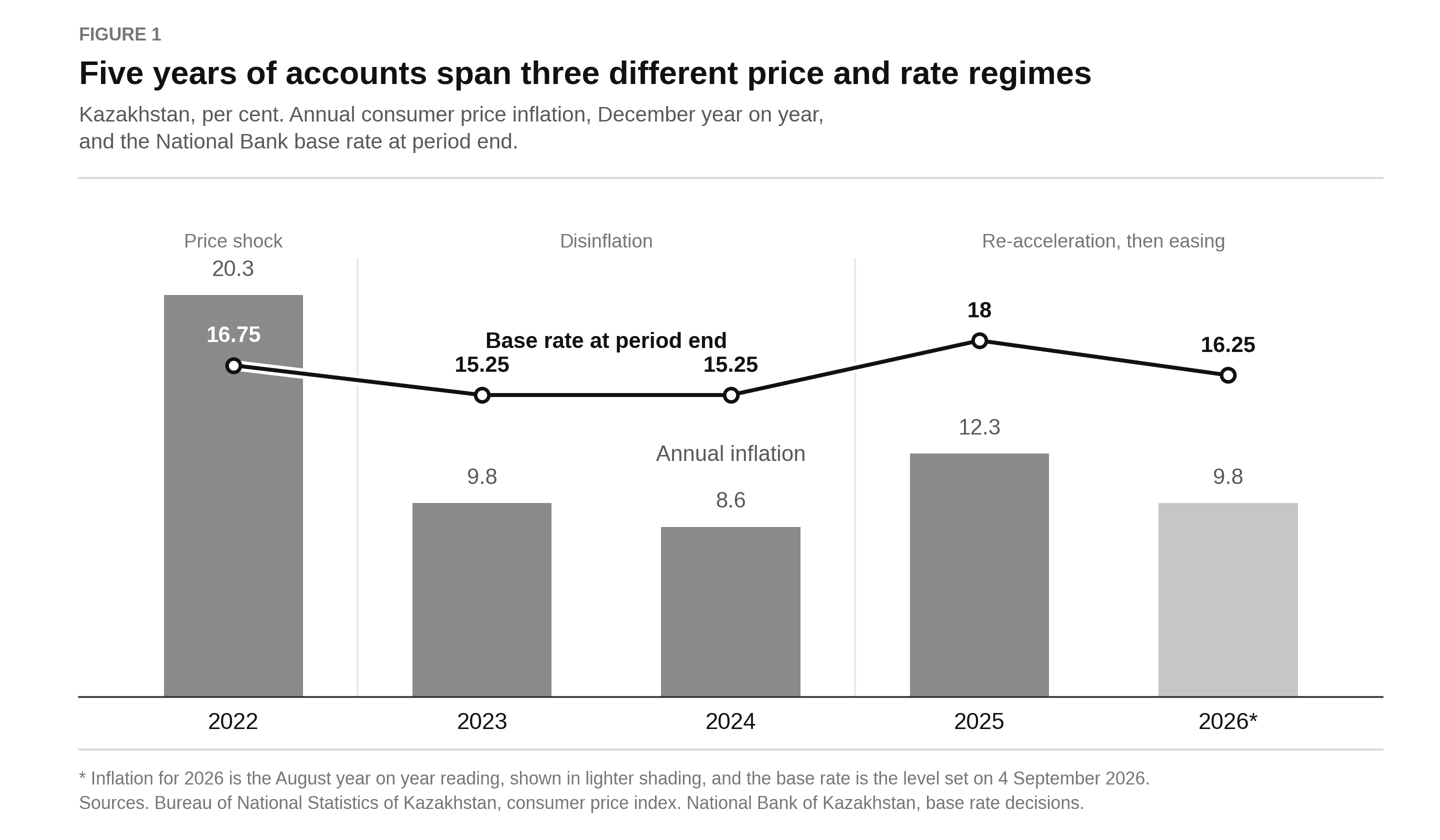
Figure 1. Sources. Bureau of National Statistics of Kazakhstan, consumer price index. National Bank of Kazakhstan, base rate decisions.
The inflation record reframes the revenue line before any cost analysis begins. Nominal output growth recorded for 2025 was 19.7% in manufacturing, 22.9% in transport and storage and 17.6% in trade against inflation of 12.3%, so a large part of the top line expansion visible in a 2025 income statement was price rather than volume. The growth environment has since changed. Real GDP grew by 6.5% in 2025, which the World Bank attributes in part to a one-off increase in oil output at Tengiz, and by 4.1% in the first seven months of 2026, with oil production down 8.9% and non-oil activity above 5%. A projection extrapolated from 2024 and 2025 performance therefore carries two risks at once, price inflation misread as volume and a national expansion that has already slowed.
Financing conditions add a second layer, and the maturity structure matters as much as the level of rates. The National Bank held the base rate at 16.75% from December 2022 and cut it to 15.25% by the end of 2023. It then raised the rate to a record 18% on 10 October 2025 and cut it three times during 2026, most recently to 16.25% on 4 September. The business loan portfolio stood at KZT 16.1 trillion at 1 July 2026 within total credit to the economy of nearly KZT 42 trillion, and 63.8% of business loans carried terms of up to one year in the first half of 2026. Credit demand in the small and medium-sized segment also depends on state programme financing. Where a target's historical margin rests on short-term working capital repriced repeatedly through a rate cycle, or on access to a subsidised programme, the buyer inherits a financing structure as well as an operating business.
Currency movement over the same years pulled in both directions rather than along a trend. The official average rate was KZT 469 to the dollar in 2024 and KZT 521.6 in 2025, with a monthly peak of KZT 540.7 in September 2025, before the tenge strengthened to about KZT 461.6 in August 2026. For an importer, two consecutive years of accounts describe two different input cost worlds.
Labour costs roughly doubled over five years and have recently moved behind prices. On the Bureau's comparable basis excluding small entrepreneurial enterprises, the average monthly nominal wage was KZT 250,300 for 2021 and KZT 486,388 in the second quarter of 2026. The latter figure was 8.4% higher year on year in nominal terms and 1.8% lower in real terms, a fourth consecutive quarterly real decline. Employers also carry a legislated charge above wages, since the mandatory employer pension contribution began at 1.5% of employee income in 2024, reached 3.5% in 2026 and is set at 4.5% in 2027 and 5% in 2028. Regulated inputs rose under the tariff for investment programme running since 2023, and the National Bank has attributed part of the persistence of inflation to secondary effects of tariff reform and fuel market liberalisation.
A three year historical margin series therefore spans several distinct cost environments, before accounting for the VAT increase that took effect in January 2026 and the payroll charges already scheduled to 2028. None of this suggests that Kazakhstan targets overstate profitability. It means that reported historical margins describe conditions the buyer will not inherit. Whether a specific business repriced, indexed its contracts, improved productivity or absorbed the increases is established through customer level price history and pass-through evidence, which no national series contains.
Where commercial due diligence in Kazakhstan actually starts
Several decisive questions have no reliable Kazakhstan-wide answer, and building a proxy for them would be fabrication rather than analysis. Whether revenue recurs or is the residue of a completed cycle, whether customers belong to the company or to a shareholder, and whether management can operate under a different owner are all enterprise level matters. So are a plant's true capacity, utilisation and deferred maintenance, and the deliverability of the synergies a buyer has assumed. Together they form the territory that operational due diligence within a wider M&A mandate exists to cover.
National data still frame the operating environment in ways that tell a buyer what to test. Fixed capital investment reached KZT 11,464 billion in January to July 2026, 7.7% higher in comparable prices, and manufacturing took 12.7% of total investment in 2025 against 10.7% a year earlier. Almost seven tenge in every ten invested over that period came from companies' own funds, which says a great deal about how capital expenditure is financed when borrowing costs sit above 16%. Productivity dispersion is equally instructive, since output per employee in micro and small business was more than twice below the medium and large segment in 2025. Both findings identify what needs testing inside the company. Neither says anything about the condition of any particular asset.
Set against the questions a buyer actually has to answer, the division of evidence between the two levels can be stated directly.
Question behind the acquisition case | What public and national evidence establishes | What only the target can establish |
|---|---|---|
Scale and formal standing | Registration, tax regime, VAT status, tax paid, headcount, invoicing restrictions and arrears, through the State Revenue Committee | Whether reported revenue reconciles to contracts, orders and cash |
Origin of demand | Weight of state and quasi-state purchasing, localisation policy, public contract history | Whether tender wins recur, and whether the relationship is institutional or personal |
Market structure | Concentration ratios and Herfindahl-Hirschman indices for 17 markets, sector analyses by the competition agency | Share of wallet with each major buyer and exposure if one is lost |
Cost base | Inflation, policy rate, exchange rate, wages, payroll charges, VAT, regulated tariffs | Whether the business repriced, indexed contracts or absorbed the increases |
Financing | Rate cycle, maturity structure of business lending, reliance on state programmes | Terms actually available to the business once ownership changes |
Operating platform | Aggregate investment, funding sources, productivity dispersion by size class | Capacity, utilisation, deferred maintenance and the real capital expenditure requirement |
People | Wage levels and trends by sector and region | Whether the management team can execute the buyer's plan |
The boundary with legal work follows the same logic as the table. Legal due diligence establishes title, contractual rights, liabilities, permits and compliance, which together describe what the company is and what it has done. It does not establish whether a contract will be renewed at a comparable price, whether a customer relationship is institutional, or whether the operating platform supports the acquisition case. Distinguishing a weakness that should be priced before closing from one that has to be corrected afterwards is a further exercise again, closer to operational turnaround than to diligence.
The 2026 position and the confirmed trajectory
What is enacted and operational can be stated without qualification. The 2026 Tax Code, the lower VAT registration threshold, the State Revenue Committee's counterparty service, the consolidated procurement platform, the published competition map, the updated beneficial ownership register and the employer pension contribution schedule running to 2028 are all in force. The Digital Code signed on 9 January 2026 took effect on 12 July 2026, consolidating rules on data and electronic documents and replacing the 2003 electronic signature law, although its effect on what an acquirer can learn about a private company is indirect.
What is adopted and still in progress carries more uncertainty. The presidential decree on economic liberalisation of 8 May 2024 introduced a moratorium on the creation of quasi-state entities until 31 December 2026 and instructed the government to complete privatisation. A new state property optimisation plan for 2026 to 2030 covers around 500 objects. Its predecessor moved 402 assets worth KZT 977 billion into the competitive sector, including the KazMunayGas, Air Astana and KEGOC listings. What remains proposed only is the competition agency's push to revise merger control thresholds and a draft law extending the regulation of economic concentration.
The mechanism that matters to buyers is narrower than the reform list suggests. From 2026 onwards mid-market companies will generate a denser, counterparty verified transaction record, which will make revenue easier to test inside a data room in three to five years than it is today, without improving the evidentiary quality of performance in 2022 to 2024. Each asset that moves from state ownership into a listed structure acquires publication and audit obligations it did not previously carry, so the population of companies with a public financial record grows through privatisation rather than through any change in private company law. On current policy nothing will make private company accounts or beneficial ownership publicly accessible, and nothing will bring a closely held partnership into mandatory audit.
Forward projections should be read as expectations rather than commitments. Concluding its 2025 Article IV consultation in January 2026, the IMF projected medium-term growth of around 3.5% and inflation returning to the 5% target only by 2030. The World Bank projects growth easing to 4.6% in 2026 and to about 3.5% by 2028. Both imply that the unusually fast nominal growth visible in recent Kazakhstan accounts is unlikely to repeat.
What the evidence settles and what it leaves to the target
Kazakhstan's information environment allows a buyer to establish the regulatory, fiscal, cost and competitive conditions in which a target operates, with a granularity that did not exist five years ago. It also allows direct verification of formal status, tax standing, tax paid, headcount and public sector contract history before access to the company is granted. That is a genuine improvement over the period, and it came from tax digitalisation and procurement reform rather than from corporate disclosure law.
It does not allow a buyer to establish the sustainability of that target's revenue, the ownership of its customer relationships, the capability of its management or the realism of its operating assumptions. The publication and audit perimeters still exclude the typical privately held target, and no national dataset exists for revenue quality at enterprise level, founder dependency, sustainable EBITDA, true capacity, maintenance backlog or synergy delivery. What national evidence does instead is precise and valuable. It establishes the conditions under which historical performance was generated, in a cost, currency, rate and tax environment that has shifted by measurable amounts since 2022. It also identifies which assumptions in the acquisition case are most exposed if they turn out to be price driven, policy dependent or personal.
The boundary is moving slowly, and only towards better verification once access has been granted, not towards more being knowable beforehand. For foreign investors in Kazakhstan, the consequence is that the national evidence base is now good enough to price the environment accurately, and residual transaction risk concentrates almost entirely in what only the target can show. Broader buy-side questions in a Kazakhstan acquisition begin from there.