
ILLIA TRETIAKOV
Founder

Swiss companies have spent the past two decades extending operating footprints abroad. The Swiss National Bank’s most recent Direct Investment release places Swiss direct investment stocks abroad at CHF 1,340 billion at end-2024, with finance and holding companies accounting for 31 per cent of that stock, and chemicals, plastics and trade together holding another 28 per cent. That structural position is not new. What is new is the operating load it places on Swiss boards. Cross-border M&A governance in Switzerland has shifted from a procedural overlay to a board-level operating discipline, and most Verwaltungsrat agendas have not caught up. Outbound transactions are still approved through governance frameworks designed for simpler, single-jurisdiction deals, and the cost of that mismatch shows up late, usually in the first eighteen months after closing, when integration debt becomes visible and the original approval logic looks thin against operating reality.
Why cross-border M&A governance in Switzerland has become a board-level discipline
The structural pressure begins inside the Swiss holding model. A small Verwaltungsrat, typically six to nine members, holds inalienable duties under the revised Swiss Code of Obligations in force since January 2023, including overall management, organisational structure, financial control and the supervision of executive management. The same body approves acquisitions in jurisdictions where it has no operating proximity, limited fluency in local commercial practice, and constrained capacity to monitor target management between board meetings. The OECD Corporate Governance Factbook 2025 documents the concentration of strategic responsibility in the Swiss board as a defining feature of the regime, alongside the separation of board oversight from operational management required by law for banks and insurers, and recommended for listed companies under the Swiss Code of Best Practice.
On top of that domestic load sits a regulatory environment that has tightened on every relevant axis. EU and US merger control timelines have lengthened. National FDI regimes in Germany, France, Italy and the United Kingdom have widened in scope and sectoral coverage. Export controls, sanctions regimes and data and security review now intersect with deal structuring in sectors that were previously unaffected, from healthcare and life sciences to industrial technology.
The Swiss Investment Screening Act, adopted by the Federal Parliament on 19 December 2025, sits inside that broader investment-screening environment rather than at its centre. SECO has confirmed that the regime targets acquisitions of Swiss businesses by foreign state-controlled investors in security-critical sectors, and is expected to enter into force no earlier than 2027. For Swiss outbound activity, the ISA is not the operative constraint. The constraint is the cumulative weight that foreign regimes impose on Swiss acquirers, and the discipline required to manage it from the board down rather than from counsel up. Our advisory practice in Switzerland is built around that distinction.
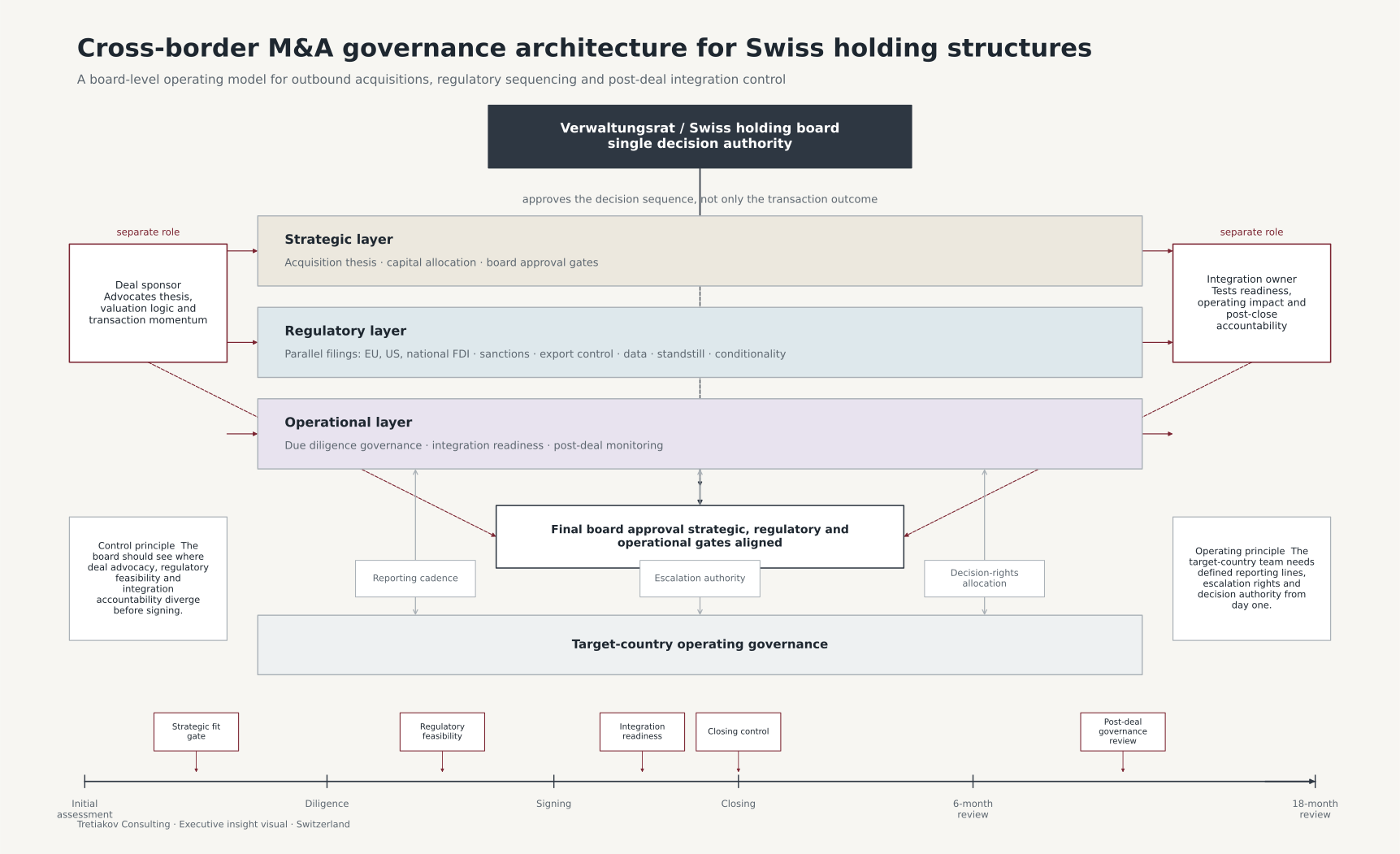
How Swiss boards govern outbound acquisitions: the decision architecture that actually works
Swiss board deal governance fails predictably at four points. The first is strategic fit, where boards approve a thesis without committing to a falsifiable test of it. The second is regulatory feasibility, where the legal feasibility memo arrives as a binary clearance signal when the real question is timing, conditionality and the standstill risk attached to each parallel filing. The third is commercial value, where the board sees the financial model but not the operating assumptions that drive the synergy line. The fourth is integration readiness, which is rarely a real gate at all and almost never has the authority to delay signing.
Boards that govern cross-border deals well treat each of these as a structural veto point rather than a checklist item. They separate the deal sponsor, who advocates, from the integration owner, who absorbs the consequences, and require both to sign off independently before final approval. They calibrate deal-team authority to the size of the irreversibility being created. They demand commercial diligence outputs that can be read at board level, not only legal and financial reports that summarise risk in categories the board cannot operationally test.
The UNCTAD World Investment Report 2025 documents the structural shift in which this governance discipline now operates: cross-border M&A value remained below the long-term average in 2024 even as global capital concentrated in fewer, larger and more complex transactions. For Swiss acquirers, that concentration translates into higher per-deal exposure and a smaller margin for governance error.
The table below sets out the gating logic in the form Swiss boards can actually run.
Decision gate | Board responsibility | Common failure mode | Required governance discipline |
|---|---|---|---|
Strategic fit | Test the acquisition thesis against a falsifiable commercial outcome | Approval of the thesis without specifying what would invalidate it post-closing | Define two or three measurable conditions that would invalidate the deal, and revisit them before final approval |
Regulatory feasibility | Map parallel filings, standstill obligations and conditionality risk across jurisdictions | Reliance on a single feasibility memo treating clearance as binary | Require a jurisdiction-by-jurisdiction timing chart with critical-path filings flagged and indemnity logic attached |
Commercial value | Validate the operating assumptions behind the synergy case | Approval of the financial model without an operational read of working capital, customer concentration and supplier exposure | Commission independent commercial diligence reporting directly to the board, separate from the deal team |
Integration readiness | Confirm operating model, leadership and systems plan before signing | Integration treated as a post-signing workstream with no authority to delay | Stand up the integration governance structure before signing, with explicit veto authority over the closing date |
Final approval | Resolve residual conditionality and confirm appetite for the worst plausible outcome | Approval under time pressure without a documented downside scenario | Require a written downside case approved by the audit committee before the resolution is tabled |
This gating logic is the practical content of board advisory and governance support when a deal is live.
Multi-jurisdictional regulatory reality: managing parallel approval processes
A Swiss outbound deal of meaningful size triggers parallel approvals that operate on different clocks, different scopes and different burden-of-proof rules. The European Commission’s FDI screening framework, in force since 11 October 2020 under Regulation 2019/452, established a coordination mechanism among EU member states that has reviewed over 1,200 transactions since inception. A revised framework politically agreed in December 2025 will require every member state to operate a national screening mechanism under harmonised minimum standards. The operational reality today is a patchwork of national regimes: Germany’s AWV review under the BMWK, France’s IEF procedure, Italy’s Golden Power, the United Kingdom’s National Security and Investment Act, each with its own sectoral list, threshold logic and standstill rules.
For the board, this is not a regulatory question. It is a sequencing question. The signing conditions, long-stop date, reverse break fee and conditionality clauses in the share purchase agreement depend on a realistic timing map across all filings, not on a single clearance forecast. CFIUS exposure on the US leg of any deal with American activity adds another dimension, often with no statutory deadline and with political risk that scales with sector sensitivity. Sanctions and export-control screens, particularly in defence, dual-use, energy and semiconductor-adjacent activity, can foreclose deal structures that looked clean on the legal feasibility memo.
The discipline required at board level is not legal knowledge. It is the willingness to refuse to vote on signing until the deal team produces a single integrated timing chart that names the critical-path filing, the standstill exposure and the indemnity logic that survives if a filing slips. That refusal, exercised once, restructures how every subsequent transaction is presented to the board.
Due diligence governance: where Swiss boards see and where they do not see
Legal and financial diligence are well understood. Counsel maps title, contracts, litigation and compliance exposure. Bankers and accountants validate the model, the quality of earnings and the working-capital position. Both are necessary. Neither answers the question the board actually needs answered, which is whether the target’s operating reality matches the operating reality assumed in the synergy case.
The gap is consistent across sectors. Customer concentration is documented but its commercial durability is not stress-tested. Supplier dependency is named but rarely traced to single-sourced components or contractor relationships that would break in a transition of ownership. Key-person dependency is acknowledged in the data room but seldom linked to a retention and decision-rights plan that survives the first six months. Systems fragmentation between the target’s ERP, finance and operations stacks is treated as an integration question for later, when it is a valuation question now.
AI-assisted and data-driven diligence has narrowed parts of the gap. Anomaly detection on transactional data, contract review at scale, supplier mapping and customer-cohort analysis sit on top of legal-financial diligence rather than replacing it. What they do not provide is commercial judgement at board level, the read that distinguishes between a target that can be integrated and one whose operating model resists integration.
The standing correction is independent operational diligence reporting to the board on a parallel track to legal and financial advice. Owner-side advisory during acquisition, framed as a board service rather than a deal-team input, is the structural fix and the basis for cross-border acquisition advisory in Switzerland that meaningfully changes board visibility.
Post-deal integration governance in Switzerland: where deal value is actually made or lost
Closing is not an outcome. It is the start of the period in which the deal either justifies its price or quietly does not. Post-deal integration governance in Switzerland fails for reasons that are structural rather than operational. Swiss holding boards typically receive monthly or quarterly reporting from foreign operating companies, which is sufficient for steady-state oversight and entirely insufficient for the first twelve to eighteen months after closing. The reporting cadence does not match the integration cadence, and by the time a problem reaches the board, the corrective action that would have worked at month three is no longer available at month nine.
Three integration risks recur. The first is decision-culture mismatch, where Swiss consensus-oriented board governance meets a directive operating culture in the target jurisdiction, producing parallel decision systems neither of which is fully authoritative. The second is ERP and finance systems integration, where the timeline is always longer than the deal team assumed and the cost of running parallel systems eats into the synergy case quarter by quarter. The third is key-person retention in the six to twelve months when the deal team has moved on and the new operating leadership has not yet stabilised.
The governance correction is an integration steering committee with explicit board representation, defined milestones, real escalation authority and a finite mandate. Without the finite mandate, the structure becomes permanent shadow management. The disciplines of deal oversight and post-deal integration governance in Switzerland are described in more detail in our work on post-deal integration governance, and they are the single most reliable predictor of whether a deal closes on its acquisition price or on its eventual write-down.
Closing perspective
The compounding effect is the point. Boards that run cross-border M&A governance in Switzerland as an operating discipline build deal capacity over time. The third outbound transaction is faster, cleaner and better priced than the first, because the gating logic, the regulatory timing maps and the integration governance structures are already in place and have been stress-tested under real conditions. Boards that treat governance as a legal overlay accumulate integration debt deal by deal, and the cumulative cost shows up in goodwill impairments, leadership turnover in foreign subsidiaries, and a constrained capacity to act on the next opportunity. Swiss outbound M&A oversight is a compounding asset or a compounding liability, depending on the discipline applied. The structural advantage is available to any Verwaltungsrat that wants it, but it has to be designed before the next deal lands on the agenda.
Tretiakov Consulting’s M&A transaction and post-deal integration advisory works at the board interface on live and imminent outbound transactions, structured as a complement to legal and financial counsel rather than a substitute. Initial engagement is typically a single board session to map the current governance load against the active deal pipeline.
Our insights