ILLIA TRETIAKOV
Founder

In most markets the demand for management consultants comes from companies. In Uzbekistan a large part of it was written into law.
Presidential Resolution No. 145 of 21 April 2025 puts stakes in 29 large state-owned enterprises to public tender and schedules 12 more for public offerings staged through 2028. Its text makes the engagement of reputable international professional consultants a mandatory feature of the tender process. The preceding resolution, adopted in April 2024, listed 247 enterprises for disposal and had already made the involvement of international consultants compulsory. The state is not simply a client of the advisory market here. It is the reason a substantial part of that market exists, and the president has set a target of reducing the state's share of the economy from its current 42 per cent.
Two transactions in the spring of 2026 showed what that produces. In the sale of the state's holding in the mobile operator Mobiuz, valued at 351 million dollars, Rothschild & Co acted as lead strategic and financial adviser, KPMG handled due diligence and Deloitte provided independent valuation, a combination now applied across the largest disposals. Weeks later the National Investment Fund of Uzbekistan raised approximately 700 million dollars through a dual listing on the London Stock Exchange and the Tashkent Stock Exchange, making thirteen separate state assets investable as one instrument under Franklin Templeton's management.
That is serious work by any standard, it is also a very particular kind of work, and a foreign company arriving with a mid-market operating problem should not read it as evidence that its own mandate will be met with the same capability.
A market rebuilt in under a decade
The international advisory presence in Uzbekistan is younger than most foreign buyers assume. KPMG opened in Tashkent in the late 1990s and then suspended operations as the economy closed. The office reopened at the end of the last decade. The UK ambassador to Uzbekistan described the firm as having four people in 2017 and more than 250 by 2023, with a further hundred planned. That figure is now dated and should be read as a growth curve rather than a current headcount. The other large networks followed comparable curves.
Set that against the neighbouring market, where the same firm has operated continuously since 1996 and now employs close to a thousand people. Uzbekistan's professional services capacity is roughly seven or eight years old, not thirty, and almost all of it was built during a single reform cycle to serve that cycle.
This matters for a practical reason, capability in a professional services market is shaped by whoever paid for it to be built. In Uzbekistan that was largely the state, the international financial institutions and the transactions arising from both.
What the market is deep in, and what it is thin in
The useful question is not which firms operate in Tashkent. It is which kinds of work the market has actually done enough of to be reliable at.
Deep | Thin |
|---|---|
Transaction diligence and valuation | Operating model design below the holding level |
Audit and IFRS conversion | Commercial, channel and pricing work |
Tax structuring and compliance | Post-deal execution over twelve months and longer |
Capital markets preparation and listing readiness | Interim and embedded executive involvement |
Work procured to international financial institution standards | Mandates where the answer is a management decision rather than a document |
The table is an assessment of where mandate volume has accumulated, not a survey and not a judgement about individual firms. A market that has spent eight years preparing state assets for sale gets very good at establishing what something is worth and whether its accounts survive inspection. It has had far fewer occasions to get good at running a factory better.
Even the deep column has edges, and they are documented. Counsel on the May listing noted that a UK offering requires an auditor registered with the Financial Reporting Council, and that no such auditor is presently established in Uzbekistan. The audit profession there is regulated, examined and inspected, and it still cannot sign the document a London listing needs. Depth in a market is always depth against a particular standard, and the standard your headquarters applies may not be the one the local market was built to meet.
The firm landscape follows the same logic. The Big Four networks are present and growing, and their Tashkent practices are strongest where the work resembles what the reform programme has been buying. The global strategy firms arrived largely through government reform mandates, and at least one now maintains a standing Tashkent office. Local firms cover audit, tax and legal work capably, with advisory capability that varies widely between them. None of that ranks anyone. It means the shortlist for a mid-market operating mandate is shorter than a foreign buyer expects, and assembling it takes longer than assembling a diligence shortlist would.
A short self-test settles which column your mandate falls into. If the deliverable is a number, an opinion or a document that a third party will inspect, you are in the left column and the market is well supplied. If the deliverable is a change inside your business that somebody has to lead, you are in the right column, and the first question to any bidder is what comparable work they have completed in Uzbekistan rather than elsewhere in the region.
There is a second consequence, and it is the one buyers notice last. Senior capacity in Uzbekistan is finite and much of it is committed to sovereign and quasi-sovereign mandates with fixed timetables. A foreign mid-market company is competing for partner attention against a listing calendar. That is not a reason to avoid the market. It is a reason to write senior time into the engagement letter in days rather than accept it as an assurance, and to ask what happens to your timetable if a tender deadline moves.
Three layers of the rulebook
Every market distinguishes what the law says from how it is applied. Uzbekistan requires a third category, and getting this wrong is the most expensive mistake a foreign buyer makes here.
The 2025 US Investment Climate Statement describes a body of decrees, resolutions and instructions that is complex and in places contradictory, notes that businesses may be required to comply with instructions that are not publicly available, and records that foreign investors frequently seek ad hoc benefits through presidential decrees and government resolutions, which have proven straightforward to reverse. It also observes that there are no publicly available figures for state enterprise employment or their contribution to GDP, while the ten largest such enterprises generate around 30 per cent of state budget revenue.
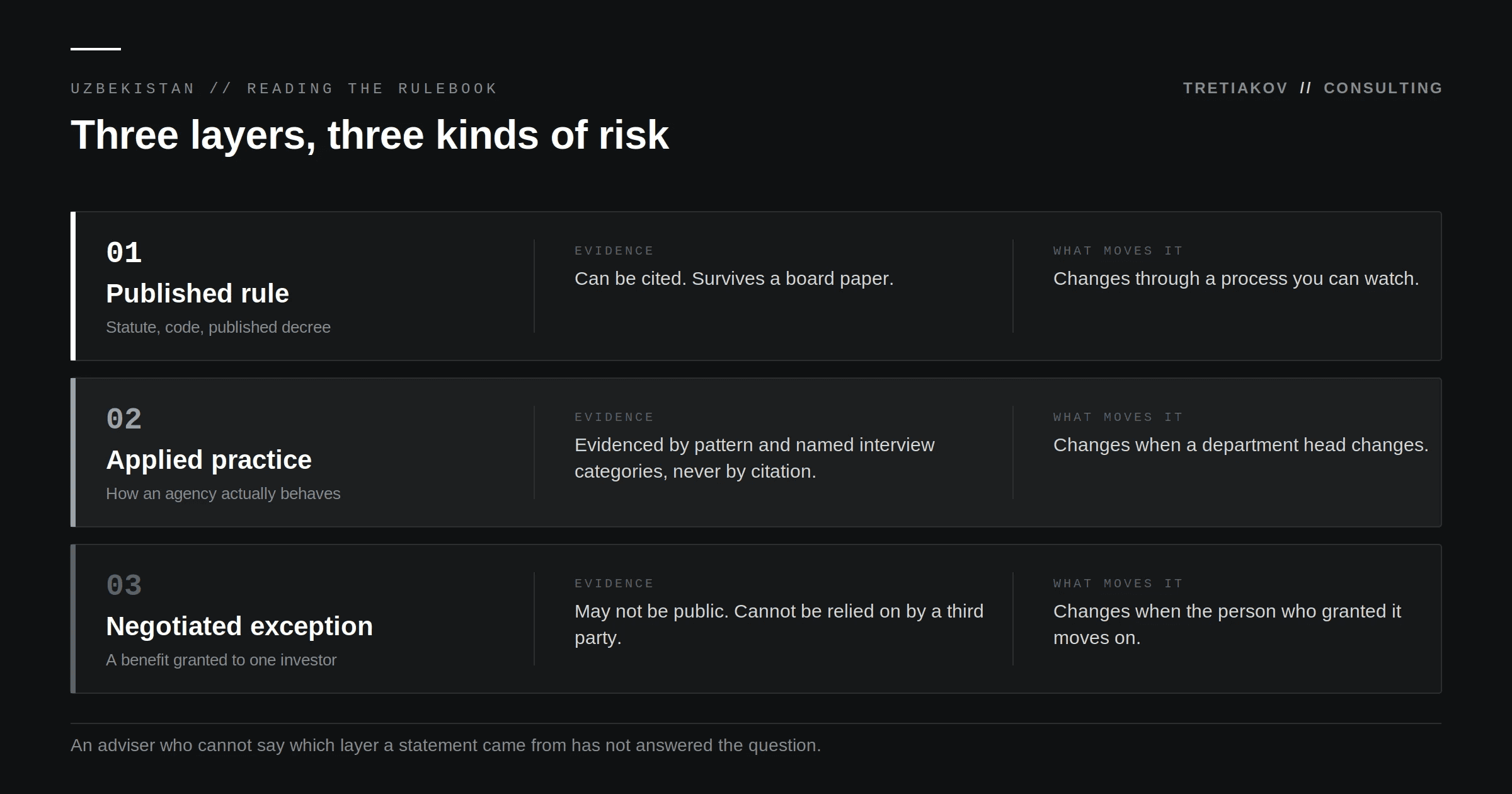
So three layers: The published rule, which can be cited and will survive a board paper. The applied practice, which is how an agency actually behaves and which can be evidenced by pattern and by named categories of interview but never by citation alone. And the negotiated exception, which is a benefit granted to a specific investor by decree or resolution, which may not be public, and which is reversible.
An adviser who presents all three as though they were one thing is not being dishonest. Most local practitioners genuinely experience them as a single operating reality. But a foreign investment committee cannot act on that. It needs each statement labelled, because the three carry entirely different risk. A published rule changes through a legislative process you can watch. An applied practice changes when a department head changes. A negotiated exception changes when the person who granted it moves on.
The test is simple to administer. Ask the adviser to take any conclusion in a previous deliverable and say which layer each supporting statement came from. An adviser who has never thought in these terms will produce a fluent answer that does not separate them, and that is the answer you needed.
Advice has an expiry date, and the brief should say so
Uzbekistan is rewriting its rulebook faster than advice can age.
The country adopted 30 legal acts in 2025 for WTO accession and planned 29 more for 2026, covering customs, technical regulation, export duties, trade defence, intellectual property and sanitary standards. Bilateral market access negotiations are complete with 33 of the 34 members involved. Accession was targeted for the March 2026 Ministerial Conference, missed that date, and remains the stated objective within 2026. That is roughly one significant trade-related instrument a fortnight, before any other area of law is counted.
Tax moves on the same rhythm, Presidential Decree UP-100 was signed on 26 May 2026 and took effect on 1 June, raising the small business turnover threshold to twelve thousand times the base calculation value, close to five billion soum, and introducing a voluntary 6 per cent VAT rate for catering, retail and services as an alternative to the standard 12 per cent. Five days between signature and commencement, in the middle of a financial year.
There is a further wrinkle that a foreign buyer should understand rather than resent. Uzbekistan deliberately tests legal frameworks by presidential decree ahead of full legislation, and it works. A 2023 resolution created a capital markets regulatory sandbox. A resolution of December 2025 built the legal framework for depositary receipts, which had not previously existed. A third, adopted in April 2026, supplied the dual listing mechanics and authorised a stabilisation structure that privatisation law did not otherwise permit. That sequence produced a first-of-its-kind listing from a standing start in under nine months.
It also carries a warning that the transaction's own counsel put on the record. The April resolution was adopted specifically for that offering, and how far its provisions will apply to future ones remains to be seen. A framework built by decree for one deal is not yet law for the next one. That is the negotiated exception layer operating at national scale, and it is why the date on a piece of advice matters as much as its content.
A financial model built in April 2026 was wrong by June. That is not a criticism of whoever built it. It is the operating condition, and it changes what a competent brief looks like.
Consider two versions of the same commission. The example is illustrative rather than a description of a particular engagement.
A weak brief. "Advise us on entering Uzbekistan."
A stronger brief. "Determine whether this investment case survives WTO accession, the next tax cycle and the withdrawal of any benefit granted by decree rather than by statute. State for each material assumption which of the three layers it rests on, and the date by which it must be rechecked."
The second version does something the first cannot. It gives the deliverable a maintenance schedule. An answer that arrives with named assumptions, the layer each one sits on and an expiry date against each remains useful eighteen months later, because the reader can see exactly which parts have gone stale and which have not. An answer without that structure has to be commissioned again from the beginning.
It also changes who is willing to bid, and that is information. A firm that cannot commit to labelling its own evidence usually has a reason.
Licensed does not mean capable
Uzbekistan has built a genuine institutional framework for audit. The Chamber of Auditors and the National Association of Accountants and Auditors operate as recognised professional bodies. Auditors must hold a qualification certificate, pass an examination and complete annual professional development. There is a public register of audit organisations, and external quality control is conducted by the Ministry of Economy and Finance in cooperation with those associations.
There is nothing equivalent for management consulting, no licence, no register, no national institute, no examination. The only route to the Certified Management Consultant designation runs through the Central Asia Chamber of Management Consultants, which covers Uzbekistan but is based in Almaty, in another country. ISO 20700 sets out international guidelines for how consultancy assignments should be specified, executed, accepted and closed, and asking whether a firm works to it is a reasonable procurement question, but it is a voluntary standard with no enforcement here.
The practical consequence is a confusion that catches out careful buyers. A firm presents a licence number, a register entry and a chamber membership. All of it is real, and none of it says anything about whether the firm can design an operating model or run a commercial diagnostic. Regulatory legitimacy in audit is not a proxy for capability in advisory, and in Uzbekistan the two frequently sit inside the same legal entity.
The other half of the same confusion runs through the word international, because the privatisation decrees use it as a procurement category, firms position against that category. It certifies participation in a state process. It does not certify that anyone senior will work on your mandate.
What drives the price
There is no published benchmark for advisory fees in Uzbekistan, and any figure circulated as one should be treated with suspicion. What can be described accurately is the structure and the variables.
Two reference points distort private pricing here in a way they do not elsewhere. State tenders for privatisation advisory are large, competitive and visible, and international financial institution procurement runs on published rate cards. Both create anchoring effects. A firm that has spent two years on institutionally procured work often prices a private mid-market mandate as though it were a workstream of a larger programme, which produces a number that looks reasonable and a scope that is not the client's problem.
The variables that move the real cost are more useful to understand than any headline rate. Time on the ground in Tashkent and beyond it. Production of documents in Uzbek and Russian to a standard that will bear scrutiny, which is a translation cost and an interpretation cost at once. Data reconstruction, which is the largest hidden item wherever a target or partner has state adjacency and records were never built to be audited. Negotiated access to counterparties. The number of parties inside the client organisation who must agree. And whether the mandate is analysis or delivery, because implementation carries duration risk that analysis does not.
One consequence follows for reading proposals, a proposal is priced against the scope the bidder imagined. A bidder who has not seen the data reconstruction or the two-language documentation is pricing the visible half of the work. Ask each bidder to name the three things most likely to extend the timetable. The answers separate the field faster than the fees do. Which commercial model fits which shape of mandate is a separate question, treated in our note on engagement models.
When you need a different specialist
A significant share of enquiries described as consulting are answered better, faster and more cheaply by somebody else. Two of the entries below are specific to Uzbekistan.
If the real question is | You need |
|---|---|
Entity registration, LLC formation, branch versus subsidiary | Corporate lawyer or formation provider |
VAT regime choice after the 2026 decree, profit tax, transfer pricing | Tax adviser |
Whether an activity qualifies for IT Park residency | Tax adviser or IT Park specialist |
Land use, given that foreign entities cannot own land | Real estate and land law specialist |
Statutory accounts, IFRS conversion, audit | Registered audit organisation |
Certification and technical regulation under WTO alignment | Regulatory or standards specialist |
Work permits and immigration | Immigration specialist |
Recruiting a named position | Executive search firm |
Technical or engineering feasibility | Engineering consultant |
The land line deserves particular attention because it is a structural constraint rather than a procedural one. Foreign citizens and non-resident entities cannot own land in Uzbekistan, which shapes what an industrial investment can look like before any commercial question is reached. That is a legal matter first and a strategic one second.
Advisory work becomes the right purchase at the next step, when the question is no longer what the rule is but what to do given the rule. Whether the structure still fits the operating model. Whether the margin survives. Whether the thesis holds once the incentive expires. Those questions sit alongside the ones addressed in our notes on participating in the privatisation programme, on entering the market and on cross-border acquisitions.
What this asks of the buyer
Uzbekistan is not a difficult market to buy advice in because the advisers are weak. Several are very good, and the work visible on the largest transactions is of international standard.
It is difficult because two things are being built at once. The rulebook is being rewritten faster than in any neighbouring market, and the advisory profession that interprets it is younger than the reform that created it. Neither will settle inside the timeframe of any particular mandate.
That puts an unusual amount of weight on how the brief is written. Name the decision. Require each material assumption to be labelled by layer and dated. Write senior time into the contract in days. Establish whether the capability you need is one the market has actually built, or one it has not had cause to build yet. None of this requires local knowledge to administer, only the discipline to ask before signing rather than after.
If you are scoping a mandate and would find it useful to test the brief before it goes to market, Tretiakov Consulting's Uzbekistan practice is open to a conversation.
Frequently asked questions
How should a foreign company choose a management consultant in Uzbekistan? Start from the capability rather than the firm. Establish whether the market has done enough of your kind of work to be reliable at it, since depth sits in transaction, audit and capital markets work and is thinner in operating and commercial mandates. Then establish who will personally deliver, on how many committed days, and whether the adviser separates published rule from applied practice from negotiated exception.
Is management consulting regulated in Uzbekistan? No. Audit is regulated, with qualification certificates, a public register and state external quality control. Management consulting has no licence, no register and no national professional body. Certification is available only through the Central Asia Chamber of Management Consultants, which is based in Kazakhstan, and ISO 20700 applies on a voluntary basis.
What does it mean when a firm calls itself an international consultant in Uzbekistan? Usually that it meets a procurement category defined in the privatisation decrees, which require reputable international professional consultants on large state disposals. It describes eligibility for a state process. It says nothing about seniority on a private mandate.
How much does management consulting cost in Uzbekistan? There is no reliable published benchmark. Pricing is distorted by state tender and international financial institution rate cards, which anchor expectations toward large programme structures. The variables that move real cost are time on the ground, documentation in two languages, data reconstruction, counterparty access and whether the mandate is analysis or delivery.
How long does advice stay valid in Uzbekistan? Less time than most foreign buyers expect. Thirty legal acts were adopted in 2025 for WTO accession with 29 more planned for 2026, and a presidential tax decree signed on 26 May 2026 took effect five days later. A brief should require every material assumption to carry the date by which it must be rechecked.
Our insights