
ILLIA TRETIAKOV
Founder
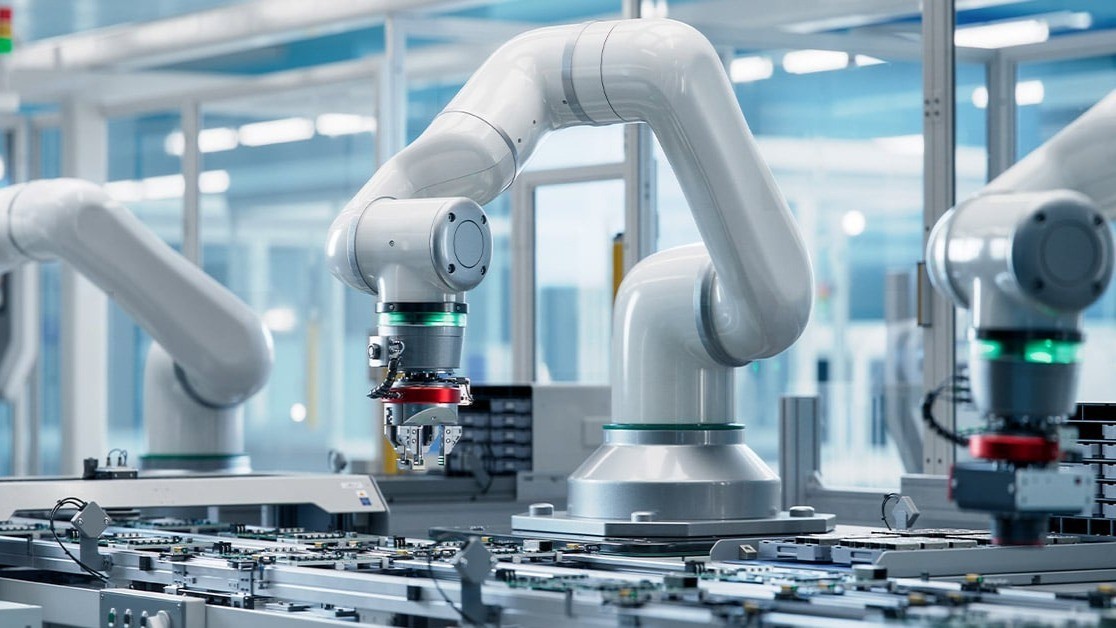
At Hannover Messe, in vendor keynotes and on the glossy pages of corporate sustainability reports, the smart factory appears to be an accomplished fact. Sensors stream data in real time. Digital twins simulate production flows before a single part is cut. AI algorithms predict machine failure days before it occurs. The narrative is compelling. But walk onto the shop floor of a mid-market production company in Swabia or the Ruhr and the picture is altogether different. Manufacturing modernisation in Germany beyond the Industry 4.0 hype reveals a more complex reality: ageing ERP systems that do not communicate with machine controllers, changeover procedures that rely on the memory of a senior Meister, and maintenance records stored in paper logbooks. The gap between what the technology vendors promise and what a typical Mittelstand manufacturer can absorb is not a marginal inconvenience. It is the central challenge of German industrial competitiveness over the coming decade.
The Industry 4.0 Promise And What Actually Happened
The term Industrie 4.0 was formally introduced at Hannover Messe in 2011 and subsequently adopted as a pillar of the German government’s Hightech-Strategie 2020. The vision was clear: when people, machines and industrial processes are intelligently networked, the fourth industrial revolution would produce smart factories, and the Federal Ministry for Economic Affairs would help the business community take advantage of this potential. More than a decade of public and private investment followed. The Ministry of Economic Affairs funded nearly €100 million across two dedicated programmes, Autonomics for Industrie 4.0 and Smart Service World, to foster research and innovation.
The question is what this investment has produced at the level of mid-market manufacturing. A 2025 Bitkom survey of 552 industrial companies found that 42 percent of German industrial firms now use artificial intelligence in production and 82 percent agree that AI will be decisive for future competitiveness, yet just under half believe German industry is in danger of missing the AI revolution entirely. IoT platforms are being used by 46 percent of companies, with almost as many planning to adopt them. These figures indicate broad awareness but do not reveal depth of implementation. The reality for a mid-market manufacturer with 200 to 2,000 employees is fundamentally different from that of Siemens or BMW. Budgets are tighter, IT departments smaller, process maturity lower and the tolerance for operational disruption close to zero.
Consider, as an illustrative scenario, an automotive components manufacturer in Baden-Württemberg with approximately €80 million in revenue. The company invested €1.2 million in IoT sensors and a manufacturing execution system. Eighteen months later, the system generated data continuously, but not a single production KPI had improved. The underlying causes were prosaic: the ERP system did not synchronise cleanly with production scheduling, changeover procedures were unstandardised and bills of materials contained known errors that operators routinely worked around. The technology was functional. The process was not ready to absorb it. This is not an isolated pattern. It is, in the experience of practitioners working across German mid-market production environments, the norm rather than the exception. Industry 4.0 implementation without process readiness produces data without decisions.
Manufacturing modernisation is not an IT project. It is a transformation of the operating model from which technology is one instrument among several, and rarely the first one that should be deployed.
Why Technology-First Approaches Fail in Mid-Market Manufacturing
Three failure patterns recur with striking consistency across German manufacturing digitalisation programmes in mid-market companies.
The first is the dashboard without a decision system. A company installs shopfloor dashboards displaying real-time OEE, downtime alerts and production throughput. The screens are visible. The data flows. But operators and shift leaders do not use the information to change what they do. The reasons are usually straightforward: the data feeding the dashboards is inaccurate because manual inputs are inconsistent, there is no defined response process specifying who acts on which deviation within what timeframe, and the indicators shown are not linked to any operational action. The result is expensive wallpaper.
The second is automation without volume justification. A production area is automated on the basis of an ROI calculation that assumes full capacity utilisation. In practice, utilisation runs at 60 to 70 percent. With a high-mix, low-volume product range, the automated cell proves more expensive per unit than skilled manual labour. The business case was built around an abstraction, not the actual production economics of the company.
The third is predictive maintenance investment layered onto an immature maintenance process. The company has no structured total productive maintenance programme, no usable failure history in digital form and no clear specification of critical spare parts. It purchases an AI-based predictive maintenance solution. The algorithm has nothing reliable to learn from. The most expensive digitalisation investment is the one made before the process is ready to absorb it.
These patterns share a common root cause. In each case, the investment was driven by what the technology could do in theory rather than by what the production environment actually needed. Smart factory concepts in German manufacturing will only deliver returns when they are preceded by an honest assessment of process readiness.
Basics First - Building the Process Foundation
Before any digital layer can create value, the production process beneath it must be stable and measurable. This is not a novel insight. It is engineering logic that German manufacturing professionals understand instinctively. But in the urgency to respond to competitive pressure, it is routinely bypassed.
What basics means in concrete operational terms is well defined. It means a verified, honest OEE measurement: not the figure presented to the owner at quarterly reviews, but the number the Meister sees on the shift. It means standardised changeover procedures, whether modelled on SMED or adapted to the specific production context, that are documented, trained and followed. It means accurate bills of materials and routings in the ERP system, not data that the production team has learned to work around. It means structured shopfloor management as a foundation for data-driven decisions, not as a cosmetic lean exercise. And it means at minimum twelve months of clean, structured maintenance records before any serious discussion of predictive maintenance begins.
Consider a second illustrative example. A precision engineering company in North Rhine-Westphalia with approximately 400 employees deferred a planned MES investment by nine months. Instead, the company invested that period in process standardisation: a consistent OEE methodology across all production areas, a comprehensive BOM cleansing exercise and setup time reduction on three critical machine groups. The result, based on anonymised transformation patterns observed in comparable engagements, was an OEE improvement from 58 percent to 71 percent without a single euro spent on digitalisation. When the MES was subsequently implemented, it functioned from the first week because it received clean, reliable data.
Process reliability is not the opposite of digital ambition - it is its prerequisite. Production technology modernisation must begin with the process, not the platform.
Manufacturing modernisation in Germany, when approached with this discipline, builds on a foundation that makes every subsequent technology investment more productive. The alternative, digital investment atop an unstable process base, produces the kind of expensive disappointment that erodes boardroom confidence in modernisation itself.
Building the Business Case - Where Modernisation Creates Real Value
The inability to articulate a credible business case is one of the most common barriers to manufacturing investment approval in owner-managed and mid-market companies. Supervisory boards and owners do not want to hear about digital transformation roadmaps. They want to know what it costs, when it pays back and what happens if the company does not invest.
A practical approach to smart factory implementation in Germany starts not with the question of which technology to deploy but with the question of where the company loses money, capacity, quality or customers. The framework follows a clear sequence.
The first step is identifying value creation levers. This means bottleneck analysis by process step, scrap and rework rates by production area, unplanned downtime by machine group and labour cost per unit by product family. These are the economics of the factory, and they determine where intervention creates the highest return.
The second step is mapping technology to the identified problem. Only once a specific operational problem has been quantified should the question of technology arise. The answer might be automation, data capture, advanced scheduling or process control, but it is always chosen because it addresses a defined problem with a calculable return.
The third step is assessing readiness. For each priority project: does the data exist? Is the process stable enough to absorb the change? Are there people who can operate and sustain the new solution after go-live? Where the answer is no, readiness-building becomes Phase 1 of the programme, not an afterthought.
The fourth step is building the investment case in production economics language. ROI is expressed not in abstract efficiency gains but in specific, verifiable units: reduction in scrap by a defined tonnage per year, reduction in changeover time by a defined number of minutes per changeover at a known frequency per week, reduction in unplanned downtime from a measured baseline to a defined target. McKinsey’s analysis of Industry 4.0 implementation across sectors confirms that, when successfully implemented, such solutions can deliver 30 to 50 percent reductions in machine downtime, 10 to 30 percent increases in throughput and 15 to 30 percent improvements in labour productivity. But these figures come from companies that approached modernisation with process discipline. The strongest business case for manufacturing modernisation is written not in technology language, but in production economics.
The German Context - Labour, Skills, and the Culture of Quality
Three factors make manufacturing modernisation in Germany a qualitatively different challenge from modernisation in any other European market. Understanding these factors is essential for any company, investor or advisory board evaluating a modernisation programme.
The first is the cost of labour. Germany’s average hourly labour cost stood at €43.40 in 2024, ranking seventh in the EU, with the manufacturing sector recording an average hourly cost of €48.30, some 43 percent above the EU average. For machinery and equipment manufacturing specifically, VDMA data places Germany at €51.40 per hour worked in 2023, alongside Austria, the Netherlands and Sweden in the highest-cost group within the EU. These figures make automation investment arithmetically attractive. But for companies operating high-mix, low-volume production, full automation is frequently uneconomic. The correct response is selective automation combined with human-machine collaboration, not a blanket replacement of human labour.
The second is the skilled workforce, and its impending departure. According to the DIHK Skilled Labour Report 2025/2026, more than a third of German companies still cannot fill vacancies. The most frequently expected consequences of personnel shortages are rising labour costs, increased workload for existing staff and restrictions on services, with almost a quarter of companies expecting the loss of company-specific knowledge due to the retirement of older employees; in the industrial sector, this figure exceeds one third. For a manufacturing operation in the German market, the challenge is acute: the Meister and Facharbeiter who carry decades of process knowledge will retire in growing numbers through 2035. The task is not to replace these people with robots. It is to capture their expertise in systems and processes that allow less experienced operators to perform at a comparable level with technological support. This requires involving experienced workers as co-designers of new processes, not treating them as obstacles to digitalisation.
The third factor is the culture of quality. German manufacturing culture assigns personal responsibility for quality to the skilled worker on the shop floor. The Facharbeiter takes pride in the precision of his output. Introducing automated quality control or data-driven process adjustments can be perceived as an expression of distrust. This cultural dimension is not a soft consideration. It is a hard constraint on the speed and method of German manufacturing digitalisation. Change management must proceed through involvement and demonstration, through pilots that prove their worth visibly before being mandated more broadly.
Managing the Transition - From Pilot to Scale
The principle is straightforward. Pilot, validate, scale. Not a simultaneous transformation across all production areas but a controlled, evidence-based progression.
Selecting the right pilot area requires balancing four criteria: sufficient visibility, so that results are noticed across the plant; manageable complexity, so that the pilot can succeed within a reasonable timeframe; a motivated team, with a Meister and shift leaders who are engaged rather than assigned; and clean baseline data, so that improvement can be credibly measured before and after.
Validation means confirming business results, not technical functionality. The question is not whether the system works but whether OEE improved, scrap decreased or unplanned downtime was reduced by a measurable margin. If the answer is no, the response is iteration, not premature scaling.
Consider a third illustrative scenario. A metalworking and assembly company in Bavaria with approximately €120 million in revenue piloted predictive maintenance on one CNC line out of eight. After six months, unplanned downtime on that line fell by an estimated 34 percent. But when the company attempted to scale, it discovered that the remaining lines ran different controllers, older software versions and different operating profiles. An additional four months of adaptation was required before the second line could be brought online. Without that iteration, scaling would have produced a technical failure and an erosion of internal confidence.
Operational stability during transition is not a luxury. It is a non-negotiable condition for any manufacturing modernisation programme.
Scaling does not mean copy-paste. Each production area has its own product mix, equipment age and team dynamics. Pilot learnings must be adapted, not replicated mechanically.
Building internal digital capability is equally important. The digitalisation of German manufacturing operations cannot remain permanently dependent on external system integrators. At minimum, the company needs one or two people internally who understand data architecture, can engage with technology vendors on equal terms and can maintain and develop solutions after go-live. For a mid-market company, this does not mean an IT department of twenty. It means an industrial data engineer and targeted upskilling of existing maintenance and work preparation staff.
Industrial investment programmes that treat capability building as a post-implementation afterthought consistently underperform those that embed skill development from the outset.
What a Pragmatic Modernisation Programme Looks Like
McKinsey research consistently finds that roughly 70 percent of transformation efforts fail to achieve their stated objectives. In manufacturing, the failure rate is compounded by the operational consequences of disruption: lost orders, quality escapes and customer dissatisfaction. A pragmatic modernisation programme must therefore be structured to minimise risk while building evidence of value at each stage.
The sequencing of such a programme, based on patterns observed across industrial and manufacturing operations, typically follows five elements:
Phase 0: Process stabilisation and data readiness assessment (4 to 8 weeks). Verify OEE methodology, clean BOM and routing data, establish maintenance data baselines, assess shopfloor management maturity.
Phase 1: Priority definition based on value-impact mapping (2 to 4 weeks). Identify the three to five highest-value operational problems where technology intervention has a quantifiable return.
Phase 2: Pilot design, implementation and validation (3 to 6 months). Deploy on one production area or line with clear KPIs, defined baseline and agreed success criteria.
Phase 3: Scaling roadmap, sequenced by readiness rather than ambition (6 to 18 months depending on scope). Adapt pilot learnings to each subsequent production area, accounting for equipment differences, team capability and process maturity.
Continuous: Internal capability building. Not a one-time training event but embedded skill development across maintenance, production engineering and operations management.
This is not a linear process. Phase 0 may reveal that the company is not ready for Phase 2 without substantial baseline work. That discovery is not a failure. It is exactly the kind of diagnostic honesty that prevents a company from spending eighteen months on a technology deployment that never delivers results. Three months invested in stabilisation is always cheaper than eighteen months lost to premature digitalisation.
The strongest manufacturing modernisation programmes are those that match ambition to readiness and build evidence before committing capital.
Conclusion - Modernisation Must Start With the Operating Reality, Not the Technology Narrative
Industry 4.0 remains an important strategic framework. The technologies it encompasses, from IoT and advanced analytics to machine learning and digital twins, have genuine potential to transform production economics. But the framework is not a plan. And the technologies are not solutions until they are connected to specific operational problems in specific production environments.
Manufacturing modernisation in Germany must start where the factory is, not where the vendor brochure imagines it to be. It must begin with process reliability, data readiness and the discipline to build a business case that supervisory boards and owners can interrogate. It must respect the expertise of the skilled workforce while building the systems that will carry that expertise forward as the demographic transition accelerates. And it must be sequenced with the same engineering discipline that German manufacturers apply to their products.
Some 15 million jobs depend directly and indirectly on German manufacturing industries. The stakes of getting modernisation right, or wrong, extend well beyond the individual company. They touch the competitiveness of an entire industrial ecosystem.
The strongest manufacturing modernisation programmes in Germany are not the most technologically ambitious. They are the ones that understand what the factory is ready to absorb.
Our insights