

A reliable picture of company sales in Kazakhstan has to be assembled from state disclosures, company announcements, regulatory decisions and a few market studies. The most detailed public transaction study we found, prepared by Baker Tilly for Qazaqstan Investment Corporation (QIC), covers the period to 2022. Its published summary counts 360 disclosed transactions in shares and convertible instruments between 2012 and 2022, worth $49.7 billion including follow-on investments. Among its private equity fund deals, the average was seven times the median, so a few large transactions set the headline figures.
Since 2020 the conditions for selling a business have changed more visibly than the deal count. The state completed a five-year privatisation plan and started a new one, and US sanctions led Sberbank to sell its Kazakh bank to a state holding. Merger control was simplified in 2024, and since January 2026 foreign sellers of long-held Kazakh shares have lost a capital gains exemption.
For owners and boards considering selling a business in Kazakhstan, public information therefore explains the rules and mechanics of an exit better than the price of an individual private company. We trace the market, the law and state policy from 2020 to 2026 and the official targets to 2030, then use four recent exits to show how these forces work in a sale. The analysis is part of a series from our Kazakhstan practice.
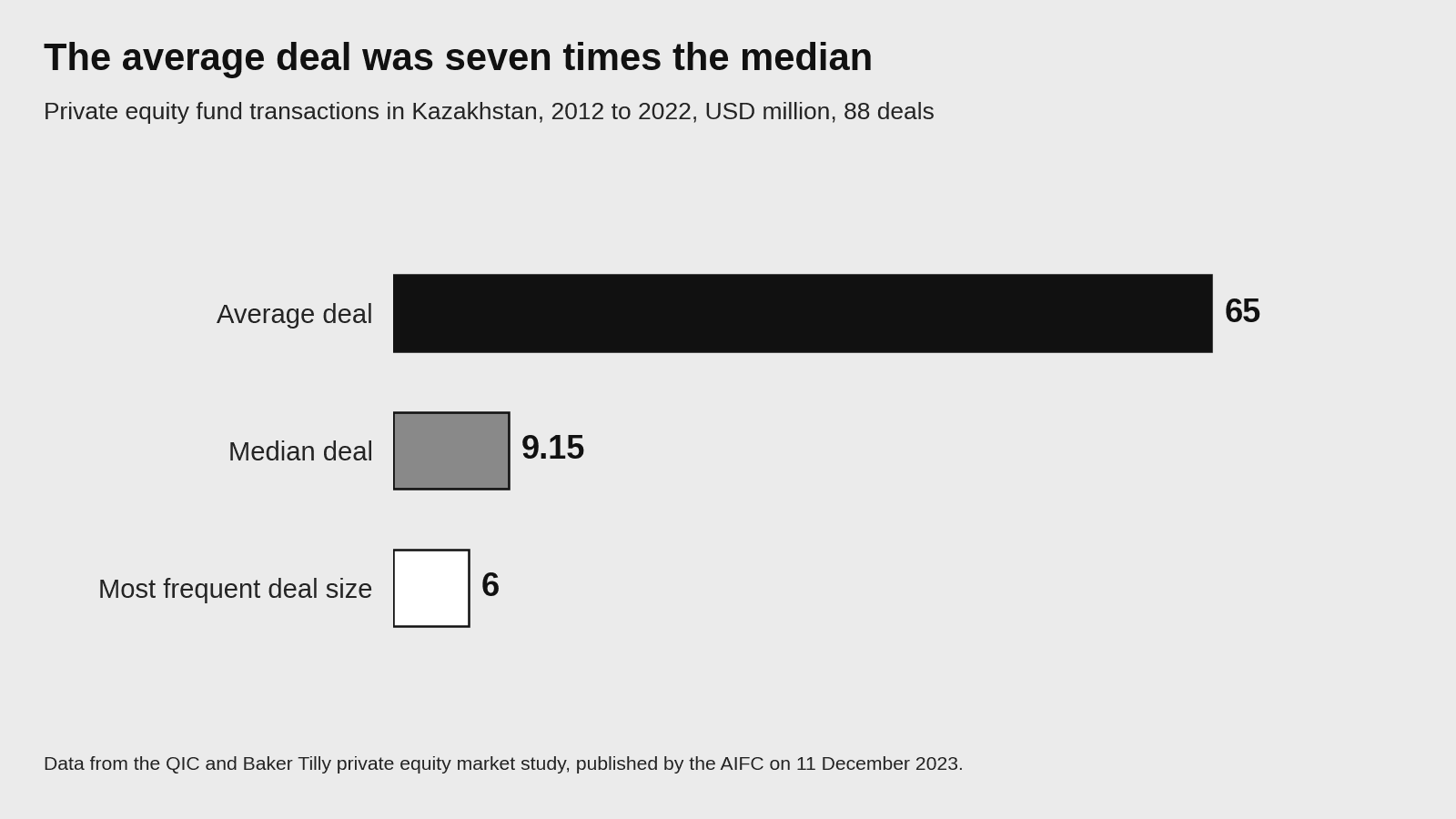
The chart covers private equity fund transactions only and is based on the QIC and Baker Tilly findings published by the AIFC.
The market for selling a business in Kazakhstan today
Private deal data remain thin. Baker Tilly noted that, unlike more developed markets where associations track private transactions, no organisation in Kazakhstan monitored and consolidated such data, so its team combined S&P Capital IQ records, public sources, surveys and interviews. It cautioned that not all of those sources were reliable. The study was only the second of its kind after a 2019 edition, and we found no comparable series for 2023 to 2026. Its release also quotes about $45 billion for the decade, a figure it does not reconcile with the larger total.
The one seller that publishes complete results is the state. Under the privatisation plan for 2021 to 2025, 402 state and quasi-state assets were sold for KZT 977 billion. The largest transactions were stock market placements of KazMunayGas, KEGOC and Air Astana, which together raised about KZT 187 billion.
Public markets have become a working exit route for the state. Air Astana described its 2024 offering as the largest privatisation in Kazakhstan to date, and local investors took 58% of it.
Deal structuring has also moved onshore. In 2023 the AIFC authority said that funds and transactions once structured mainly through foreign jurisdictions were increasingly set up under AIFC law. For a private seller, the market therefore offers a partial benchmark. It shows how exits are structured and which routes are open, but little to price a privately held company against.
How the law and state policy changed after 2020
Competition law has been rebuilt around a stronger regulator. The Agency for Protection and Development of Competition was re-established as an independent agency by presidential decree in October 2020, and the OECD's 2025 peer review traces the antimonopoly packages that followed. The 2022 package brought monitoring trustees into merger control, and 2024 amendments added a register of conglomerates. Changes of June 2024 also shortened merger review deadlines and reduced filing requirements, while the OECD notes that purchases of production assets moved to notification after closing and that this part of the regime now contains conflicting provisions.
Policy decisions in Kazakhstan and abroad shaped several of the largest divestments of the period. The Kazakh subsidiaries of three Russian banks came under US sanctions in 2022, and Sberbank sold its bank to the state holding Baiterek, which later resold it. In telecoms, Kazakhtelecom sold its Tele2 and Altel operator in line with the President's instruction to demonopolise the mobile market, and in steel the state bought out ArcelorMittal after fatal accidents at its Temirtau operations.
The tax framework changed in a single step. The new Tax Code, signed in July 2025 and in force since 1 January 2026, raised VAT from 12% to 16%. It also ended a capital gains exemption for foreign sellers of Kazakh shares, the change that bears most directly on exit proceeds. Tax administration has become more visible to outsiders as well. Since December 2025 the State Revenue Committee's counterparty service has shown, for any business identification number, taxes paid, headcount, founders and restrictions on electronic invoicing.
Rule | Earlier rule | Position in 2026 | Status |
|---|---|---|---|
Acquiring over 50% of voting shares above the threshold | Prior consent | Prior consent with shorter deadlines | In force |
Acquiring significant production assets | Prior consent | Notification after closing | In force since 2024 |
Non-resident gain on long-held Kazakh shares | Exempt if conditions were met | Taxable at source, treaty relief possible | In force since 1 January 2026 |
Indirect sale of entities holding mainly Kazakh assets | Special regime for subsoil users only | Extended beyond subsoil users | In force since 1 January 2026 |
Tax Code amendments reviewed in August 2026 | Not applicable | Under discussion | Proposal |
Official targets and plans to 2030
Two government documents set the direction to the end of the decade. The Investment Policy Concept adopted in October 2024 targets at least $150 billion of gross foreign direct investment over six years. The optimisation plan for 2026 to 2030covers 500 state and quasi-state assets, and the government expects it to cut the state's share of the economy to 13.2% of GDP. For private sellers, these documents point to a continuing supply of state assets and an official push for foreign capital, and their published summaries set no target for sales of private companies. We found no institutional forecast of Kazakhstan transaction volumes against which these investment and privatisation targets could be translated into an outlook for private M&A.
Further legislative change is at proposal stage. The government's Tax Code project office reviewed an amendment package in August 2026, and the items EY highlights concern digital assets, investment agreements and infrastructure costs. A draft of wider Tax Code amendments intended to apply from 2027 was published in September 2026. The OECD's recommendations on merger control remain recommendations, and we have not found an adopted amendment that implements them.
What recent exits show about price and proceeds
Four exits completed since 2023 show how these changes work in a single sale. Each had a state holding or a state-controlled company among its buyers or sellers, which limits their use as price comparables and makes them useful for understanding deal mechanics.
Kazakhtelecom's sale of Mobile Telecom-Service, the operator behind the Tele2 and Altel brands, to a subsidiary of Qatar's Power International Holding shows how much of a price can be deferred. Kazakhtelecom's consolidated financial statements put the consideration at $1.1 billion. Only $700 million was paid when control passed in January 2025. The remaining $400 million is contingent consideration due within three years, and it can be reduced if conditions in the agreement are breached.
ArcelorMittal's exit from Temirtau in December 2023 shows how intra-group balances change the picture. The sale was widely reported at $286 million, yet the company's completion announcement also set out $250 million of intra-group repayments at completion and a further $450 million, guaranteed by a sovereign fund, payable over four years. The reported price therefore covered only the equity after those balances and not the full amount paid for the business.
The same negotiation produced the only quantified gap between an asking price and a final price that we found. The Minister of Industry and Construction said ArcelorMittal had initially asked for $3.5 billion. That account comes from one party, and the buyer was a state fund acting after a presidential instruction to end investment cooperation with the company, so the case says nothing about how international buyers price Kazakh companies.
Two claims often come up when owners discuss price. One is that local sellers and international buyers systematically disagree on value, the other that foreign buyers apply a Kazakhstan discount. We found no public data that would confirm either, and no public dataset of Kazakh transaction multiples, so what a foreign buyer will pay for a Kazakh business has no market-wide answer. The methods of business valuation in Kazakhstan are a separate subject.
Currency can move value between agreement and completion. Lesha Bank agreed in 2024 to buy Bereke Bank for KZT 65 billion, reported at $146.6 million at the exchange rate of the announcement. At completion in October 2024 the same tenge price was worth $134.9 million, about 8% less, an exposure carried by any party that measures proceeds in another currency.
Timing matters in a staged exit. BAE Systems held 49% of Air Astana before the airline's February 2024 IPO, which was priced at $9.50 per global depositary receipt. Air Astana's statement records that BAE sold part of its holding in the offering and most of the rest in December 2025, in a placing priced at $5.80 per receipt. In March 2026 BAE agreed to sell its last receipts at $5.10, about 46% below the IPO price.
Across the four cases, the gap between headline value and seller proceeds comes from intra-group settlements, contingent consideration, the currency of the price and the timing of a staged exit. Four transactions are too few to measure a typical effect. How buyers price and protect themselves against these exposures is covered in our analysis of M&A advisory and buyer-side transaction risk in Kazakhstan.
What exactly is being sold
The legal object of a sale and the business whose performance is being valued are not always the same, and they can diverge when a subsidiary has operated inside a group. For a group preparing a Kazakhstan subsidiary for sale, Temirtau illustrates the point. QIC bought all shares in two companies, the Temirtau steel and mining business and a pipe plant in Aktau, and ArcelorMittal transferred the assets on an as-is operational basis. The group's loans to its subsidiary were dealt with in the same deal.
Beyond intra-group balances, the perimeter can extend to real estate, contracts, employees, licences, intellectual property, guarantees, shared systems and the brand. The four announcements say what was bought and little about what stayed with the seller. At Temirtau the brand stayed with ArcelorMittal, and the business became Qarmet within days of completion.
Mapping which contracts, balances, rights and people belong to the business before a buyer is approached is sell-side preparation work, and it forms part of our M&A advisory in Kazakhstan.
The financial record a buyer will test
The reporting and audit perimeter that determines what a buyer can check from outside is set out in our analysis of commercial due diligence in Kazakhstan. For a seller, the point that matters is narrower. The accounting law requires IFRS statements from large businesses. The audit law, however, makes an audit compulsory for a limited liability partnership outside the public interest category only where two conditions hold. It must have participants holding less than 10%, and it must also have more than 250 employees or annual income above three million monthly calculation indices. A partnership of that kind with two equal owners can therefore reach any size without a statutory auditor.
For such a company, unless its owners commissioned a voluntary audit, the figures prepared for a sale may be the first to face independent testing. The tax authority's counterparty service adds a limited public cross-check through data such as taxes paid and headcount, although it does not provide the underlying tax returns needed for a full reconciliation with management accounts.
The 2026 Tax Code adds a point that bears directly on the earnings of owner-managed companies. According to KPMG's review of the new code, assets or benefits provided to participants and their related parties at the company's expense are now treated as constructive dividends, and the concept is tied to transfer pricing adjustments. Related-party benefits of the kind removed when earnings are normalised can therefore also be classified as constructive dividends for tax purposes.
At Temirtau the buyer verified before it priced. A standstill agreement signed in December 2022 allowed the Kazakh side to assess and audit the business before terms were settled a year later. Public sources do not show how far weak records reduce a price in Kazakhstan, and we do not put a figure on it.
When the business depends on the departing owner
We found no national statistic on how far Kazakh businesses depend on their current owners, so the question can only be examined company by company. The disclosed exits show dependence on a departing foreign parent more clearly than dependence on a founder.
Bereke Bank, Sberbank's former subsidiary, is the clearest case. It was under US sanctions imposed because of its parentwhen Baiterek acquired it. Baiterek's chief executive said at the time that lifting the sanctions and restoring normal operations came first, with a sale to follow. The US removed the bank from its sanctions list in March 2023, and the agreement with Lesha Bank was signed a year later. Separation from the former parent preceded the onward sale, in the order the holding had set out.
At Temirtau the management question was settled before the sale closed. After the fatal fire at the Kostenko mine in October 2023, the President entrusted the company's leadership to a former executive director, who became chief executive of the renamed business. None of the four disclosures describes a transitional service agreement or a group service retained after completion, so that part of separation remains outside the public record.
Air Astana shows a partner leaving in stages through the public market. BAE Systems co-founded the airline with the Kazakh state in 2001 as a joint venture, and the sovereign wealth fund Samruk-Kazyna remained the largest shareholderas BAE sold down. How the role of such partnerships has changed is the subject of our analysis of joint ventures in Kazakhstan.
For founder-owned companies, we found no disclosed Kazakh transaction that documents how dependence on a founder's customer relationships, guarantees or personal assets affected price or structure. Where the owner also runs the company, the transfer of leadership is as much a question of management succession in Kazakhstan as of the sale, and the evidence needed to judge it sits inside the company.
Approvals that decide completion and taxes that shape proceeds
The approval that applies across sectors is merger control. Under the Entrepreneurial Code, a merger or the acquisition of more than 50% of voting shares needs prior consent when the combined assets or sales of the buyer's group and the target exceed ten million monthly calculation indices. GRATA's guide to the regime and the OECD's peer review both describe this test, and at the 2026 index the threshold equals KZT 43.25 billion.
Because the buyer's group counts towards the test, the sale of a small company to a large group can still require consent. A transaction between two foreign companies executed outside Kazakhstan is also caught when it affects shares or assets in the country. GRATA notes that closing without a required consent exposes the buyer to a fine and the deal to invalidation by a court.
Timing is only partly fixed by statute. Under the procedure GRATA describes, the authority has five business days to accept a filing and 15 business days to review it, but it can suspend the review for information requests or market analysis within a 12-month overall limit. The firm puts the practical duration at three to four months, an adviser's estimate and not published data.
Sector regulators add their own conditions. Lesha Bank's purchase needed the financial market regulator's approval, granted in August 2024, for the buyer to become a bank holding and acquire the bank. Completion can also turn on registration. In the Tele2 and Altel sale, Kazakhtelecom disclosed that the contract took effect only after conditions precedent were met and the operator was re-registered to its new participant, about seven months after signing.
Public data do not show how long it takes to sell a business in Kazakhstan, and the four exits give single observations only. Signing to completion took about six months for Bereke Bank and seven for the telecom operator, and the Temirtau sale completed a year after its standstill agreement. Baiterek's resale of Bereke Bank took just over two years from its own acquisition, against the period of up to 18 months its chief executive had indicated at the outset.
The capital gains change is specific to foreign sellers. Until the end of 2025, a non-resident could, subject to conditions, sell shares in a Kazakh company that was not a subsoil user without Kazakh tax on the gain once it had held them for more than three years. The Tax Code in force since 1 January 2026 no longer extends that exemption to non-residents, as KPMG notes, while Morgan Lewis's review of the draft code showed residents keeping it. Such gains now face withholding at 15% unless a double tax treaty provides relief.
According to KPMG, the same code extends the special capital gains regime beyond subsoil users to disposals of entities whose assets consist of 50% or more of a Kazakh resident's assets, which can reach sales of holding companies abroad. The Ministry of Finance approved the method for measuring that asset share in October 2025, with effect from 1 January 2026. KPMG also notes that if the tax agent fails to withhold, the liability passes to the Kazakh company whose assets back the shares, and that treaty relief is lost if the agent pays the tax from its own funds. For a foreign group selling a long-held subsidiary, a gain that was exempt under the old rules can now be taxed at source, while the target itself carries the residual liability if withholding fails.
Selling and liquidating are different exits
A share sale passes an operating entity, with its contracts, staff, licences and liabilities, to a new owner. A liquidation ends the entity, realises or distributes its assets one by one and requires tax obligations to be settled before the company leaves the register. For a foreign group that has already weighed whether to remain in or exit Kazakhstan, the chosen exit strategy decides whether value is realised from a going concern or only from what remains once liabilities are settled.
The state itself uses both routes. Alongside the assets it sold under the 2021 to 2025 plan, it sent 68 others for reorganisation or liquidation. Under the 2026 Tax Code the tax side of a liquidation follows new rules. A Ministry of Finance order in force since 1 January 2026 sets out how obligations are met on liquidation, reorganisation and termination of activity, through a tax audit, desk control or a simplified procedure.
For a foreign company that operates through a branch and is exiting the Kazakhstan market, the state services portaldescribes a statement from the revenue authorities on tax debt, which they refuse to issue while obligations remain unmet. How often exits end in liquidation is not visible in official data. About a fifth of registered legal entities were not active at 1 December 2025, according to the Bureau of National Statistics, and the series does not separate dormant companies from those being wound up.
What the evidence establishes about preparing a company for sale
For anyone selling a business in Kazakhstan, the public record supports several findings about preparation and leaves some common assumptions untested.
What public evidence establishes |
|---|
Disclosed transactions are too few and too skewed by large deals to price a typical private company |
Privatisation, sanctions and demonopolisation shaped the largest recent exits |
The gap between a reported price and seller proceeds appears in intra-group settlements, contingent consideration, the currency of the price and the timing of staged exits |
Where a foreign parent left, separation came first, through sanctions relief before Bereke Bank's resale and a management change before the Temirtau sale closed |
Merger consent, sector approvals and re-registration can determine when a signed sale completes |
Since 1 January 2026 a non-resident seller of long-held Kazakh shares can owe tax that the previous code exempted |
What public evidence does not establish |
|---|
A market-wide valuation gap between local sellers and international buyers, or a measurable foreign-buyer discount |
Transaction multiples for privately held Kazakh companies |
A typical time to sell beyond statutory review periods and single observed cases |
The price effect of founder dependency or weak financial records |
For an individual sale, the usable evidence on price is therefore company-level, while the public record mainly shows how consideration, approvals and tax can shape what the seller finally receives.
The executive view on selling a business in Kazakhstan
For owners and boards, the central finding is that Kazakhstan's public record explains the terms of an exit far better than its price. Privatisation results, disclosed divestments and the rule changes since 2020 show how sales are structured, approved and taxed. They offer no transaction multiples and no reliable guide to what a buyer will pay for a privately held company, so the valuation case has to be built from the company's own records.
Founders and foreign groups start from different positions. A foreign group divesting a Kazakhstan subsidiary deals with the perimeter, intra-group balances, any sector approvals and, since January 2026, tax at source on gains from shares it has held for years. A founder faces financial records that may never have been audited and a company that may depend on its owner, two areas where public data offer no benchmark and the evidence sits inside the business.
The outlook to 2030 brings further state disposals under the optimisation plan, an investment policy aimed at foreign capital and tax amendments that remain proposals. None of this alters the evidence on price. In the exits observed, what a seller actually received, and when, depended on how the deal was structured, and for foreign sellers the 2026 tax rules now add a further deduction.
Tretiakov Consulting advises owners and boards on M&A transactions and exit preparation in Kazakhstan. To discuss a disposal, contact the team.