
ILLIA TRETIAKOV
Founder

Kazakhstan's consulting market grew roughly six-fold between 2019 and 2024. The national study of the market for 2024, produced by Almaty Management University with the Central Asia Chamber of Management Consultants, Grant Thornton Kazakhstan and a group of industry participants, put total market capacity at around USD 1.4 billion excluding sole practitioners and freelancers. Annual growth reached 23 per cent, against a global industry average closer to 5 per cent.
The same study asked what was constraining the market. The largest single answer had nothing to do with demand. A third of respondents named the difficulty of assessing the price and value of advisory services. Just over a quarter named a shortage of qualified specialists. A fifth named the low institutional maturity of the market itself.
A market can grow six-fold in six years and still not have settled what good work looks like, what it should cost, or how a buyer is supposed to tell the difference before signing. Growth and maturity are separate variables, and in Kazakhstan they are moving at different speeds.
That changes the question a foreign company is asking, it is not whether competent advisers exist in Kazakhstan. They demonstrably do, and international professional networks have been operating in the country for three decades. It is how to establish, in advance, whether a particular adviser's model, governance, methodology and delivery standards will hold under the conditions of an international mandate, where the work will eventually be read by an investment committee in London, Brussels or Singapore that has never been to Almaty and will not accept "this is how it is done here" as a reason for anything.
Why the local-versus-international split is the wrong first cut
The instinct of most foreign buyers is to sort the market by origin and treat international as the safe default. It is an understandable instinct and a poor filter.
International depth in Kazakhstan is neither new nor thin. KPMG opened in the country in 1996 and marked thirty years there in February 2026, with close to a thousand professionals across Astana and Almaty and an advisory practice running since 2008. The other large networks have been established locally for comparable periods. This is not a market where international method has just arrived, or where the presence of a global brand is by itself a distinguishing fact.
It also means the brand tells you less than it appears to. A firm's reputation is a statement about the firm. Your engagement is a statement about a specific team, a specific partner's calendar and a specific set of commercial pressures in the month you happen to sign. Meanwhile the local segment ranges from two-person practices to organisations that have delivered under international financial institution governance and multinational reporting requirements for years.
The variation that matters runs within both categories rather than between them. Any test that sorts advisers by where they are headquartered will misclassify a large number of them in both directions.
There is a structural reason the burden falls on the buyer. Management consulting is not a licensed profession in Kazakhstan, as it is not in most jurisdictions. Anyone may use the title. Voluntary quality markers do exist. The Certified Management Consultant designation is awarded regionally through the Central Asia Chamber of Management Consultants, which has been a full member of the international body CMC-Global since 2014 and operates as a personnel certification body under ISO 17024. ISO 20700 sets out international guidelines for how management consultancy assignments should be specified, executed, accepted and closed. Both are worth asking about, and the answer is informative either way. Neither is widely held, and neither removes the need for the buyer to form an independent view.
Four operating models, and what each one costs you
The market resolves into four operating models with genuinely different economics. The table below sorts them by structure, not by quality.
Type of firm | Usually strongest when | Typical limitation |
|---|---|---|
Global strategy consultancies | Major strategy, transformation and board-level programmes where external validation carries weight | Economics and staffing model are often disproportionate to a mid-market mandate |
Big Four and multidisciplinary professional-services firms | Multidisciplinary work, diligence, tax, legal and accounting-adjacent complexity, large teams, regulated processes | Senior partner involvement varies considerably by engagement |
Local Kazakh consultancies | Local market knowledge, language, institutional relationships, narrower defined assignments | International governance and execution experience varies significantly between firms |
Senior-led specialist advisers | Ambiguous senior-level problems, direct principal involvement, execution-oriented mandates | Limited bench capacity, narrower functional breadth |
Two things should be said plainly about that table.
The first is that large multidisciplinary firms do several things a small practice cannot, and pretending otherwise is a marketing position rather than an assessment. They carry audit-adjacent depth, tax and legal capability under one engagement, the ability to field forty people on a deadline, professional indemnity cover at scale, and the institutional continuity to still be answerable in five years. For diligence on a regulated target, or a programme with hard external reporting obligations, those are not conveniences. They are the requirement. Which model fits which type of mandate is treated at length in our note on strategy consulting for boards and foreign investors.
The second is that the table sorts firms by model and economics, not by quality. The spread of delivery standards inside each of those four rows is wider than the average difference between them. That is why the rest of this article is about tests that apply to any firm in any row.
Six tests that apply to any adviser
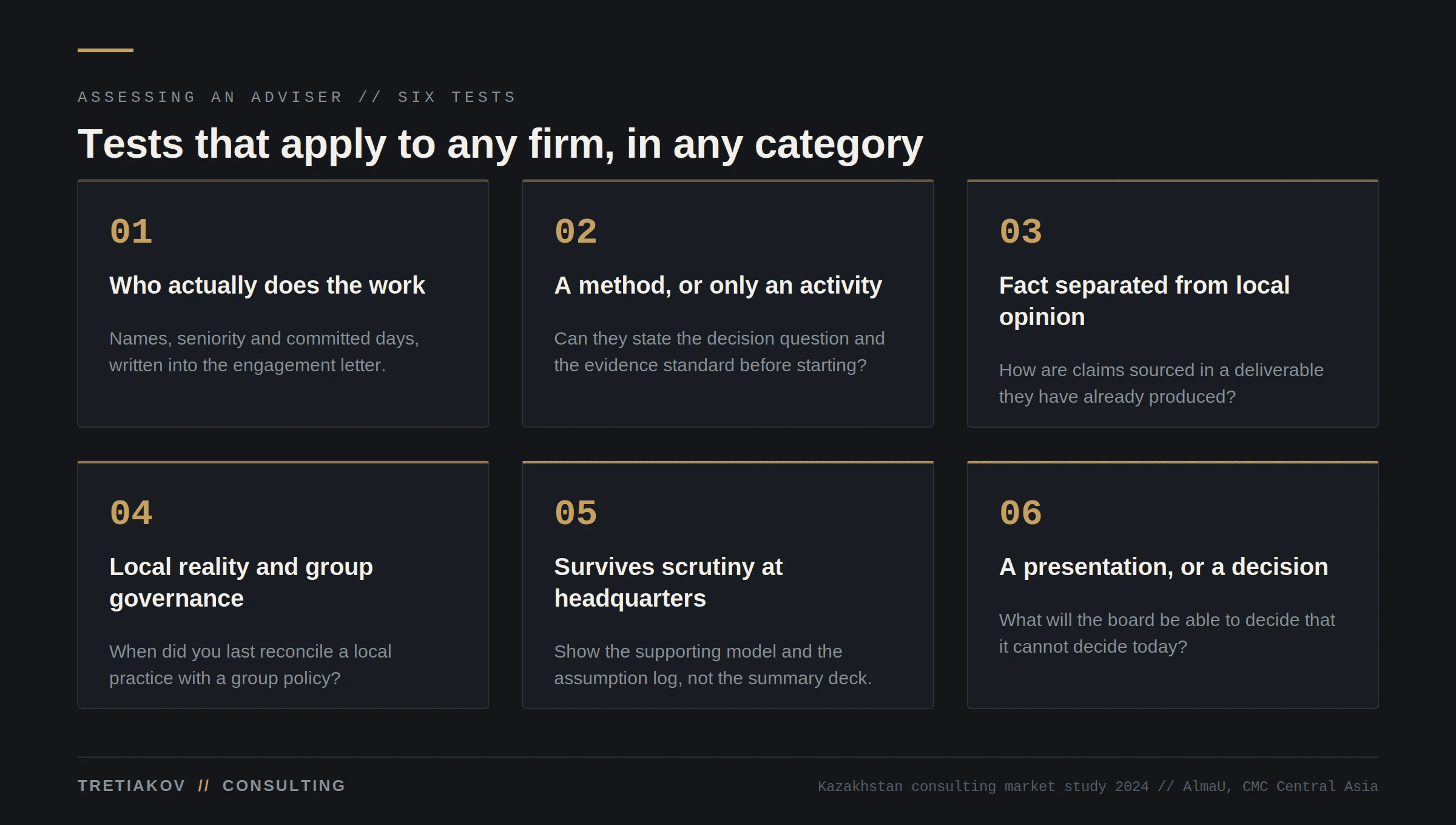
1. Who actually does the work
The people named in the pitch and the people named in the delivery plan are frequently different sets. The gap between them is the most common single source of disappointment in advisory work, and it is checkable in advance.
Ask for the delivery team by name and seniority, with days committed, written into the engagement letter rather than described in a meeting. Ask what proportion of total effort the most senior person will personally deliver, and what happens to that number if the mandate slips by a month. Ask who will be physically in Kazakhstan and who will be on a call from elsewhere.
This test carries extra weight in Kazakhstan for a reason visible in the market data. Twenty-eight per cent of respondents to the 2024 study named a shortage of qualified specialists as a constraint. A market growing at 23 per cent a year with a thin senior bench meets demand by stretching the seniors it has. That is not a criticism of any particular firm. It is an arithmetic fact about the market you are buying in, and it makes written commitments on senior time more valuable than they would be in a slower market.
2. Whether there is a method, or only an activity
A proposal that lists activities is not a method. Interviews, desk research, market sizing and benchmarking are inputs. A method is a chain of reasoning that starts from a decision question and terminates in an answer, with a stated standard for what evidence would be sufficient at each step.
The test is whether the adviser can state, before work begins, five things. The decision the client is trying to make. The hypotheses that would answer it. What evidence would confirm or reject each hypothesis, and to what standard. How that maps onto workstreams. And the form the output will take. A firm that can do this in the proposal will usually do it in the work. A firm that cannot is selling capacity, and the client is buying hours against an undefined deliverable called "market analysis", which is an input to a decision rather than a decision.
ISO 20700 exists largely to give both sides a shared structure for exactly this, covering specification, execution, acceptance of the outcome and closure. Whether or not a given adviser works to it, the question is a legitimate part of procurement, and how it is answered tells you something about how the firm thinks about its own process.
3. Whether fact is separated from local opinion
The most valuable thing an adviser does in an unfamiliar jurisdiction is mark the boundary between what is documented, what is observed practice, and what is assertion. The three are constantly conflated, and for a foreign investor the conflation is expensive.
"That is how it works here" is a hypothesis. Sometimes it is accurate. Sometimes it describes one person's network rather than the market. Sometimes it was accurate three years ago and has since been overtaken by a regulatory change that nobody in the room has read.
Kazakhstan makes the point concretely. The legal framework formally treats foreign and domestic investors equally. The United States Department of State's 2025 Investment Climate Statement nonetheless records that foreign firms encounter inconsistent regulatory enforcement in licensing, taxation and dispute resolution, and that government contracts and procurement processes often favour domestic firms. Both statements are true at the same time. An adviser who gives you only the statute has told you nothing operational. An adviser who gives you only the folklore has given you something you cannot check, cannot attribute and cannot put in a board paper. What you need is both, labelled.
A practical way to test this is to ask for a redacted extract from a previous deliverable and look at how claims are sourced. Statements traceable to a document, a data set or a named category of interview are one thing. Statements that float free are another.
4. Whether the adviser can hold local reality and international governance together
Failure runs in both directions here, which is why the local-versus-international framing is not merely imprecise but actively misleading.
A purely international method applied without local calibration produces a plan that is coherent on paper and cannot be executed. The market sizing is correct and the assumptions are wrong about how long a permit takes, how a partner behaves when a contract is silent, or what a verbal commitment means. A purely local view produces conclusions that may be entirely correct and cannot be defended in a group board pack, because the reasoning is carried in relationships rather than in evidence.
The current tax position illustrates the requirement. Kazakhstan's new Tax Code, adopted on 18 July 2025, replaced the 2017 code and took effect on 1 January 2026. It raised the standard VAT rate from 12 to 16 per cent, halved the VAT registration threshold, introduced progressive personal income tax, and removed the exemption that previously allowed foreign shareholders to sell shares held for more than three years without capital gains tax. That last change alters exit economics for a large number of existing structures. Any financial model built on pre-2026 assumptions is wrong. An adviser who knows this but cannot explain to a group CFO why the assumption changed and what else in the same reform is likely to move next is only half useful.
The test is to ask for a specific instance in which the adviser had to reconcile a local practice with a group policy, what they recommended, and what the client's headquarters said in response. The answer is difficult to fabricate. The recurring friction points between local practice and group standards are set out in more detail in our note on governance and compliance for foreign-owned businesses.
5. Whether the output survives scrutiny at headquarters
The real audience for the work is usually not in the room when it is presented. It is an investment committee or a board several time zones away, reading a summary, whose first question is on what basis.
The evidence chain therefore has to be reconstructable months later by someone who was not present. Sources traceable. Assumptions listed separately from conclusions, so that each can be challenged individually. Sensitivities run on the assumptions that actually move the answer. The conditions under which the recommendation would fail stated inside the document rather than raised in discussion.
Ask to see the supporting model and the assumption log, not the summary deck. A firm that produces both as a matter of course will hand them over without hesitation. A firm that produces only the deck will explain why the model is not usually shared.
6. Whether the work ends in a presentation or a decision
The last test is the one to apply first. At the end of this engagement, what specifically will the chief executive, the board or the investment committee be able to decide that they cannot decide today?
If the answer is that they will be better informed, the mandate is under-specified and will almost certainly disappoint, whoever delivers it. Being better informed is not a decision outcome. It is what happens on the way to one, and it is the natural resting place of any engagement whose brief did not name a decision.
A decision-shaped output names the decision, gives a recommendation with the conditions attached to it, sets out what was ruled out and why, and specifies what would have to become true for the recommendation to be reversed. That last element is rarer than it should be and is the most useful part of the document eighteen months later.
How advisory work is priced, and what actually drives the number
A third of the respondents in the 2024 market study named the difficulty of pricing and valuing advisory services as their principal problem. That is the market telling a buyer, in its own words, that the commercial side of the transaction is where the uncertainty sits.
No credible published benchmark exists for Kazakhstan-specific advisory fee ranges, and any figure circulated as one should be treated with suspicion. What can be described accurately is the structure of the commercial models and the variables that move the number.
Four commercial models cover most of the market. A fixed fee against a defined scope transfers delivery risk to the adviser and works when the scope is genuinely definable in advance. Time-based billing suits exploratory work and transfers that risk back to the client, which makes a cap and a change-control clause essential rather than optional. A retainer buys continuing access and judgement rather than a deliverable. Milestone-based fees split the mandate into stages with a decision point between them, which is often the most disciplined structure for a first engagement with an unfamiliar adviser. A success component is appropriate where the outcome is a discrete transaction with an observable value, and inappropriate where it would give the adviser a financial interest in reaching a particular analytical conclusion.
The variables that move the number are more useful to understand than any headline rate. Travel and time on the ground. Translation to a standard that will bear scrutiny. Data reconstruction, frequently the largest hidden cost when records are thin or held in formats never designed to be audited. Negotiated access to stakeholders. The number of parties inside the client organisation who have to agree before the work can proceed. And, above all, whether the mandate is analysis or delivery, because implementation carries duration risk that analysis does not.
One consequence follows for how proposals should be read. A proposal is priced against the scope the bidder has imagined. A bidder who has not seen the constraint workstream, the data that will have to be reconstructed, or the number of stakeholders whose access must be negotiated, is pricing only the visible part of the problem. The cheapest proposal is therefore often a measurement of how much of the work the bidder has failed to see, rather than a saving. This is checkable without asking anyone to justify a number. Ask each bidder to name the three things most likely to make the work take longer than planned. The answers separate the field faster than the fees do.
Scoping the mandate
The highest-leverage act in an advisory relationship happens before any adviser is selected. It is the writing of the brief.
Consider two versions of the same commission. The example is illustrative rather than a description of a particular engagement, but the contrast is exact.
A weak brief. "Assess the Kazakhstan market."
A strong brief. "Determine whether Kazakhstan can support €20 million of annual revenue within five years, which customer segments could produce it, what market-access constraints would prevent it, and what evidence would invalidate the investment case."
The second version is not simply longer. It does four things the first cannot.
It names a threshold, which means the answer is allowed to be no. A brief without a threshold cannot fail a market, and an assessment that cannot conclude against is not an assessment.
It decomposes the number into segments, so that evidence attaches to parts of the answer rather than to the whole. That is what makes the conclusion auditable later, when one segment underperforms and the board wants to know whether the thesis or the execution was wrong.
It names constraints as a workstream in their own right. Most disappointing market work is demand-side work. It establishes that customers exist and stops short of establishing whether you can reach them, supply them, price to them and get paid by them under local conditions. The constraints that recur in Kazakhstan specifically are discussed in our note on entering the market as a foreign mid-market company, and the channel and distribution dimension in our note on commercial and go-to-market strategy.
And it asks what evidence would invalidate the case. This is the most useful clause a buyer can write and the one most often left out. It forces the adviser to argue against the client's preferred answer as part of the paid work, rather than leaving that job to whoever is most sceptical in the committee meeting.
Before briefing anyone, five things are worth settling internally. What decision this work is meant to inform. Who owns that decision. What changes if the answer comes back either way. What data already exists and what will have to be built from scratch. And who inside the organisation has to agree before anything can happen. Mandates that go wrong usually went wrong at one of those five points, and the adviser is rarely the reason.
Where engagements go wrong
There are two failure modes and they need separating. Conflating them produces the kind of writing on this subject that anyone who has sat on the client side of a failed engagement stops reading.
The adviser-side failures are the ones the six tests above are designed to catch in advance, which is the argument for applying them.
The client-side failures are different, and no test applied to an adviser will prevent them. No named decision owner, so the output arrives with nowhere to go. Data withheld or never reconstructed, with the gap absorbed silently into assumptions. Local management controlling what reaches the adviser, which is particularly acute when the mandate concerns the local entity's own performance. Scope changed mid-engagement without a corresponding change to the plan. And, most commonly, nobody willing to act once the answer arrives, usually because it was not the answer the sponsor wanted.
That second list is the one buyers consistently underweight, and the one entirely within their own control. Where the mandate is a transaction rather than a strategy question, the same discipline applies to buyer-side rigour before signing, covered separately in our note on acquisitions and due diligence.
When a management consultant is the wrong purchase
A significant share of enquiries described as consulting are better answered by a different specialist, faster and for less money. Naming them is not a disclaimer. It is part of buying well.
If the real question is | You need |
|---|---|
Company registration, entity structure, branch versus subsidiary | Corporate lawyer or formation provider |
Tax exposure, transfer pricing, VAT treatment under the 2026 code | Tax adviser |
Payroll, statutory accounts, reporting compliance | Accountant |
Sector licensing and permits | Regulatory or legal specialist |
Work permits, quotas and immigration | Immigration specialist |
Recruiting a named position | Executive search firm |
Purchasing existing market data | Research provider |
Technical or engineering feasibility | Engineering consultant |
The tax line deserves emphasis in the current period. With a new Tax Code in force since January 2026, a company's first question is very often technical and has a determinate answer, and a management consultant is the wrong person to ask. Advisory work becomes relevant at the next step, when the question is no longer what the rule is but what to do given the rule. Whether the entity structure still fits the operating model. Whether the margin assumptions survive. Whether the market thesis holds at the revised cost base.
The buyer's own judgement is the primary quality filter
Kazakhstan's consulting market is growing faster than the institutions that would ordinarily tell a buyer what good looks like. Certification is voluntary and thinly held. There is no licensing gate. A third of the participants in the market's own study named the difficulty of judging what advisory work should cost and what it is worth, a problem the market has not solved for itself and will not solve within the timeframe of any particular mandate.
In that environment, the buyer's own assessment is not a supplement to the market's quality signals. It is the primary one. None of the six tests requires local knowledge to administer, only the discipline to ask before signing rather than after. What they cost is a conversation. What skipping them costs does not appear in the fee, and usually surfaces between month four and month nine, by which point the options are narrower and more expensive than they were at the briefing stage.
If you are scoping a mandate in Kazakhstan and would find it useful to test the brief before it goes to market, Tretiakov Consulting is open to a conversation.
Frequently asked questions
How do you choose a management consultant in Kazakhstan? Assess the mandate rather than the firm's origin. Establish who will personally deliver the work and on what committed time, whether the proposal contains a method that terminates in an answer, whether the adviser separates documented fact from local opinion, whether the output will withstand challenge at headquarters, and what decision the work will make possible. A global brand does not guarantee senior attention, and a local firm does not lack international governance experience by definition.
How much does management consulting cost in Kazakhstan? No reliable published benchmark for Kazakhstan-specific fee ranges exists, and the 2024 national market study found that a third of respondents regard the pricing and valuation of advisory services as the market's principal problem. What can be assessed is the commercial model, fixed fee, time-based, retainer or milestone-based, and the cost drivers behind it, which include time on the ground, translation, data reconstruction, stakeholder access, internal approval complexity and whether the mandate is analysis or delivery.
Is management consulting a regulated profession in Kazakhstan? No. There is no statutory licensing requirement and anyone may use the title. Voluntary standards exist. The Certified Management Consultant designation is awarded regionally through the Central Asia Chamber of Management Consultants, a full member of CMC-Global operating as an ISO 17024 personnel certification body, and ISO 20700 provides international guidelines for how consultancy assignments should be specified and delivered.
Should a foreign company use an international firm or a local one in Kazakhstan? The distinction is less useful than it appears. International networks have operated in Kazakhstan for three decades, and the local segment ranges from very small practices to organisations experienced in international governance. Delivery standards vary more within each category than between them, which is why the assessment should be applied to the specific team and the specific mandate.
When does a foreign company not need a management consultant? When the question has a determinate technical answer. Registration, tax treatment, licensing, immigration, payroll, recruitment for a named role and the purchase of existing market data are all better handled by the relevant specialist. Advisory work becomes relevant when the question is what to do given the rules rather than what the rules are.
Our insights