
ILLIA TRETIAKOV
Founder

The most expensive performance problem in a French business is rarely a missed target. It is more often a capable management team meeting the numbers it has been given while the board watches the company become slower to decide, thinner on margin and harder to finance. The strategy itself is usually sound and the local team is usually competent, which is precisely why the problem is so often misread.
What fails sits between the two, in the operating architecture, the governance rhythm and the capital discipline that are meant to turn a board decision into a delivered return. This is where business management and strategy consulting in France earns its place, because the task is no longer to produce a better plan but to build the management system that allows a sound plan to reach the profit and loss account before cost, complexity and decision latency absorb its value.
France makes this gap easy to underestimate, because the market still rewards arriving. It remains the leading destination for foreign investment in Europe, and capital continues to flow towards its industrial base, its energy transition and its emerging position in artificial intelligence. The harder question facing owners, investors and boards is no longer whether France is worth entering or holding. It is whether the organisation can convert that attractiveness into returns under a cost of capital, a regulatory load and a level of competitive intensity that the previous cycle never imposed.
The New Management Problem in France Is Not Strategy Alone
Many French mid-market and foreign-owned businesses spent much of the previous cycle operating in conditions that allowed strategy and management to be treated as separate disciplines. Demand was reasonably predictable, capital was inexpensive, competition was largely domestic, and the labour and regulatory framework, however demanding, changed slowly enough to be planned around. In that environment a strategy could be set at the top and an operating model could be left to evolve gradually beneath it, because the cost of any misalignment between the two was modest and the market was forgiving enough to absorb it. That settlement is no longer reliable, and it has weakened quickly. Companies now face a higher cost of capital, a sustained demand for productivity gains, the capital intensity of the energy transition, an accelerating shift towards artificial intelligence, an active industrial policy and a continuous redesign of supply chains, and they face all of it at once rather than in sequence. None of these pressures can be answered by strategy alone, and none can be answered by operational effort alone, because each of them lands at the join between the two, which is exactly where most organisations are least equipped to respond.
The point is not that French managers are weak, and the distinction needs to be held firmly in place, because the wrong diagnosis here leads directly to the wrong remedy. Local teams are frequently excellent at what they are mandated to do. The difficulty is that the decisions which now determine value, including what to stop selling, where to place capital, how quickly to decide and who carries accountability for the result, increasingly sit above the level at which the local team is permitted to act. The gap is not between strategy and effort but between board-level ambition and the operating architecture required to turn that ambition into margin, speed and disciplined capital deployment. That the pressure is structural rather than temporary is visible in the wider data, since the INSEE business climate indicator has held below its long-run average for close to two years, which tells a board that it is managing against a sustained headwind rather than a passing dip.
What Companies Lose When Strategy and Management Are Disconnected
When strategy and management are disconnected, the loss is rarely visible as a single event, because it accumulates quietly through a series of individually reasonable decisions that no one owns in aggregate. Understanding where the value goes requires looking at the mechanism rather than the symptom, because the same financial outcome can be produced by very different operating failures, and the wrong diagnosis is more expensive than the problem it is meant to solve.
Margin is usually the first thing to go, and it goes for structural rather than commercial reasons. The local team carries responsibility for the profit and loss account but does not control the drivers of complexity that determine it. Group sets growth targets and adds products yet rarely forces the retirement of obsolete lines, so the portfolio proliferates and complexity cost compounds through procurement, inventory and logistics. Purchasing is fragmented because decision rights are divided between the French entity, the regional headquarters and the group, which means scale is never fully consolidated into negotiating power.
Price realisation then drifts downward, not because the sales force is weak but because commercial governance never connects pricing authority, channel discipline and margin accountability in a single place. The financial signature of this failure is a gross margin that erodes while revenue holds, which is the pattern boards most often misread as a pricing problem when it is in fact a question of who is allowed to decide what.
Speed is the second loss, and it is the one owners feel most acutely once they have seen the alternative. A decision that should take a single accountable manager a fortnight instead travels through local management, the regional centre, group finance, legal and human resources before returning, and every handover adds delay while diluting ownership of the outcome. Decisions are frequently taken twice, once locally and once again when they are re-examined at group level, or they are deferred until the commercial window that justified them has already closed. The consequence is not only lost transactions and late launches but working capital and senior attention trapped in a process that produces motion without resolution.
Capital discipline erodes more slowly and is therefore harder to see until a downturn exposes it. Maintenance expenditure is defended as necessary and escapes serious challenge, growth capital is approved without staged decision gates so that commitment runs ahead of evidence, and acquisitions are assessed for their strategic logic but not for the operational cost of integrating them. Underperforming assets remain inside the portfolio because no governance mechanism compels the reallocation of capital away from them. In a low-growth cycle this becomes visible far more quickly, because weak demand no longer disguises capital that has been allocated by habit rather than by return, and with the Banque de France projecting growth of only around 0.9% for 2026 the margin for that kind of indiscipline has narrowed considerably.
Management bandwidth is consumed in parallel, and its depletion is one of the most under-priced risks in a mid-market business. Senior local time is absorbed by daily firefighting and reporting rather than by the design of the organisation, and because institutional knowledge tends to reside in a small number of individuals rather than in systems, nothing structural can be changed without stalling operations. The same people hold the customer relationships, the supplier history and the regulatory contacts, so transformation programmes begin and then stall, and key-person dependency is quietly priced into the value of the business by any acquirer who examines it closely. Strategic optionality is lost as a direct result, because when the operating model is rigid and knowledge is personal rather than institutional, the business cannot pivot, divest or acquire cleanly, and options that appear open on a strategy document turn out to be closed in practice. The cost of this is felt most sharply at the moment of a transaction or a transition, when the inability to act on a window of opportunity translates directly into a discount.
Board visibility is the final casualty and in some respects the most dangerous, because it conceals all of the others. A board typically sees outputs in the form of revenue and earnings but not the operating mechanics that produce them, so the early signs of deterioration, including productivity leakage, delayed projects, customer concentration and weak accountability, remain invisible until they surface in the financial statements, by which point the cost of correction is materially higher than it would have been had the board seen the problem forming. This is the layer at which board-level visibility and decision rights determine whether a company is genuinely managed or merely reported on.
The mechanism is constant across the economy, but the form the loss takes is specific to the sector. In industrial and manufacturing businesses it appears as capital committed to capacity that the group strategy no longer requires, and as energy and supply-chain decisions taken locally without the benefit of group leverage. In consumer and retail businesses it appears in channel architecture, where direct, wholesale and digital routes to market pull against one another and pricing authority belongs to no one, so promotional depth compounds while like-for-like margin falls. In mid-market business-to-business services it appears as key-person dependency, where revenue is concentrated in relationships that have never been institutionalised, which both limits growth and is repriced the moment the business is brought to a transaction. The patterns we set out in our analysis of B2B commercial transformation in France recur with notable consistency across these sectors.
France’s Macro Context: A Strong Market with a Harder Execution Environment
The macroeconomic picture in France in 2026 is best understood as a duality, because the country is simultaneously more attractive and more difficult to operate in than the headline narrative suggests, and the two facts cease to be in tension once the difference between visibility and execution is properly drawn.
On the side of attractiveness, the evidence is genuine. The EY European Attractiveness Survey ranked France the leading destination for foreign investment in Europe for the seventh consecutive year, with 852 job-creating projects recorded in 2025, ahead of the United Kingdom and Germany, and confirmed the country as the leading European location both for industrial projects and for artificial intelligence. For a board, this matters less as reassurance than as a signal of intensifying competition, because every project announced in France competes for the same skilled labour, the same industrial sites, the same permits, the same suppliers and, most importantly, the same scarce management bandwidth. Attractiveness of this kind raises the pressure on execution rather than relieving it. The same survey also recorded that the number of announced projects fell by 17% over the year, which is a reminder that investor interest, however durable, has become more selective and more conditional on the quality of execution it expects to find on the ground.
The figures published by Business France point in the same direction, with 1,878 foreign investment decisions and 47,734 associated jobs recorded for 2025, although these are decisions and projections rather than realised investment or net job creation and should be read as a measure of intent rather than of outcome. The distinction matters for any company weighing business consulting for foreign investors in France, because the distance between an announced decision and an operating, staffed and productive asset is precisely the distance this analysis is concerned with.
On the side of difficulty, the evidence is equally clear. The Banque de France recorded 69,392 corporate failures in the twelve months to the end of February 2026, an increase of 4.6% on the year and above the previous record, against a pre-pandemic average closer to 59,300. What gives this figure its weight for a board is not its scale but its distribution, because the increase has reached medium-sized and larger companies rather than being confined to the most fragile end of the market. These failures are no longer noise from the weakest firms but a broad stress test of operating models that were built for cheaper capital, more forgiving demand and slower transformation cycles, and the maturity of a large volume of state-guaranteed loans through the summer of 2026 represents a further pressure that has not yet fully worked through.
Beneath the cyclical pressure sits a structural one. The OECD attributes France’s persistent shortfall in GDP per capita relative to the strongest economies mainly to lower labour productivity and a weaker employment rate rather than to any deficit of effort, and the same body records an employment rate of 69.3% against an OECD average of 72.1%, with a rate of only 42.4% among workers aged between 60 and 64 against an average of 55.9%, alongside a long-standing underinvestment in intangible assets even as investment in tangible assets remains comparatively high. For management this is the structural reason that effort does not always convert into output, because the drag is located in the system rather than in the people who operate within it.
The investment that attracts the most attention belongs to a third category that boards should treat with particular care. Around €38bn of the France 2030 programme had been committed to more than 7,500 projects by the end of 2024. Separately, the artificial intelligence package announced in early 2025 amounted to approximately €109bn of private investment announcements, while SoftBank has pledged data-centre capacity in France on a multi-year horizon. These are announced and pledged figures rather than capital that has been committed in full and deployed, and the distinction is not pedantic, because they indicate where the state and large investors wish the economy to go rather than where the execution capacity, the grid connections, the permitting and the management depth already exist to absorb them. The distance between a pledge and a running asset is the execution gap restated at national scale.
Why Local Management Alone Often Cannot Solve the Problem
If the problem sits above the local team, it cannot be resolved by asking the local team to work harder, and this is the most common and most costly misunderstanding a board can bring to it. The mandate of a country management team is, by design, narrower than the problem it is now being asked to solve, because the questions that determine value have become cross-border in nature. The role France should play within a wider European structure, the allocation of capital between France and other markets, the design of governance across legal entities, the architecture of productivity, the sequencing of transformation and the placement of board-level decision rights are all matters that a local team can inform but cannot resolve on its own authority.
The difficulty is compounded in the mid-market and in family-owned businesses, where governance is frequently under-built relative to the complexity the business has reached. Research by Bpifrance Le Lab has found that around 76% of family-owned small and mid-sized companies operate with neither a family council nor a family charter, which leaves them without an agreed mechanism for separating family considerations from business decisions or for managing succession in an orderly way.
The Institut Français des Administrateurs has observed that unlisted mid-sized companies face almost no binding governance requirements, which means that the discipline a board is meant to provide depends entirely on choices the owners make voluntarily rather than on any external obligation. For these companies, strategic advisory for family-owned companies in France is rarely about imposing a corporate template and far more often about building the minimum governance and decision architecture that allows the business to be steered through a more demanding cycle and, in due course, transferred or sold without destroying value. This is the territory we examine in our work on governance in French owner-managed companies, where the absence of structured decision-making is consistently the binding constraint rather than any shortage of commercial talent.
The same logic applies to strategy consulting for mid-market companies in France, where the value of external advice lies less in generic analytical horsepower than in the independence and seniority required to ask the questions that an internal hierarchy is structurally reluctant to raise.
Where Business Management and Strategy Consulting in France Must Connect
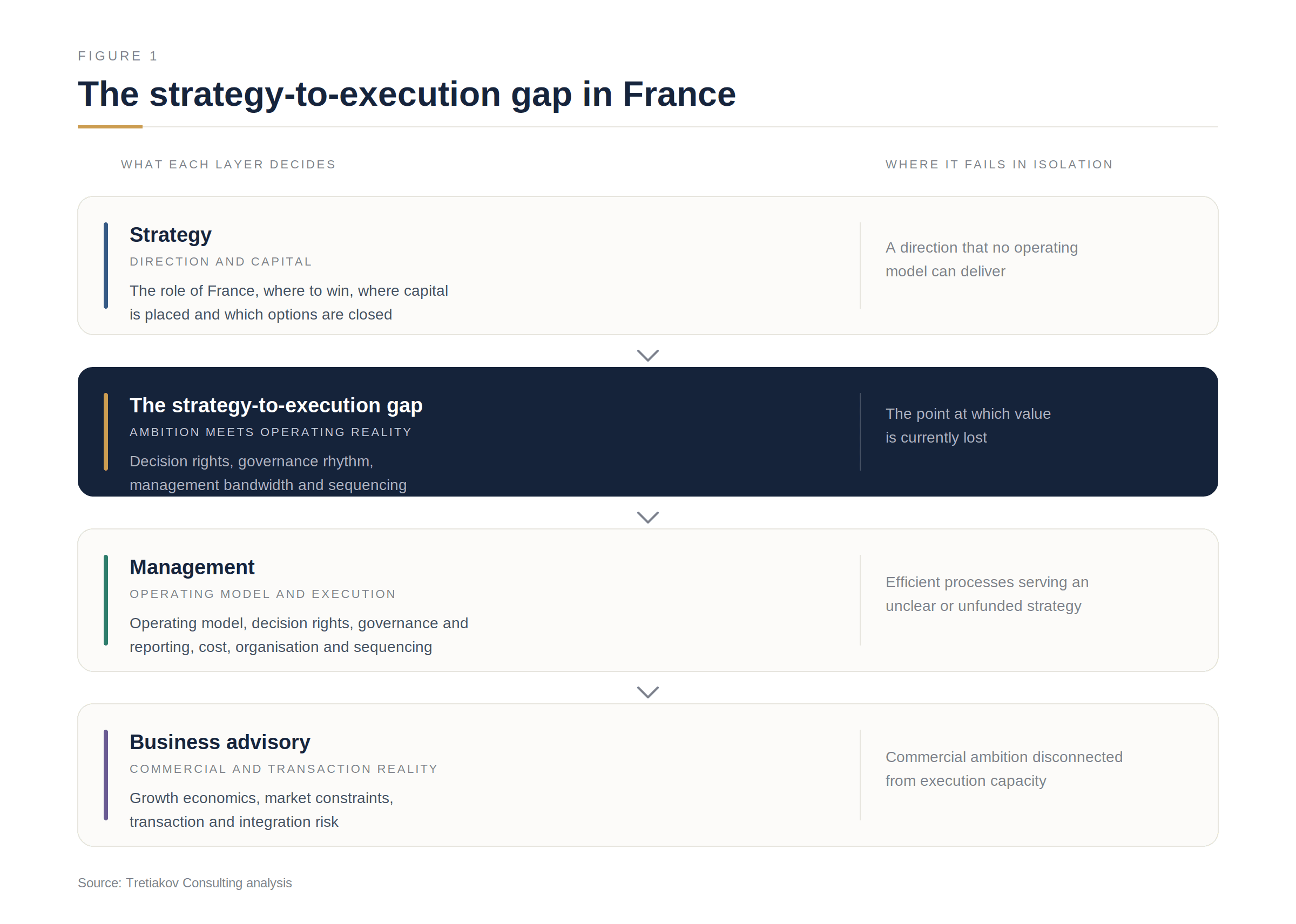
The practical conclusion is that the three disciplines which are usually bought separately have to be designed to work as one. The work becomes most valuable precisely at the point where strategy, management and broader business advice meet, because that is where value is currently being lost, and treating any one of them in isolation tends to produce a partial result that does not survive implementation.
Strategy consulting, in this context, answers the questions of direction. It establishes what role France should play within the wider business, where the company can realistically win, whether the country is best understood as a sales market, an industrial base, a logistics platform, a centre for research or decision-making, or a platform for acquisition, and how that role fits within a European or global structure. This is the proper domain of strategic advisory in France, concerned with the allocation of capital and the closing of options rather than with the production of plans for their own sake.
Management consulting translates that direction into an operating reality. It designs the operating model, defines decision rights, establishes the governance rhythm and reporting that allow a board to see the business clearly, addresses cost structure and organisational design, and sequences transformation so that it can be absorbed without overwhelming the organisation. The value of management consulting in France lies in its insistence that a strategy is only as good as the system built to execute it, and it is here that operating model redesign becomes commercially relevant, not as an exercise in redrawing an organisation chart but as the mechanism that makes a strategy executable in the first place.
Business advisory services in France connect these two layers to the commercial and financial reality of the business, bringing together the logic of growth, the economics of the market, the practical constraints of management and the risks that attach to any significant transaction. It is at this level that the distinction between an interesting idea and an executable one is drawn, and it is the level at which a board most often needs a partner who has sat on the operating side of these decisions rather than one who has only advised on them from a distance.
The consulting market itself has begun to reflect this shift in what buyers are willing to pay for. Syntec Conseil reported that the French consulting market was effectively flat in 2024, one of its weakest years in more than two decades, with the strategy and management segment recording no growth at all after a far stronger preceding year and with the outlook for the following year similarly narrow. This does not indicate that companies need less advice. It indicates that buyers have become markedly less willing to pay for diagnosis unless it is visibly connected to execution, to return on investment and to a measurable improvement in management capacity. The market, in other words, has begun to price the very gap this analysis describes, rewarding the firms that close it rather than those that are content to describe it, which is the standard that business management and strategy consulting in France now has to meet.
Figure 1. The strategy-to-execution gap in France
A France Strategy-to-Execution Framework for Boards and Owners
The framework below is the practical expression of how business management and strategy consulting in France should operate in current conditions. It sets out the questions a board ought to be able to answer if it wants to know whether its French business can convert strategy into return, together with the reason each question carries particular weight today and the kind of output required to address it. It is framed around decisions rather than around functions, because the failures described above are failures of decision-making before they are failures of execution.
The question the board must answer | Why it matters in France in 2026 | The output required to close the gap |
|---|---|---|
Is our capital allocated by return, or by habit? | With baseline growth of around 0.9% for 2026, weak demand no longer hides capital tied to legacy priorities or protected projects | A capital-allocation framework with staged gates and a mechanism that forces reallocation away from underperforming assets |
Does our operating model deliver the productivity the group assumes? | The OECD attributes France’s per-capita shortfall mainly to productivity and employment, which makes this a structural issue rather than a matter of effort | An operating-model redesign and a hard productivity baseline, not an organisational chart |
Who actually decides, and how quickly? | In cross-border groups the local mandate is narrower than the problem, so decisions stall or are taken twice | A decision-rights map and a governance rhythm with named accountability |
Are we ready for transformation, or fragile under it? | Close to two years of below-average business climate leave little slack for a programme that fails | A sequenced transformation plan that protects management bandwidth and proves itself early |
Can the business survive the loss of a key person? | Around 76% of family SMEs and mid-sized firms have neither a family council nor a charter, and many face a transition within the decade | Succession and governance structuring that moves knowledge from individuals into systems |
Is announced investment actually bankable and buildable? | The AI package and large data-centre pledges are announced, not deployed, and France 2030 is committed rather than fully disbursed | An investment-readiness and deliverability assessment that prices the execution gap honestly |
For a board that suspects its French operation is carrying the wrong role within the wider group, the productive next step is not another strategy workshop but a focused review of decision rights, operating-model capacity and execution constraints, which is the basis on which we structure an advisory engagement.
How to Choose the Right Consulting Firm in France
The question of how to choose a consulting firm in France is best answered by matching the firm to the mandate rather than to the strength of its brand, because each category of adviser is genuinely suited to a particular kind of problem and poorly suited to others. The landscape of business consulting firms in France divides, in practice, into four broad categories, and the most expensive mistakes are made when a board engages the wrong category for the problem it actually has.
The global strategy houses are well suited to a board that needs a defensible direction, scale benchmarking and the analytical authority that comes with a recognised name, although their distance from execution and their reliance on leveraged delivery mean that senior attention can thin once the engagement moves from the proposal to the work itself. The large multidisciplinary firms bring scale, breadth and reach across technology, tax and regulation, which makes them effective on large transformation programmes with many workstreams, although delivery can become process-heavy where the mandate calls for judgement under uncertainty, and the seniority present at the scoping stage is not always sustained into delivery. Specialist boutiques offer genuine depth in a single function or sector, which is valuable when the problem is well bounded, but their reach is limited when the problem is cross-border and cross-functional in the way that most strategy-to-execution problems now are.
Senior-led business consulting in France occupies the remaining and increasingly important space, suited to mandates that are too integrated for a narrow boutique, too sensitive to execution for a pure strategy exercise and too dependent on senior judgement for a leveraged delivery model. The defining characteristic of a consulting firm for complex business mandates in France is continuity of seniority from diagnosis through to delivery, so that the people who frame the problem remain accountable for resolving it. The single most useful question an owner or board can put to any prospective adviser is therefore a simple one, namely who, by name, will be working on the engagement once the proposal has been signed.
Firm type | The buyer it suits | Its real strength | Where it struggles on a complex French mandate |
|---|---|---|---|
Global strategy house | A board needing direction, benchmarking and analytical authority | Brand, analytical depth and access at board level | Distance from execution and leveraged delivery, so senior time thins after the pitch |
Large multidisciplinary firm | A multi-workstream transformation with technology, tax and regulatory dimensions | Scale, breadth and reach | Delivery turns process-heavy where judgement is required, and seniority can fall away after scoping |
Specialist boutique | A single, well-bounded functional or sector problem | Genuine domain depth | Limited reach when the problem is cross-border and cross-functional |
Senior-led independent | An integrated, execution-sensitive, seniority-dependent mandate | Continuity of senior judgement from diagnosis to delivery, with owner and board alignment | A smaller bench, which requires the mandate to be scoped to where seniority, not headcount, is the constraint |
When Companies Should Seek External Strategic and Management Advisory
The right moment to seek external strategic and management advisory is rarely a crisis, and the companies that engage well are usually those that recognise a pattern before it becomes an emergency. For owners and boards weighing the question of when to hire a strategy consultant, the more useful framing is to identify the conditions under which the cost of deciding without independent challenge exceeds the cost of the advice itself, because that is the test that distinguishes a worthwhile engagement from an expensive distraction. This is the point at which business advisory services in France move from a discretionary expense to a form of risk management.
Those conditions are recognisable. They include a French business that is growing while its margin fails to convert, a competent local team that has become overloaded to the point where nothing structural can change, a board that lacks genuine visibility of how its results are produced, a strategically important market whose role within the wider group has never been clearly defined, and a transformation that has stalled somewhere between headquarters and the local organisation. To these internal patterns are added the external triggers, including a lender or investor conducting due diligence and asking how decisions are governed, a generational transition approaching in a family business, and a capital event that requires the company to demonstrate that it is genuinely investable rather than merely active.
A foreign investor considering entering or expanding in France faces exactly this calculation, because the decisions taken at the point of entry, including the choice of operating model and the placement of decision rights, are expensive to reverse once the business is running. The same applies with even greater force around a transaction, where the strategic case for an acquisition is frequently sound while the operational cost of integration is consistently underestimated, and where disciplined post-merger integration is what determines whether the value identified in the deal is actually realised. This is the practical remit of business management and strategy consulting in France, which addresses not a single decision but the system within which a sequence of consequential decisions is made.
Conclusion
The advantage in France no longer accrues to the company with the most sophisticated strategy, nor to the one with the most efficient processes, because both can coexist with a steady erosion of value when the connection between them is weak. The question a board should be asking in the current cycle is not whether France remains attractive, since the evidence that it does is not seriously in doubt. The question is whether the organisation possesses the governance, the operating model and the capital discipline to convert that attractiveness into returns before cost, complexity and the slow accumulation of decision latency absorb it. That, in the end, is the work of business management and strategy consulting in France, which is not the production of another plan but the construction of the management system that allows a sound plan to be carried through the cost, governance and execution constraints that now define the French market.
For owners and boards weighing the role of France within a wider European agenda, the practical next step is a focused and honest assessment of where strategy, governance and execution currently disconnect, and of what that disconnection is costing in margin, in speed and in forgone opportunity. That assessment is the foundation on which every subsequent decision should rest, and it is the starting point of our advisory work with companies operating in France.
Frequently Asked Questions
What is the difference between management consulting and strategy consulting?
Strategy consulting is the discipline a board turns to when it has to decide what the business should become, where its capital should be placed and which options it should deliberately close. Management consulting in France becomes valuable when that direction has to be tested against the operating model and translated into a governance rhythm and the execution discipline that delivers it. The two are often bought separately, but in practice the failure usually sits between them, which is why engaging one without the other tends to leave a sound strategy stranded for want of a system to carry it.
When should a board hire a strategy consultant in France?
A board should engage strategic advisory in France when it faces a decision under uncertainty with capital attached, and when the cost of getting that decision wrong exceeds the cost of independent challenge. The clearest examples are the definition of what France should contribute to the wider business, a significant reallocation of capital, a succession or a significant change in ownership or control, and the assessment of an acquisition or a disposal. The trigger is the weight of the decision rather than a general wish for more analysis.
What does a business consultant actually do in France?
The work usually begins by separating the visible performance problem from the operating constraint that lies beneath it. A weak margin may be a pricing issue, but it may equally be a question of channel architecture, product complexity, decision latency or under-built governance, and each of these requires a different intervention. A senior business consultant identifies which mechanism is actually driving the result before recommending any change, because the cost of acting on the wrong diagnosis is almost always greater than the cost of the original problem.
How should an owner choose a consulting firm in France?
The decision should follow the mandate rather than the brand. A board-level question about portfolio and direction may be well served by a global firm, a bounded technical problem by a specialist, and an integrated, execution-sensitive situation by senior-led advisory in which the people who diagnose the problem are the people who remain to resolve it. Among business consulting firms in France the most reliable test is to ask, before any engagement is signed, exactly who will be accountable for the work once delivery begins.
Our insights